
Will investors be better or worse off under new housing tax changes? See what 18 years of data reveals

The federal government’s tax reforms are the most significant changes for housing investors Australia has seen since 1999. From July 1 2027, three things will change:
Some have called these housing tax changes broken promises, which risk crashing the housing market. But others consider it long overdue change to level the playing field for first home buyers.
Amid so much heated debate, how many investors are actually likely to be worse or better off under these changes?
That’s what we set out to shed light on. Our new modelling draws on 920,000 pieces of individual property data – covering all residential sales in Australia and about 75% of new tenant rents – from July 2007 to June 2025.
We used that data to estimate how many of those investments would have ended up paying more or less tax in that 18-year period, if the reforms starting in July 2027 had already been in place.
What our modelling found
After comparing the pre- and post-reform tax systems, we found that about 53% of property investments would have paid more tax in total under the new reforms.
This means a surprisingly high proportion, 47%, would have paid the same, or less, in total tax on housing investments.
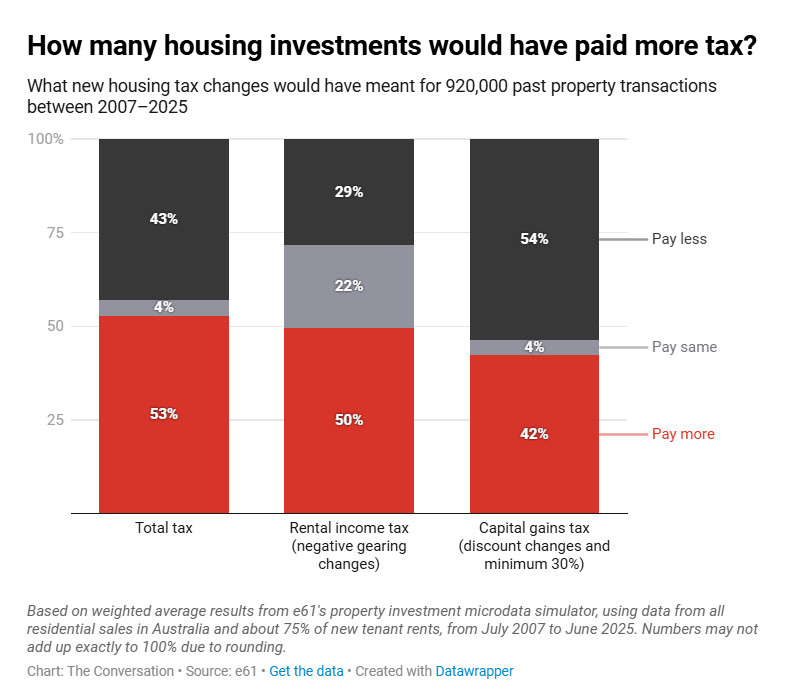
Each investor’s “total tax” change is their change in rental income tax, plus their change in CGT. While much of the public focus has been on negative gearing, we found the CGT changes have a bigger impact.
About 50% of investments are negatively geared: in other words, they make losses on rental income.
Most of those investments would have paid more rental income tax if the July 2027 tax changes had been introduced earlier. But those rental income tax increases tended to be small relative to the CGT changes.
We found the incoming CGT changes actually would have benefited the majority (54%) of property investments from mid-2007 to mid-2025.
Why the size of your capital gain is key
The new capital gains tax system starting in July 2027 will tax only capital gains that exceed the rate of inflation, as measured by the consumer price index (CPI). This gives all investments a similar tax-free component of gains.
In contrast, the pre-reform 50% CGT discount has given investments that realise high capital gains a substantially larger tax-free component than others.
Therefore, next year’s reforms will increase the CGT payable for properties with relatively high gains (roughly more than double the rate of inflation), while lowering it for other properties.
Our results show that, at least in the past 18 years, most investments have been below this cutoff of growing by less than roughly double inflation.
Still, if an investment makes a high capital gain, its tax rise is likely to be bigger than its tax cut if it makes a small gain.
As this chart shows, for investments in the top 20% of capital gain performance, our modelling found average capital gains tax would have risen by about 11% of the purchase price.
In contrast, for the bottom 60%, it would have fallen by about 3–4%.
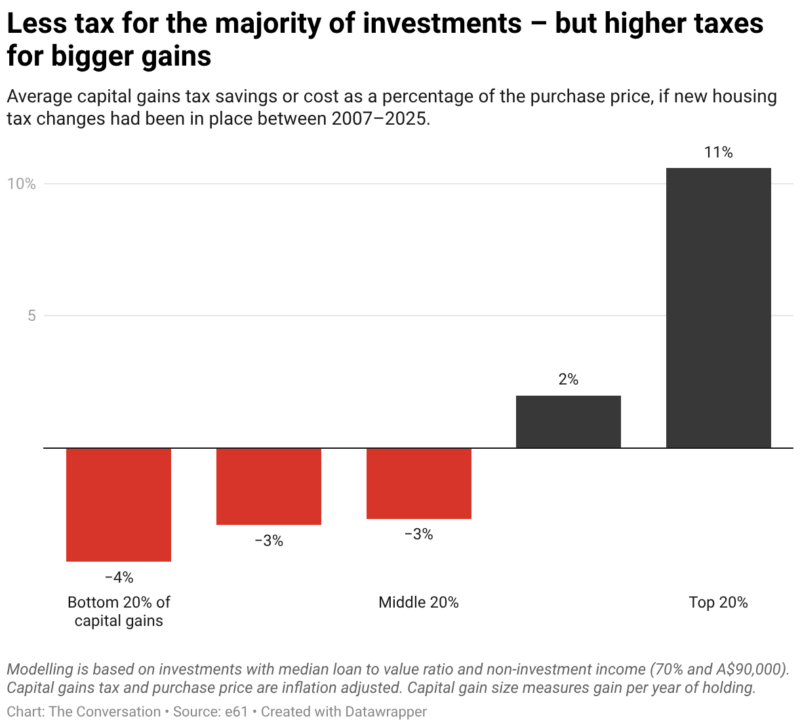
So while CGT would have fallen for the majority of investments, we estimate that the average CGT rate would have risen – and therefore the total tax revenue would have too.
Overall, investors would have faced less risk under the reforms. Why? The reduction of tax for low capital gains improves the worst-case outcomes.
Who pays more tax?
Who would be most affected by the introduction of the new 30% minimum capital gains tax rate?
This change is particularly aimed at people selling property in low-income years – who are often retirees.
Retirees who own an investment property are unlikely to qualify for the age-pensioner exemption to the 30% minimum tax. So they will be among the investors most affected by the July 2027 changes.
Investors with highly leveraged properties are also among the worst off.
These investors pay more in interest and have a higher likelihood of being negatively geared. For these investments, the negative gearing changes can be more consequential than the CGT changes.
What does this tell us about housing market impact?
Our estimates suggest the impact on housing investor taxes will be less dramatic than many headlines have made out. After July 1 next year, the majority of investors are likely to pay more in tax, but it may be a slim majority.
Investors are unlikely to know whether they’re in tax rise or tax cut territory. It’s mainly determined by the size of their capital gain, which is unknown until they sell. Like stock returns, capital gains are unpredictable.
Under these reforms, the downside is there now appears less prospect of high after-tax gains. But on the upside, there is also less chance of large after-tax losses. So how investors will react to these tax changes from July next year will depend on their personal preferences around risk.
Guest authors are Nick Garvin, Visiting Fellow, School of Economics, UNSW and Elyse Dwyer, Visiting Fellow, School of Economics, UNSW
This article is republished from The Conversation under a Creative Commons license. Read the original article here.


