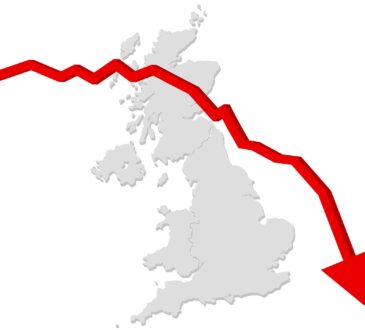
Annual house price growth in the UK halved to 0.8% in September, marking the weakest rate of expansion since December 2025, according to the latest Nationwide House Price Index.
The lender reported that average house prices declined 0.2% on a monthly basis to £274,251. England recorded annual price growth of 0.5%, while regional variations remained pronounced across the country.
Regional performance
Northern England, comprising the North, North West, Yorkshire & The Humber, East Midlands and West Midlands, posted annual price growth of 1.6%. The North West, including Cheshire, Lancashire and Greater Manchester, remained the top performing English region with prices up 3.9% year on year.
Northern Ireland led all UK regions with annual growth of 5.9% in the third quarter of 2026, whilst Scotland recorded a 1.2% increase. East Anglia was the weakest performing region, posting an annual decline of 0.7%.
Economic pressures weigh on market
Robert Gardner, Nationwide’s Chief Economist, attributed the subdued market conditions to economic uncertainty. “Geopolitical tensions remain high, with the conflict in the Middle East exerting upward pressure on energy prices, fanning inflation concerns,” he said.
The economist noted that this has led to increased financial market expectations of Bank Rate rises, maintaining upward pressure on mortgage pricing. However, he pointed to encouraging signs that higher energy prices are not feeding through to underlying price pressures, with private sector wage growth remaining modest.
Gardner suggested that underlying affordability is improving, as house price growth has been below earnings growth for some time. “These gains have been only partially offset by higher mortgage rates,” he said, suggesting activity should regain momentum in coming quarters if the energy shock fades and confidence returns.
Market participants respond
Industry figures acknowledged the challenging conditions. Nicky Stevenson, Managing Director of Fine & Country, said the market remains finely balanced with buyers having more choice. “Sellers who price realistically from day one will be best placed to convert any renewed interest into viewings and offers,” she said.
Jason Tebb, President of OnTheMarket, noted that the dip in annual growth suggests price sensitivity as focused buyers and sellers returned from holiday determined to complete transactions before year end. He added that all eyes will be on the upcoming Budget to see what measures the government has planned.
Iain McKenzie, Chief Executive of The Guild of Property Professionals, said elevated borrowing costs are making the typical autumn recovery more difficult. Net mortgage approvals for house purchase fell to 54,900 in August, below the previous six-month average, reflecting broader concerns about property transaction volumes.
Nathan Emerson, Chief Executive at Propertymark, said it is unsurprising that economic uncertainty is being felt across the housing market. “Many consumers are taking a more cautious approach to their household finances, with affordability pressures continuing to influence decisions around buying and selling property,” he said.
Outlook and policy considerations
Tomer Aboody, founding director of specialist lender MT Finance, said the data points to a housing market which continues to soften. “With the prospect of more taxation on the way in the budget, understandably buyers and sellers are reluctant to make a move unless it is essential,” he said.
Jeremy Leaf, a north London estate agent and former RICS residential chairman, said higher borrowing costs and inflation, combined with plenty of choice, are compromising confidence. “The result is buyers are negotiating harder, especially for flats, to build in sufficient headroom to weather any further financial storms,” he said.
Despite the cautious outlook, there are signs of renewed interest. Home searches are now 7% higher than a year ago, suggesting buyers are re-engaging with the market even if some are not yet ready to commit. The autumn market is expected to be characterised by genuine demand but also a high degree of caution, with affordability and pricing continuing to determine whether interest translates into transactions.