
The Stock Market Is Facing 3 Huge Problems Right Now, and History Is Clear About What’s Coming

This month marks four years of the current bull market, and many stocks show no sign of slowing down. The S&P 500 (^GSPC -1.11%) is up more than 15% over the last six months, while the tech-focused Nasdaq Composite (^IXIC -1.88%) has surged nearly 20%.
But no bull run can last forever, and the market faces a few major headwinds that could dampen its performance going forward. Fortunately, history still has good news about what’s coming next.
Image source: Getty Images.
1. Rising bond yields
The bond market has been roiling in recent weeks. Long-term bond yields have soared to multi-decade highs, with both the 10-Year and the 30-Year Treasury yields recently reaching their highest levels since 2002.
Borrowing becomes more expensive when yields rise, affecting everything from mortgage rates to credit card interest. This can have a ripple effect on the economy — when debt becomes more expensive, many consumers spend less, which can slow economic growth.
2. Elevated oil prices
Oil prices have been surging all year due to the ongoing war in Iran, stoking fears that prices will remain elevated for the foreseeable future. Brent crude oil futures are currently trading at around $106 per barrel, up by more than 55% since the beginning of the year.
Higher energy prices are also keeping inflation above the Federal Reserve’s 2% target. The Fed already raised interest rates in September to combat rising costs, and according to CME Group‘s FedWatch tool, there’s an 88% probability another rate hike is coming by the end of the year.
Interest rate hikes also make borrowing more expensive, which, in current market conditions, could have an outsize impact on tech companies. Hyperscalers have spent hundreds of billions of dollars on data centers, and if the AI build-out slows due to higher borrowing costs, it could impact the broader market.
3. A strong tilt toward tech stocks
Indexes like the S&P 500 are market-cap-weighted, meaning larger companies make up a larger share of the index. The 10 largest companies alone account for around 40% of the S&P 500’s total value, and many of these companies — like Nvidia, Amazon, and Microsoft — are taking big swings on AI.
The risk here is that a handful of companies have an oversized impact on the market as a whole. If tech stocks continue to thrive, the rest of the market likely will, too. But if they tumble, they risk dragging everyone else down with them.
What history says is coming next
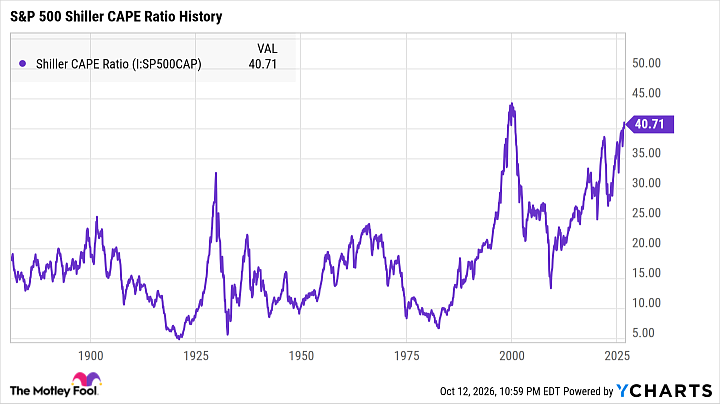
In the near term, tech valuations could lead to volatility within the market. The S&P 500 Shiller CAPE Ratio has predicted some of the most severe downturns in history — including the Great Depression and the dot-com bubble burst — and it’s warning that valuations are at their highest levels in decades.
This metric measures the S&P 500’s 10-year inflation-adjusted earnings, with a higher ratio signaling elevated valuations. It currently sits at just over 40, which is significantly above its long-term average of 17 and close to its dot-com-era record of 44.
Shiller CAPE Ratio data by YCharts
No market indicator can predict when a downturn may begin, and it’s possible that stocks may have many more months of growth ahead. What history can reasonably predict, however, is that the market will thrive over the long term.
Since 1919, the S&P 500 has ended each of its rolling 20-year periods with positive total returns, according to analysis from Crestmont Research. This means that if you’d invested in the S&P 500 at any point in the last century and held your investment for 20 years, you’d have made money.
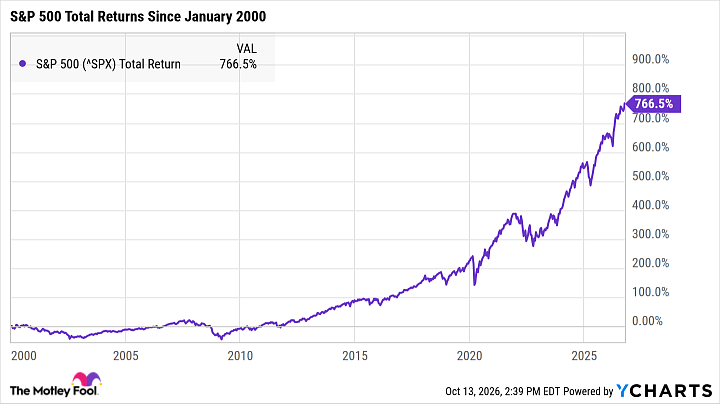
In the last two decades alone, the market has survived the dot-com bubble, the Great Recession, the COVID-19 crash, and the 2022 bear market — along with countless smaller corrections along the way. Despite all of that volatility, though, the S&P 500 is up by more than 766% since early 2000.
If history can prove just one thing, it’s that staying invested for the long term can significantly reduce your chances of losing money during a crash or bear market. By loading up on quality investments now, you can position yourself for lucrative long-term gains.


