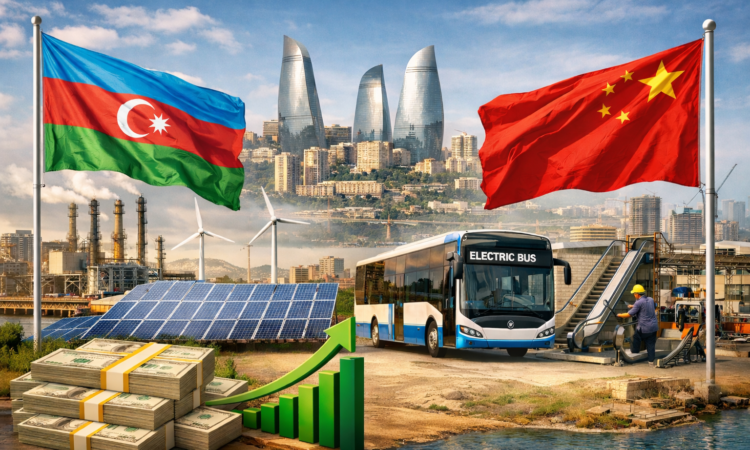

Azerbaijan’s growing economic partnership with China is opening
new opportunities for industrial development, investment
diversification and regional connectivity. The recent meeting
between Economy Minister Mikayil Jabbarov and Gao Bo, chairman of
the board of CSCEC International, has brought another potentially
significant dimension of this relationship into focus: the
establishment of an Azerbaijan-China Industrial Park and the
implementation of large-scale industrial and infrastructure
projects.
The discussions reflect Azerbaijan’s broader economic strategy
of strengthening its non-oil sector, attracting international
capital and expanding domestic production capacity. Cooperation
with one of China’s major construction and infrastructure companies
could support these objectives by combining investment
opportunities with engineering expertise, advanced technologies and
extensive international experience.
The proposed Azerbaijan-China Industrial Park deserves
particular attention. Such a project could become a platform for
Chinese manufacturers seeking to establish production facilities in
the South Caucasus while providing Azerbaijan with additional
industrial capacity, skilled employment and opportunities for
export growth.
China has developed extensive experience in industrial park
construction, manufacturing clusters, infrastructure development
and technology-based production. Bringing this experience to
Azerbaijan could accelerate the development of industries ranging
from construction materials and electrical equipment to machinery,
renewable energy components and industrial technologies.
For Azerbaijan, the economic significance of such cooperation
extends beyond the volume of foreign investment attracted. The
central objective is to transform investment into productive
capacity, generate additional value within the domestic economy and
strengthen the country’s position in regional supply chains.
The non-oil sector has increasingly become a major priority of
Azerbaijan’s economic development agenda. According to official
figures, Azerbaijan’s gross domestic product reached approximately
87.7 billion manats in January-August 2026, while non-oil and gas
industrial production recorded growth of 5.4 percent. These figures
demonstrate the importance of expanding manufacturing activities
and developing new sources of economic growth.
Chinese investment could contribute to this transformation
through the establishment of production facilities, the development
of industrial infrastructure and the participation of local
companies in international supply chains. Every new manufacturing
enterprise creates demand for transportation, construction,
engineering, maintenance, packaging and other supporting services,
generating economic activity across multiple sectors.
Employment creation represents another important dimension.
Industrial projects require engineers, technicians, construction
workers, logistics specialists and administrative professionals.
Their operations can also stimulate demand for vocational education
and specialised training, helping Azerbaijani workers acquire
skills aligned with modern manufacturing requirements.
The potential geographical dimension of this partnership is
equally important. Azerbaijan’s liberated territories offer
significant opportunities for industrial development as
reconstruction and economic reintegration continue. Industrial
facilities established in these territories could contribute to
employment creation, local business development and the formation
of sustainable economic centres.
The development of manufacturing activities in Karabakh and
Eastern Zangezur would complement investments in roads, electricity
networks, water infrastructure, residential construction and
transport connectivity. Chinese companies with experience in
large-scale infrastructure projects could bring additional
technical and organisational capabilities to this process.
Industrial employment would also strengthen the economic
foundations of the Great Return programme by creating opportunities
for returning residents.
Azerbaijan’s geographical position provides another compelling
advantage for potential Chinese investors. Located at the
intersection of important East-West transport routes, the country
offers access to the Caspian region, Türkiye, the South Caucasus
and European markets. The Middle Corridor, connecting China and
Central Asia with Europe through the Caspian Sea and Azerbaijan,
further strengthens this strategic position.
Manufacturing products in Azerbaijan could therefore provide
Chinese companies with opportunities to serve several regional
markets. Meanwhile, the expansion of industrial production would
increase demand for freight transportation, warehousing, port
services and logistics infrastructure, creating additional benefits
for the national economy.
Energy cooperation also offers considerable potential.
Azerbaijan’s investments in renewable electricity generation,
transmission infrastructure and green energy export capacity could
support the development of energy-intensive manufacturing
industries. Chinese expertise in solar technologies, electrical
equipment and energy storage systems could complement Azerbaijan’s
ambitions in this field.
The success of the proposed partnership will ultimately depend
on the quality of its implementation. Investment agreements,
production targets, technology transfer, local workforce
participation and export opportunities should form the foundations
of individual projects. Strong cooperation between Chinese
investors, Azerbaijani institutions and domestic businesses could
maximise the economic benefits.
The meeting between Jabbarov and Gao Bo represents an
opportunity to advance this agenda. Turning the discussions into
concrete industrial projects could strengthen Azerbaijan’s
manufacturing base, create thousands of employment opportunities
over time and expand the country’s role in regional production
networks.
Azerbaijan’s economic future increasingly depends on its ability
to convert geographical advantages, international partnerships and
infrastructure investments into productive industries. Cooperation
with Chinese companies could become an important contributor to
that transformation, positioning the country as a growing
manufacturing and logistics centre between Asia and Europe.