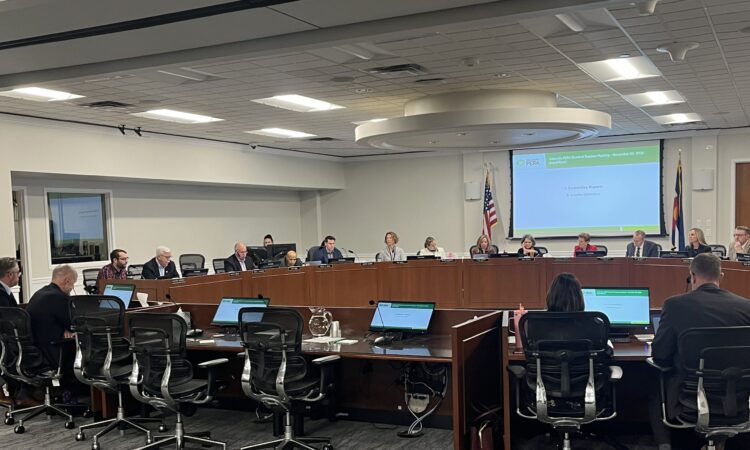
The Colorado state pension board Friday reluctantly agreed to rein in investment staff bonuses and put new limits on how much its top-paid employees can earn.
The move came in response to growing pressure from state lawmakers and members of the Colorado Public Employees’ Retirement Association in the wake of a Colorado Sun investigation into the bonuses in June.
At a time when retiree pensions have been shrinking in order to save the retirement fund from financial ruin, The Sun’s investigation found that PERA paid its investment staff millions of dollars in bonuses worth as much as three times their pay. The outsized bonuses stemmed from a pension compensation policy adopted in 2018 that called for investment staff to earn bonuses higher than 75% of its chosen peers — a mix of top public pensions and private sector firms and endowments that PERA competes with for talent.
On Friday, PERA’s board voted 11-5 to replace that policy with one that calls instead for compensation levels that are “competitive” with top public pensions, and leans into the organization’s public service-oriented mission as a recruitment tool.
But while a majority on the board supported the proposal, many of them did so reluctantly — and in part, because they worried that if they didn’t take action, the state legislature would step in and cut the incentive program even further.
“We are not doing this in a vacuum,” said board member Tina Mueh, a retired schoolteacher. “This is a preemptive move.”
With the board’s vote, PERA’s executive director, Andrew Roth, said he would enact a new pay plan that puts lower caps on bonuses and isn’t as aggressive in attempting to compete with higher private sector pay.
Under the pay plan recommended by PERA’s staff, the pension’s top investment officials cannot earn more than 150% of their salaries in incentives — down from a cap of 225%. Lower-level investment analysts can earn anywhere from 50% to 100% of their salaries in maximum incentives, down from 75% to 150% under the old policy.
Roth said that would put PERA’s pay ahead of a number of top public pensions, but behind some as well — a position he described as “comfortably aligned with our peer group.”
Nonetheless, several board members worried the changes went too far, risking an exodus of investment staff. PERA officials say they save $100 million by managing many of their assets internally rather than relying on outside firms.
“I’ll be blunt: I don’t like this at all,” said Andrew Schremp, a gubernatorial appointee on the board who works in private equity and voted against reducing bonuses. “I don’t even know why we’re having this discussion.”
Roth said he’s been hearing about the bonuses for months from lawmakers and PERA’s members, who are upset that their pension dollars are funding large bonuses at a time when they’ve been forced to sacrifice financially. Over the last two decades, PERA has slashed retiree benefits and required public workers and taxpayer-funded agencies to contribute billions more to the fund.
“I think having this vote demonstrates PERA’s commitment to being responsive to its stakeholders,” Roth said.
Incentive pay is only awarded if investment staff deliver higher returns than their benchmark index funds. It has become a common practice at public pensions across the U.S., as investment portfolios become more complex, and institutional investors look for every edge they can get to maximize their returns. And, despite the Colorado pension’s broader financial woes, PERA’s investment team has long been a bright spot, generating higher returns on average than many of its peers.
Scott Simon, a board member who also serves as the chief investment officer for Colorado’s firefighter and police pension, said PERA was being “pennywise and pound foolish” by putting billions of dollars of investment returns at risk over a few million dollars in bonus pay.
“The current model’s working,” Simon said. “And if we’re unique, maybe we embrace that uniqueness.”
“Strong and credible oversight”
The stakes are high.
PERA provides retirement benefits to more than 700,000 teachers, state workers and local government employees. And when its investments underperform, retirees, workers and taxpayer-funded public agencies alike bear the financial hit, through reduced benefits and higher contributions.
If PERA does begin to face recruitment problems, Roth said, the new policy gives staff the flexibility to come back to the board to ask for changes.
“We are not at this point in time expecting any kind of mass exodus,” he told the board during a Thursday budget hearing.
Moreover, Roth said that if the board didn’t change its compensation policy, PERA would have to pay even higher bonuses than it already does — as much as 677% of someone’s salary. Including base salaries, that would have cost PERA $32 million — $8 million more than what PERA’s board approved.
“That would put us out in front of any other public fund in the United States,” Roth said. The largest pension in the U.S. today, CalPERS, caps its investment bonuses at 270% of salary.
Under the new policy, Roth said PERA will continue aiming for the top quarter of top public pensions in bonus pay — many of which manage much larger portfolios than PERA. But instead of also chasing the top quartile of its private sector competitors, PERA’s bonuses will now be tied to the bottom quartile of bonus pay among a group that includes banks, investment firms and foundation endowments. Nonetheless, investment staff compensation will actually rise slightly overall despite the cuts to the top earners because it makes some employees eligible for bonuses who weren’t in the past.
It was not immediately clear if the changes will be enough to fend off legislative intervention. The changes delivered some of what PERA’s members and lawmakers are seeking, including a cap on bonuses, but not everything that critics have called for.
Secure PERA, a coalition that represents a number of public workers unions, retiree groups and employers, sent the board a letter earlier this week calling for the board to have the ability to defer or eliminate bonus pay in years that PERA fails to meet its 7.25% assumed rate of return on its investments.
State Sen. Chris Kolker, a Centennial Democrat, has proposed outlawing bonuses entirely in years when PERA loses money on its investments, like it did in 2022. Despite the down year, nine investment officials received more than $400,000 each in incentive pay based on their performance.
Under Roth’s plan, the board will now have the ability to defer bonuses for 12 months when there’s a negative investment return — but not eliminate them.
Based on Friday’s discussion, it’s not at all clear that PERA’s board has any intention of using that power. One board member questioned why the board was involved in setting the staff’s compensation at all.
“I feel strongly that this is a CEO responsibility,” Simon said. “Getting into the weeds with governance of the investment compensation program I think is going in the wrong direction.”
PERA’s members disagree. Many of them say they want more oversight, not less.
“When members and retirees are being asked to make sacrifices to keep PERA financially strong, they should have the confidence that the system is working just as hard on their behalf,” Karen Wick, program manager for Secure PERA, told the board Friday. “That means ensuring that the board has the authority and discretion to exercise strong and credible oversight when the fund is not meeting its financial obligations.”