The S&P 500 and Dow Jones Are Dangerously Close to Joining the Nasdaq in a Correction. Here’s the Level That Would Put the Nasdaq in a Bear Market, and What History Says Investors Should Do During a Stock Market Crash.

Buying high-quality stocks and ETFs during periods of intense volatility can pay off for long-term investors.
By Daniel Foelber –
The stock market sell-off has gone from bad to worse, with ripple effects extending to the major indexes.
The Nasdaq Composite (^IXIC -5.28%) is now firmly in a correction, which is a drop of at least 10% from this high. As of Nov. 19 market close, the Dow Jones Industrial Average (^DJI -1.93%) is down 9.7% from its high, while the S&P 500 (^GSPC -3.70%) has proven more resilient but is still down 8.2% from its highs. It’s worth mentioning that the Nasdaq and S&P 500 were both at all-time highs in early October — showcasing the speed and severity of the sell-off.
Here’s the level that the Nasdaq would need to reach to be in bear market territory, the differences between a stock market crash and a bear market, and how to navigate further volatility.

Image source: Getty Images.
22,178.20 in the Nasdaq Composite would mark a 20% decline
The Nasdaq Composite closed at 23,879.20 on Nov. 19 — putting it 13.5% off its all-time high.
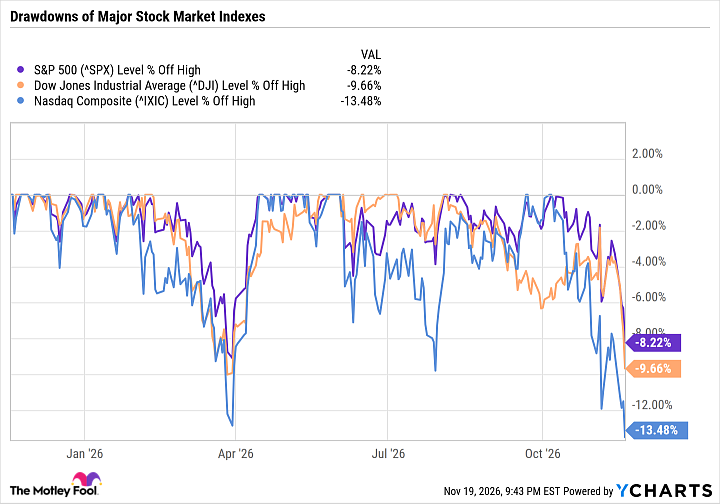
If the Nasdaq fell to 22,178.20, that would put the index down 20% from its all-time high of 27,722.75, set on Oct. 6.
A bear market is defined as a prolonged downturn of at least 20% from a high. So, for example, the rapid sell-off during the outbreak of the COVID-19 pandemic in March 2020 and the tariff-induced sell-off in April 2025 both saw the Nasdaq down over 20% from its high, but those levels were very short-lived. In contrast, the broader sell-off in growth stocks during 2022, when the Nasdaq fell 33%, was a legitimate bear market.
A stock market crash is typically defined as a sudden drop in a major index. Exact definitions vary based on speed and severity. For example, a 10% drop in a week can feel more crash-like than a 20% drop over six months, even if the 20% drop is more damaging to your portfolio. However, if the Nasdaq does fall to that 20% drawdown level over the next few weeks, I think it’s fair to call it a crash, given that the all-time high occurred just six weeks ago. And the speed of the sell-off, especially over the last couple of weeks, has been rapid. Especially in certain sectors.
^IXIC & NVDA: Performance Comparison
Key Financial Metrics

^IXIC – NASDAQ Composite Index
22,617.73
–5.28% (–1,261.47)

NVDA – Nvidia
$125.53
–14.01% (–$20.45)
52wk Range
20,794.64 – 27,599.89
Dividend & Yield
N/A
Market Cap
$3.0T
52wk Range
$124.50 – $243.37
Gross Margin
74.93%
P/E Ratio
13.49
EPS (TTM)
$9.31
Dividend & Yield
$0.52 (0.41%)
^IXIC – NASDAQ Composite Index
22,617.73
–5.28% (–1,261.47)
52wk Range
20,794.64 – 27,599.89
Dividend & Yield
N/A
NVDA – Nvidia
$125.53
–14.01% (–$20.45)
Market Cap
$3.0T
52wk Range
$124.50 – $243.37
Gross Margin
74.93%
P/E Ratio
13.49
EPS (TTM)
$9.31
Dividend & Yield
$0.52 (0.41%)
Nvidia is down 32.3% in three weeks
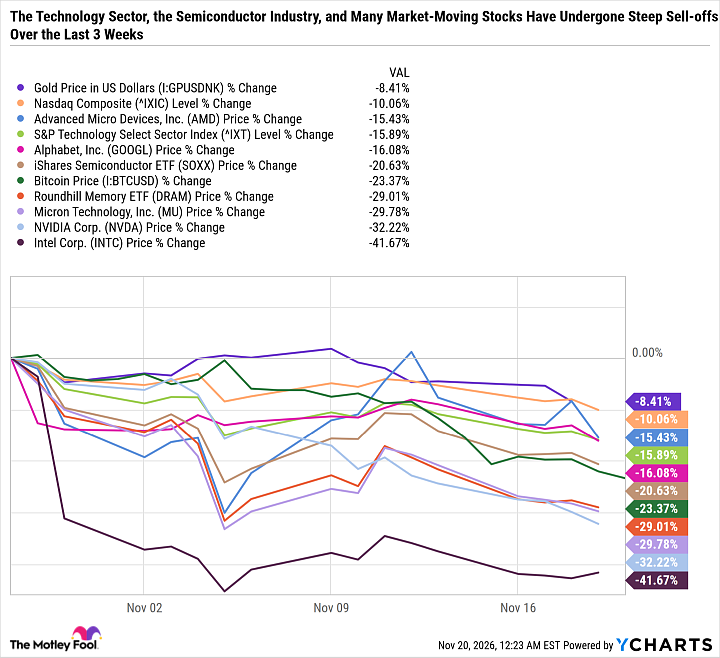
There are already pockets of the stock market that have undergone crash-like sell-offs. In just three weeks, the Nasdaq Composite is down 10.1%. Even gold and Bitcoin (BTC +1.13%) have undergone rapid declines. Nvidia (NVDA -14.01%), which was the world’s most valuable company for most of this year, has lost roughly a third of its value in three weeks — accelerated by the sudden resignation of its founder and CEO of over 33 years, Jensen Huang.
Gold Price in US Dollars data by YCharts
For investors with outsize exposure to Nvidia and other artificial intelligence (AI) stocks, the sell-off feels like a crash — even if the major indexes don’t reflect as much damage.
There are better stocks to buy on the dip than Nvidia
History says that stock market sell-offs present excellent buying opportunities in hindsight. After all, the major indexes have still delivered excellent medium- and long-term returns, even when factoring in current drawdowns. But that doesn’t mean investors should assume that every stock that is down is cheap just because the price is lower.
I’ve been bullish on Nvidia for years. But even I think Jensen Huang’s departure negatively impacts the long-term investment thesis on Nvidia. So much so that I shifted my stance from a buy to hold until we get more clarity on the extent of the national security risk, how Nvidia will be restructured without Huang, how the company will fare under new leadership, whether Nvidia can retain its top talent, if the fundamentals remain intact, and if Nvidia can continue operating with the financial muscle of a large company paired with the flexibility and innovation of a start-up. So while there’s a fair argument that the Nvidia sell-off may have gone a bit too far, the business is definitely weaker without Huang, and earnings growth may slow under a more operations-oriented leader like Colette Kress.
I think there are far more clear-cut buying opportunities in today’s market than Nvidia. One example is ASML (ASML -6.63%), which is a leader in the semiconductor equipment industry. Its machines are used by top chip fabs like those operated by Taiwan Semiconductor Manufacturing (TSM -9.48%), Samsung Electronics (SSNLF +0.00%), and Intel (INTC -7.97%). These machines are needed to manufacture next-generation AI chips at commercial scale, making ASML an excellent long-term buy for investors who believe that AI sophistication and use cases will continue to evolve.
Another approach is to buy a beaten-down growth stock exchange-traded fund (ETF) for a basket of top companies. For example, the Vanguard Growth ETF (VUG -5.32%) and Vanguard Mega Cap Growth ETF (MGK -5.58%) both have ultra-low fees and provide exposure to many top companies.
Go with your highest-conviction ideas
Stock market sell-offs are excellent times to update your watch list with new opportunities and buy stocks whose values have become more reasonable. However, investors should expect volatility to be swifter and more severe due to widespread access to information, the ability to act on it easily through high-frequency trading, and, at the retail level, mobile trading and zero-fee brokerage services.
Index concentration is another factor driving volatility. At its peak, Nvidia alone made up around 8% of the S&P 500 (still 5.4%). But as the current sell-off proves, the impact of Nvidia on the broader market extends far beyond its own weighting, through the companies that directly or indirectly depend on, compete with, or transact with Nvidia.
Therefore, it’s best to only buy stocks you are OK with holding even if volatility continues to intensify.
Where to invest $1,000 right now
When our analyst team has a stock tip, it can pay to listen. After all, Stock Advisor’s total average return is 719%* — a market-crushing outperformance compared to 192% for the S&P 500.
They just revealed what they believe are the 10 best stocks for investors to buy right now, available when you join Stock Advisor.
*Stock Advisor returns as of November 22, 2026.