

I came across two really nice research papers that both look at the impact AI has on investment research. If you read the first one, it will lift your spirits, but if you read the other one, it is going to be a bit anticlimactic. Today, then, let me start with the positive news. Tomorrow, I will discuss the other study that shows us the flip side.
The first study used Factset’s integration of Generative AI in 2023 as a natural experiment to examine what happens when analysts have access to AI.
I can already hear my readers complain about how FactSet is not the best provider of financial data, and they would never use it, but instead prefer Bloomberg, LSEG Workspace or whatever data provider they use. Other readers will comment that Bloomberg’s data is not the same quality as FactSet, and a third group will claim that nothing is as good as IBES, which you can only get through Datastream, and so on.
Truth is, I don’t use FactSet and am partial to Bloomberg (I clearly have expensive tastes), but in the end, it boils down to what you are used to and which provider and system you trust and can use best for your purposes.
So, let’s move on from that debate and focus on what happens when FactSet introduced AI support in its tools.
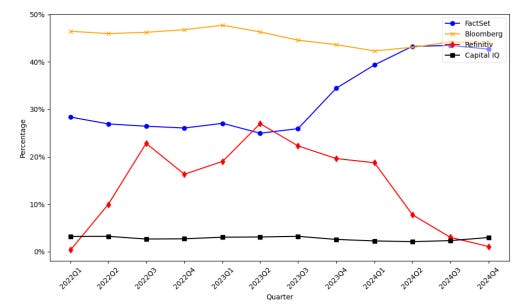
Apparently, the introduction of AI support was a success for FactSet. The chart below shows the percentage of analyst reports that quote a specific data provider as a source. In the third quarter 2023, Factset was a source in roughly 25% of all analyst reports, but by the end of 2024, that had risen to 50%. Analysts clearly loved the new feature in FactSet and switched from Refinitiv to FactSet.
Data provider sourced by analysts
Source: Xue et al. (2026)
Closer inspection of the data shows that usage increased, particularly with smaller firms and larger teams, which indicates that it is likely that users didn’t cancel one subscription to switch to FactSet, but that users who already have FactSet used it more frequently.
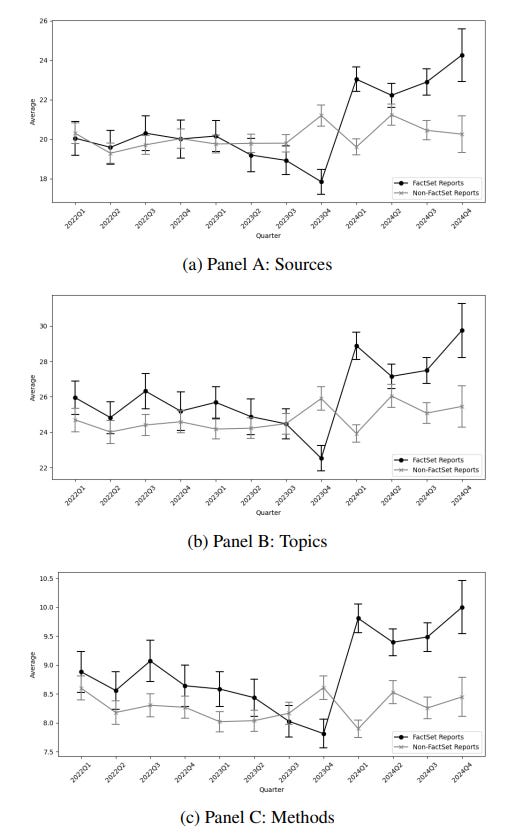
And the users of FactSet clearly found tremendous value in the AI feature. The second set of charts shows how the number of third-party sources changed for users of FactSet vs users who did not cite FactSet (Panel A). Thanks to the introduction of the AI feature, the users of FactSet found sources that they probably wouldn’t have found otherwise. The number of sources quoted in FactSet-supported research reports rose by roughly 26% after the AI feature was launched.
Panel B below shows the number of topics covered in analyst reports. Because AI makes it easy to analyse topics influencing a stock, the number of topics covered in analyst reports that used FactSet rose by roughly 24%.
Finally, AI allows for deeper quantitative analysis, and the number of analyses and tools used in analyst reports also rose by 21%.
Plus, the reports produced with the help pf Factset were on average released quicker than reports from analysts that did not use Factset.
Data provider sourced by analysts
Source: Xue et al. (2026)
The upshot of all this is that as long as we discard questions about AI hallucinations, which were not checked in the study, the introduction of AI significantly improved analyst reports. The reports were timelier, more comprehensive, and quantitatively more sophisticated. And I think, as an investor, that is something we all appreciate. AI improves investment analysis.
On a side note, I, like practically all investment analysts these days, use AI on a daily basis. And as long as you take care of hallucinations by checking AI’s results, it is indeed a tool that can make you more productive and allow you to dig deeper into more topics and analyse a market or an economy (in my case) or a stock from a variety of new angles that in the past you simply didn’t have the time to do.
Personally, I have become a fan of AI in my daily work.