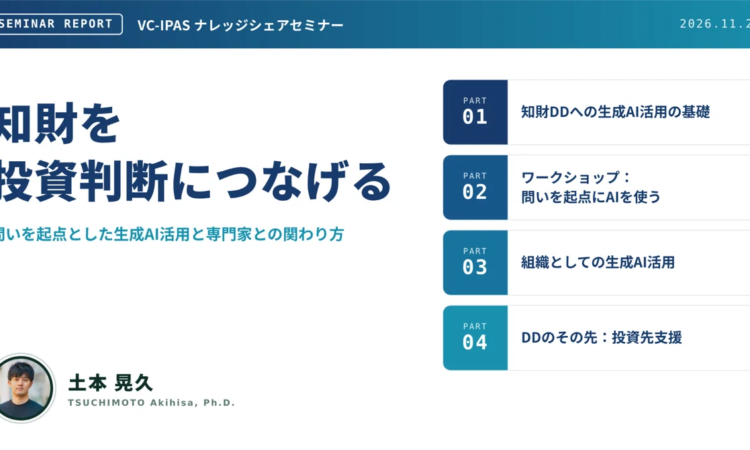
On November 20, 2026, I served as an instructor alongside Patent Attorney Tsunobuchi at the “Knowledge Sharing Program Between Host VCs,” held as part of the Japan Patent Office’s VC-IPAS project. The theme was “Connecting Intellectual Property to Investment Decisions: Utilizing Generative AI Starting from Questions and Engaging with Experts.” This article summarizes the contents of that session.
The seminar began with an explanation of the Japan Patent Office’s “Intellectual Property Due Diligence (IP DD) Manual for Capitalists.” From there, the discussion expanded to hands-on exercises using generative AI, organizational utilization, and post-investment support. We proceeded while having venture capitalists both at the venue and online run actual prompts.
Throughout the session, what I wanted to convey came down to two key points: looking at “whether business strengths can be protected” rather than “the presence or absence of patents,” and recognizing that the quality of generative AI’s output is determined by the “questions” asked.
Overview of the Seminar
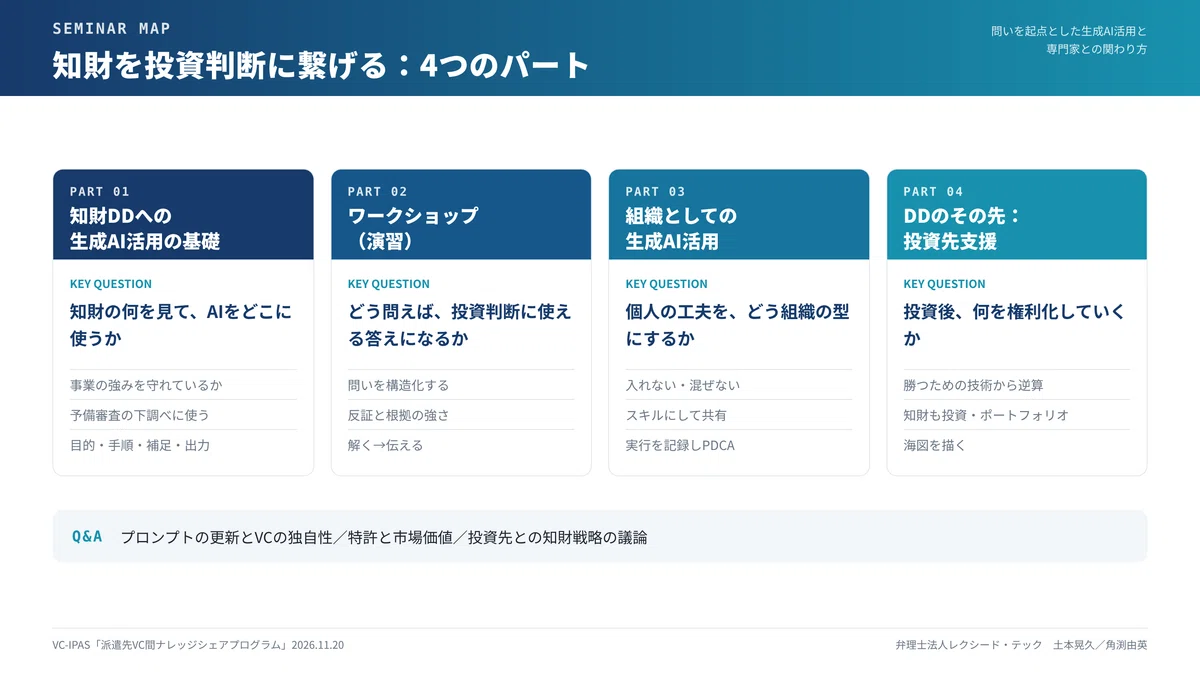
The seminar was structured into four parts followed by a Q&A session. The first half covered individual usage, while the second half addressed expansion across organizations and post-investment phases.
-
Fundamentals of Utilizing Generative AI in IP DD: An explanation of the IP DD Manual. What to look for and where to leverage AI.
-
Workshop: A practical exercise using a US sleep-tech company as a case study to formulate questions, solve them, and frame the findings for communication.
-
Organizational Utilization: Transforming individual practices into institutional contracts, rules, templates, and sharing systems.
-
Beyond DD: Thinking of IP in terms of investment and portfolio strategy as part of portfolio company support.
Part 1: Fundamentals of Utilizing Generative AI in IP DD
In the first part, following the IP DD Manual, we outlined what aspects of intellectual property to evaluate during investment screening and how to apply generative AI to that process.
Evaluate Patents by “Whether Business Strengths Are Protected,” Not by “Patent Count”
We frequently hear comments like these from venture capitalists:
-
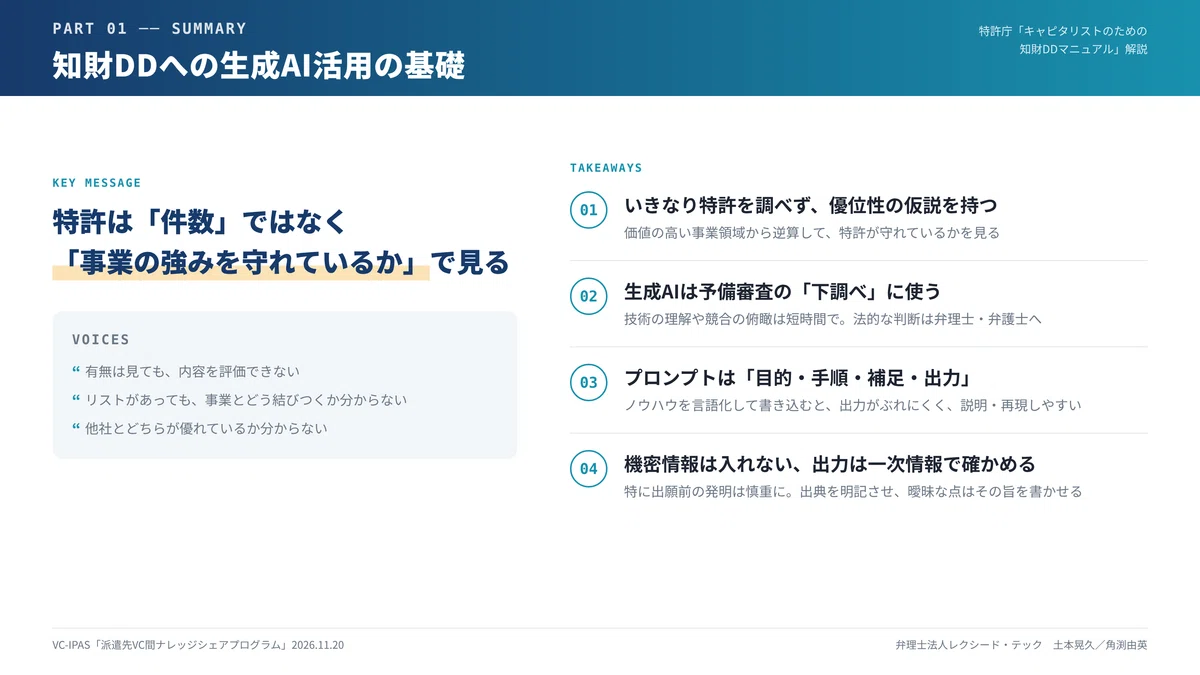
“We can check for the presence of patents, but we cannot evaluate their contents.”
-
“Even with a list of patents, we don’t know which ones tie into the business or how.”
-
“Competitors hold patents too, but we cannot tell whose are superior.”
-
“They haven’t filed applications yet, and we are worried about whether they infringe on competitors’ patents.”
While it is easy to verify the “presence or absence” of patents, interpreting their “substance” and “linkage to the business” is challenging. Even if a university holds an extensive portfolio, examining each patent individually often reveals that many will not be utilized in the proposed business plan. Therefore, rather than jumping straight into investigating patents, we recommended first forming a hypothesis regarding the business’s competitive advantage and then assessing whether the patents protect it.
Using Generative AI for “Preliminary Research” During Preliminary Screening
The manual divides investment evaluation into two stages: “preliminary screening” and “due diligence.” Generative AI proves most useful during preliminary screening, where a wide range of considerations must be investigated rapidly.
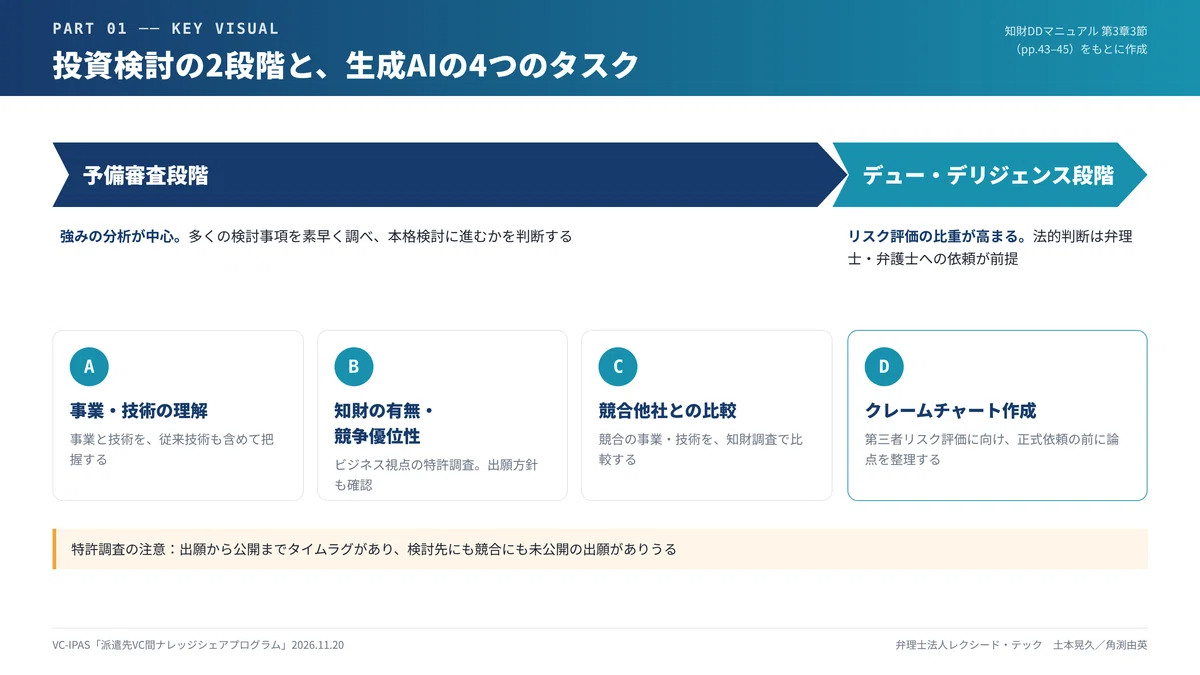
In preliminary screenings, it is used for three tasks: (1) understanding the business and technology, (2) assessing the presence of IP and competitive advantage (patent research from a business perspective), and (3) comparing with competitors. In the DD (due diligence) phase, it is used to (4) create claim charts for evaluating third-party patent risks. However, legal judgments are still fundamentally entrusted to patent attorneys and lawyers as before, with AI being utilized beforehand to organize the key issues.
Kadobuchi introduced the concept of claim charts. An independent patent claim is broken down into its constituent elements, and each element is checked one by one to see whether there is a corresponding feature in the product or service. When considering the strength of rights, it becomes crucial whether the claims cover elements that anyone would notice once the product hits the market.
Prompts and Usage Rules Determine the Results
The manual recommends structuring prompts around four components: “Objective, Procedure, Supplemental Information, and Output.” Write what you want to achieve in a single sentence, break down the procedure into bullet points, supplement with definitions of terms and information sources, and specify the output format. Doing this reduces variance in the output and makes it easier to explain and reproduce.
There are two points to keep in mind.
-
Security: Since some services use inputs for model training, do not input trade secrets or non-public information, especially pre-filing inventions. In many situations, thorough evaluations can be conducted using only public information.
-
Hallucinations: Specify terminology and information sources, require explicit citations, and have it state clearly when points are ambiguous. Even then, errors can remain, so always verify against primary sources.
Part 2: Workshop — Formulating, Solving, and Communicating Questions
In the workshop, US sleep-tech company Somnee was featured as an exercise subject based on public information. It is a startup spun out of UC Berkeley that develops a headband that measures brain waves while using weak electrical stimulation to help users fall asleep. The question was, “Should you invest in this company’s next round?”
Manual Prompts Alone Do Not Answer “Should We Invest?”
Initially, if you execute the manual’s prompts as-is, you can quickly grasp an overview of the technology, the correspondence between patents and strengths, and the competitors’ focus areas. On the other hand, frustrations often remain, such as getting only generalities, high volume without conclusions, or conclusions that change every time.
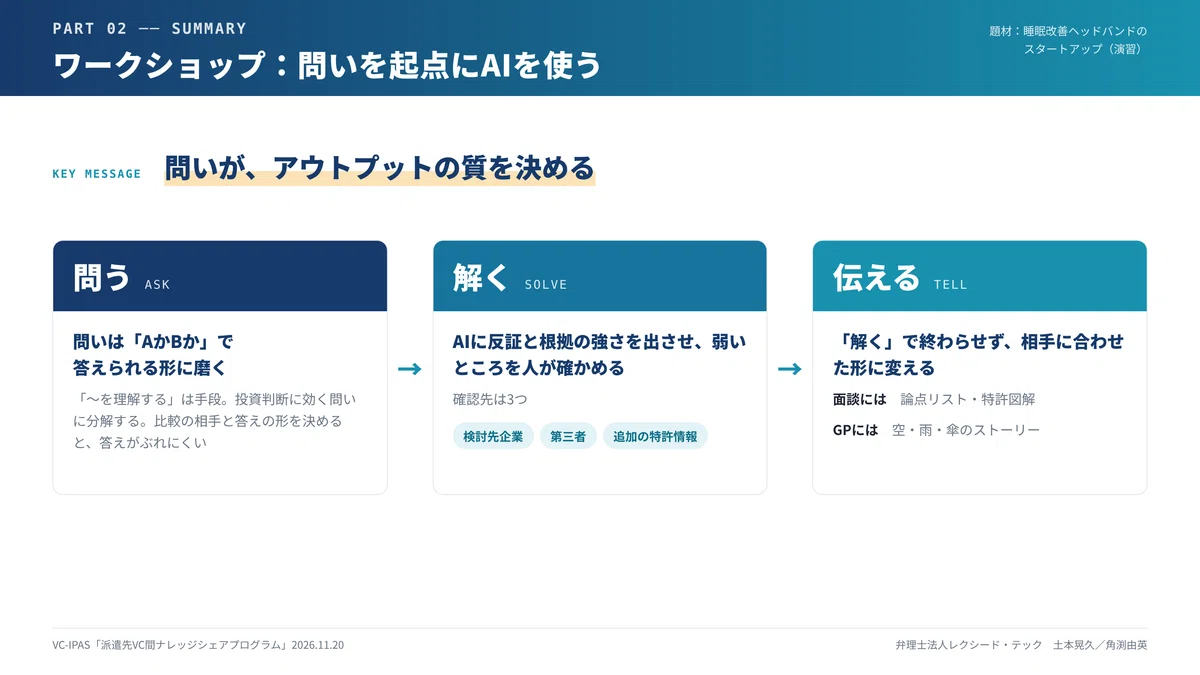
Most of the time, the cause is not the AI’s performance, but rather that “what you want to judge” has not been established as a question. “Understand Company X’s technology” is a means, not a question.
Structure Questions and Refine Them into an “A or B” Format
The overarching question of “Should we invest?” can be broken down into core questions such as the management team, the market, customer pain points, comparisons with substitutes, and technological barriers to entry. Each of these is then further reduced to smaller questions that can be answered using information about the company, market, competitors, and patents. Which questions are weighted heavily is where each investor’s distinct character emerges.
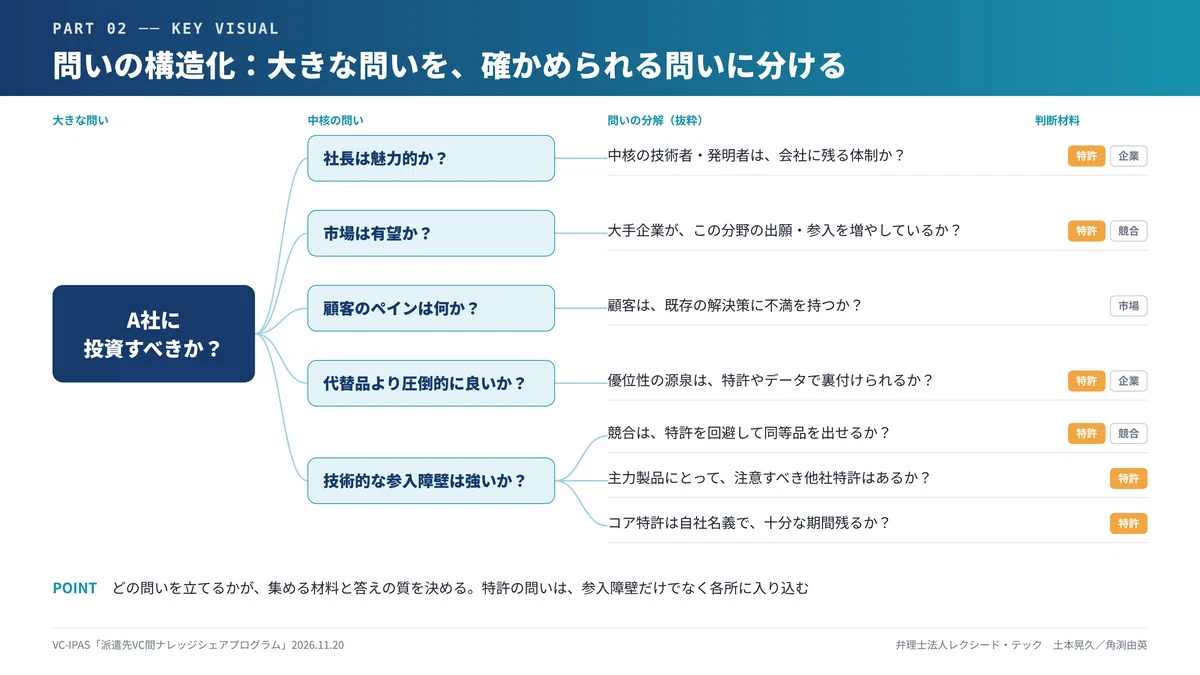
In the exercise, the following two questions were posed referencing patent information:
-
Question 1: Can the closest competitor launch an equivalent or superior product at an equivalent or lower cost without Somnee’s patents or know-how?
-
Question 2: Which third-party patents require the most attention regarding future flagship products, and could they impact the business plan?
There are two criteria for a good question: whether another AI or person given the same question and information would likely reach the same answer (reproducibility), and whether the judgment changes significantly depending on the answer (importance). Rather than asking about degree, such as “Is it strong?”, defining the benchmark for comparison and the answer format to lean toward “A or B” makes the answer less prone to wavering.
Furthermore, the AI is prompted to output counter-evidence (what facts would exist if that conclusion were wrong) and the strength of each piece of evidence (primary information, secondary information, speculation). Humans then verify areas concerning counter-evidence or weak grounds across three sources: the target company, disinterested third parties, and additional patent information.
Upon Execution, “Difference in Effectiveness” Emerged as the Key Issue
When we had the AI tackle Question 1, it returned the hypothesis that “there is a high probability it can be achieved.” The closest competitor already sells products in the same price range utilizing acoustic stimulation. Somnee’s patents are focused on electrical stimulation, meaning acoustic stimulation falls outside their scope. However, “equivalent or superior efficacy” remains unverified, as direct comparative trials have not been conducted.
In other words, the key lies in the “difference in efficacy” between electrical stimulation and acoustic stimulation. If a difference can be demonstrated, securing patents on the configuration that produces that difference could potentially serve as a barrier to entry. From Question 2, third-party patents related to closed-loop stimulation during sleep emerged as a key issue that could overlap with future features. In either case, the AI’s output is merely a hypothesis, based on the premise that legal evaluations should be entrusted to experts.
Moving Beyond “Solving” to Transforming into a “Communicable” Format
The answers obtained should be reshaped to match the intended audience and context. For a 30-minute meeting with a prospective investment target, prepare an issues list of “yes/no” questions arranged in order of importance, along with visual diagrams of key patents. For a 30-second briefing to a GP, distill everything into a single storyline.
For the storyline, we utilized the “sky-rain-umbrella” framework: the sky is cloudy (fact), it looks like it will rain (interpretation), and take an umbrella (action). Generative AI tends to jump easily from “sky” to “umbrella,” frequently leaving the intermediate “rain” as a black box. By having the AI write with an explicit awareness of the “rain,” the team can share what constitutes a discovery and where a discrepancy would alter the final decision.
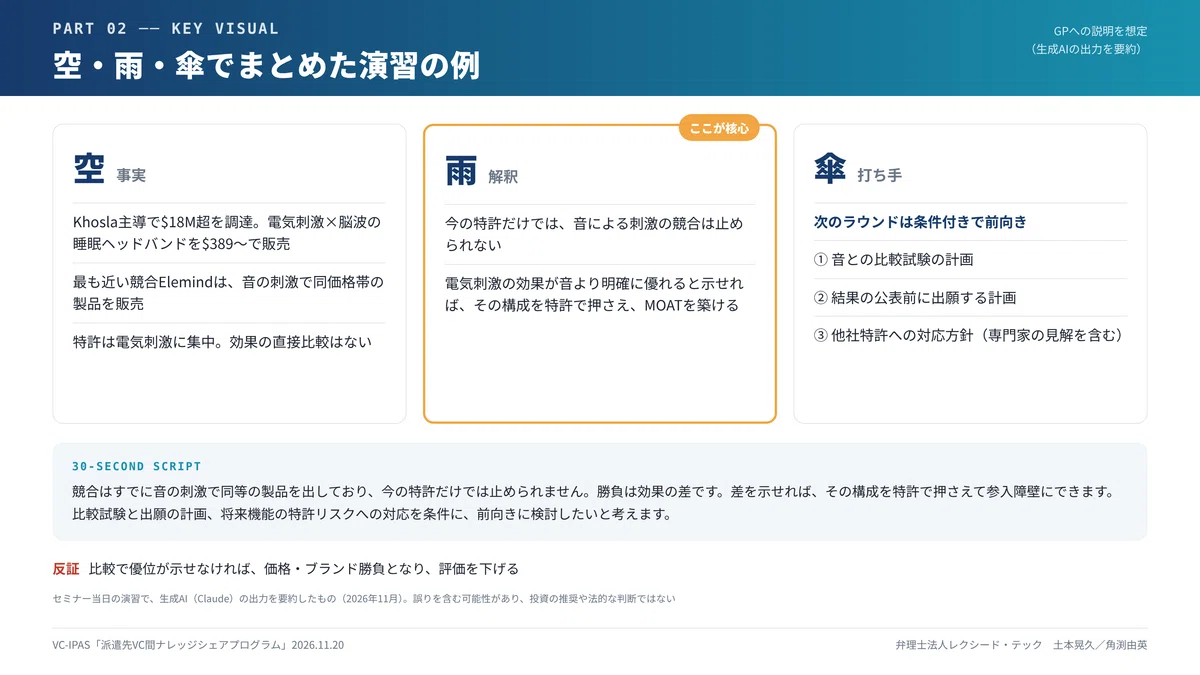
In the exercise, based on the interpretation that “current patents alone cannot stop competitors using acoustic stimulation, and the battle will hinge on the difference in efficacy,” we constructed the conclusion that positive consideration should be given on the condition of planning comparative trials and patent filings. Naturally, this is merely an illustrative exercise and does not constitute an actual investment recommendation.
Part 3: Leveraging Generative AI as an Organization
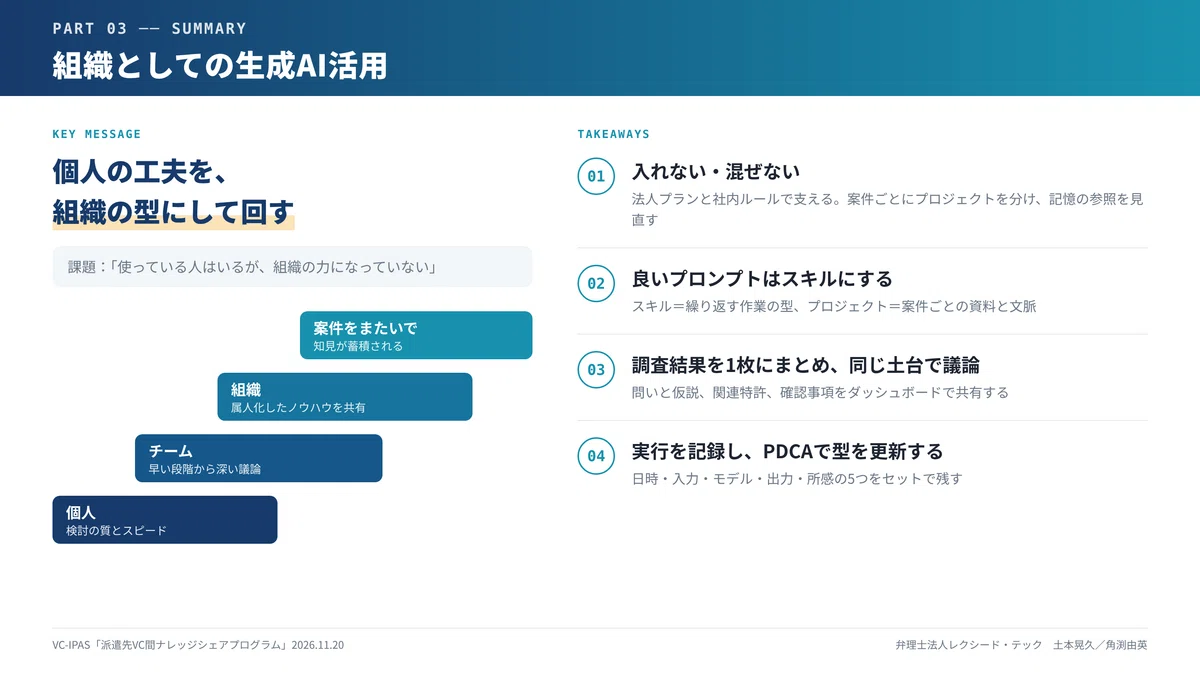
While more individuals are using generative AI, one frequently hears comments such as “people are using it, but it isn’t translating into organizational capability.” The techniques of skilled individuals are not shared, people remain on individual plans without standards for confidential information, and effective prompts get buried within individual chat histories. In this part, we introduced methods to transform individual techniques into organizational frameworks.
-
Do Not Input, Do Not Mix: Standardize on enterprise plans and ensure that business data is not used for model training. Do not input unfiled inventions. Separate projects by deal, and prevent cross-deal memory referencing.
-
Standardize into Templates: Convert effective prompts into “skills” that consolidate SOPs, templates, and reference materials for reuse across the organization. Differentiate between skills as templates for recurring tasks and projects as deal-specific materials and context.
-
Debate on Common Ground: Consolidate the hypothesis, strength of evidence, related patents, and items for confirmation for each question onto a single dashboard to share across the team.
-
Run the PDCA Cycle: Retain a set of five elements: execution date and time, input content, model used, output content, and feedback on the output. Categorize omissions or errors as either deal-specific or template issues, refine the template, and apply the improvements to subsequent deals.
When team discussions and organizational frameworks are layered onto individual efficiency gains, the overall effect multiplies significantly. As an entry point, introducing enterprise plans, leveraging skill and project features, and creating forums to share case studies from adept users are accessible ways to start.
Part 4: Beyond DD—Utilization in Portfolio Company Support
In the final part, we discussed the approach of connecting DD through to post-investment support.
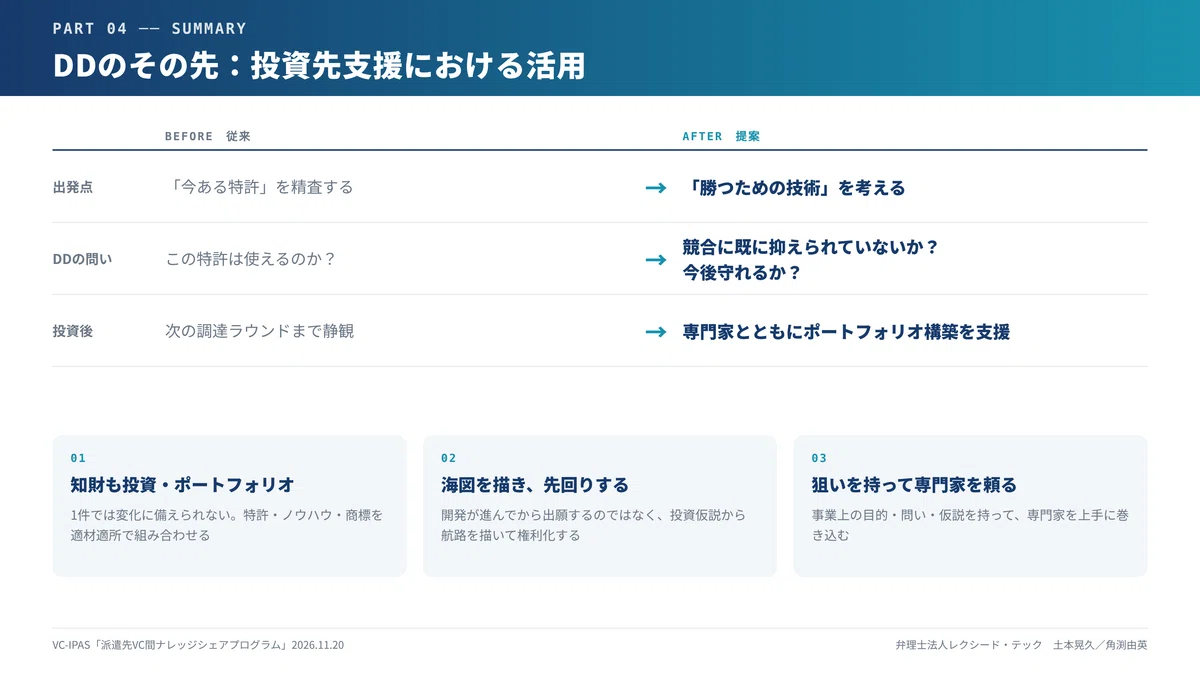
From “Is This Patent Usable?” to “Can We Protect the Technology Needed to Win?”
Conventional DD involved scrutinizing “existing patents” and asking, “Is this patent usable?” However, patents held during the founding phase may cease to be important during growth stages. We therefore proposed shifting the questions to: “Has the technology required to win already been locked down by competitors?” and “Can we protect it moving forward?” Rather than passively waiting until the next round following an investment, we support portfolio construction alongside experts.
IP Is Also an Investment and a Portfolio
R&D and patent filings incur upfront costs, but if imitation can be prevented through intellectual property rights, returns materialize in the form of improved profit margins and licensing revenue. The cost of IP is an investment in the future.
However, the future is unpredictable. Patents that never result in commercialized products may prevent competitors from entering the market, while carefully kept trade secrets may preserve a competitive edge over the long term. By combining patents, know-how, and trademarks in the right places, a portfolio prepares an organization for change. In the sense that a small portion generates outsized returns, its structure closely resembles that of VC investing.
Drawing a “Nautical Chart” and Securing Rights Ahead of the Course
Rather than “filing because development has progressed,” you first establish an investment hypothesis for the business—in other words, a “nautical chart.” The seeds of patent applications visible today are not necessarily critical to the business. Confirming on the chart where the rights you truly want are located, you run a feedback loop between your hypotheses and your R&D and business development.
I also introduced overseas case studies. Sila, which develops silicon-based anodes, is a horizontal player that supplies materials, yet it also files applications for downstream implementation areas such as electrodes and cells. Oura, known for smart rings, is an example of reinforcing its portfolio by acquiring patents from other companies in addition to its own filings. The way you build a portfolio changes depending on how you create your competitive edge.
Deciding what to secure rights for and what not to file requires highly specialized judgment. Once you have your business objectives, questions, and hypotheses in place, you strategically involve experts, using AI analyses as fodder for those discussions.
The detailed thinking behind this part is introduced in the author’s note articles, “Patents Viewed as Investments” and “Drawing a Nautical Chart: Investment Hypotheses for Intellectual Property.”
In Conclusion
Investment decisions cannot be made solely on IP information. On the other hand, by combining perspectives on technology and business and using generative AI driven by targeted questions, you can quickly get a sense of patent-related issues that have previously received little attention. Taking those initial assessments to discussions with experts will deepen the dialogue even further.
Summary
-
Look at patents not by “number of filings,” but by “whether they protect the business’s core strengths”
-
Use generative AI for preliminary examination research, leaving legal determinations to experts
-
The question determines the quality of the output: refine it into a form that can be answered as “A or B,” prompting even counterarguments and the strength of the rationale
-
Do not stop at just “solving” the answer; “communicate” it through issue lists and a “Sora-Ame-Kasa” (sky-rain-umbrella) story structure
-
Turn individual ingenuity into an organizational standard through corporate plans, skills, and execution logs
-
Post-investment, work backward from the “technologies needed to win,” draw a nautical chart, and build your portfolio
Thank you very much to all the attendees and organizers. The prompt concepts used in the seminar are also introduced in the article “How Far Free AI Can Go with IP Due Diligence,” which summarizes how to use free versions.
* The generative AI outputs in this article were created based on publicly available information in November 2026 for seminar exercises. They may contain errors and do not constitute investment recommendations or legal opinions.