



Currencies

Currencies

Trump’s tariffs were supposed to boost the dollar. Why the opposite happened.

After Trump on Wednesday unveiled a raft of punishing “Liberation Day" tariffs, stock futures tumbled. The U.S. dollar whipsawed against major currencies. This highlights the confusion that has overtaken Wall Street regarding how to trade the U.S. currency. Most analysts have insisted that tariffs should push it up, reflecting how potential fewer purchases of overseas goods would narrow the trade deficit and mechanically reduce U.S. demand for foreign exchange. Also, U.S. growth is outpacing the eurozone’s, which has historically been dollar-positive. Yet this isn’t how it has played out so...
Currencies

BTC Nears Death Cross, CNY Tumbles With Asian Markets After Trump Tariffs Put Focus on China’s Response

It's a risk-off day in Asia as traders look to Beijing's response to U.S. President Donald Trump's sweeping reciprocal tariffs on China and other Asian nations.On Wednesday, Trump announced tariffs on imports from 180 nations, including trading partners identified as the worst offenders, such as China and the European Union.The president imposed a new 34% tariff on goods from China in addition to the existing 20% tax, bringing the total levy to 54%, the highest for any nation. The action did not affect Canada and Mexico.Observers say the ball is...
Currencies

Trump’s reciprocal tariffs: India braces for economic ripples

Beyond trade, the move could disrupt currency markets, capital flows, and corporate strategies worldwide. While India faces fresh challenges, the shift may also create unexpected opportunities in an evolving global trade landscape. Read this | Trump’s tariff strike: India hit with 26% duty as trade war escalates The tariffs provide India with greater clarity on sectoral impacts and corporate cash flows. However, Indian businesses must now shift focus from cost competitiveness to innovation, said Sachchidanand Shukla, group chief economist at Larsen & Toubro. "The INR (Indian Rupee) could remain under...
Currencies

Trump’s tariff announcements shake global markets, induce currency weakness

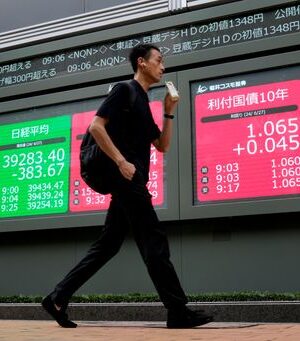
Listen to article Global markets experienced severe turbulence on Thursday after US President Donald Trump announced sweeping tariffs, including a baseline 10% duty on all imports and higher levies on key trading partners. The news led to sharp declines in stock markets, falling currencies, and rising commodity prices, with analysts warning of broader economic impacts. Futures on US indices tumbled, with the S&P 500 dropping more than 3%, while Asian markets also suffered significant losses. The Nikkei 225 in Japan fell by over 3%, while Hong Kong’s Hang Seng and South Korea’s...
Currencies

Trump’s 26% reciprocal tariff on imports from India: Here’s how auto, pharma and IT spaces may fare

US President Donald Trump as part of his sweeping reciprocal tariff measures has levied a 26 per cent tariff on imports from India. The announcement comes as he calls India's tariffs as 'very, very tough'. Further, he calls his move as a 'kind reciprocal' as the tariffs levied are half of what India levies on US products. Trump laid out the U.S. “reciprocal tariff” rates that more than 180 countries and territories, including European Union members, will face under his sweeping new trade policy. Referring April 2 as "Liberation Day",...
Currencies

USD/INR climbs as Trump imposes a 26% tariff directed at India

The Indian Rupee attracts some sellers in Thursday’s early European session.  Trump plans to implement a 26% tariff on Indian imports, weighing on the INR.  The US weekly Initial Jobless Claims and ISM Services PMI will be the highlights later on Thursday.  The Indian Rupee (INR) remains under selling pressure on Thursday, pressured by the weakening in Asian equity and currency markets after US President Donald Trump imposed broad-based tariffs. Trump said on Wednesday that he would impose 26% tariffs on imports from India effective from April 9, a component...
Currencies

Asian Markets Roiled by ‘Liberation Day’ Tariffs — Update

By Dow Jones Newswires Staff Asian equities tumbled as markets saw some of their worst fears come true: a slate of sweeping U.S. tariffs that could inflict economic damage and disrupt industries. Indexes in Japan and South Korea followed U.S. stock futures lower at Thursday's open, as investors took in President Trump's announcement of an across-the-board 10% tariff on all imports that kicks in April 5. Countries on the White House's about 60-strong list of "bad actors" on trade will be hit by sharper levies that take effect on April...
Currencies

Bitcoin (BTC) Price Slides to $83K as Tariffs Rattle Stocks, Currencies

CORRECT (April 3, 11:30 UTC): Corrects headline to say bitcoin fell after the announcement; an earlier version of the story said it held steady.By James Van Straten (All times ET unless indicated otherwise)Liberation Day is done, and markets finally have clarity on U.S. tariffs. Starting April 5, all U.S. trading partners will face a minimum of a 10% import tariff, with higher, country-specific tariffs kicking in on April 9 for about 60 countries.President Donald Trump introduced the tariffs based on perceived trade imbalances and non-tariff barriers, saying the goal is...
Currencies

Asia takes big tariffs hit: Vietnam, Thailand most affected, while exemptions ease impact for India, Singapore | snaps

US President Trump announced a blanket tariff of 10% on US imports, though most APAC countries are being hit with an additional 10% or more on top of that rate. The largest tariffs seem targeted at countries exporting lower-value-added items like footwear, furniture, garments, and textiles. Vietnam, which after China has the largest trade deficit with the US, faces a 46% tariff. Cambodia got hit with a 49% tax, while Sri Lanka got 44% and Bangladesh got 37%. The largest economies in the region, such as India, Japan, and South...
Currencies

Neelkanth Mishra sees India weathering tariff shock, but warns of market and currency risks

Neelkanth Mishra, Chief Economist at Axis Bank believes India is well-placed to withstand the economic impact of US tariff moves, but warned that the country's financial markets and currency may not be immune to global volatility.“The market should start getting used to the fact that uncertainty will now accentuate," Mishra said.He expects some countries to retaliate, which could lead to significant currency fluctuations and increased market stress in the coming weeks as trade negotiations begin. He stated that India is relatively less impacted by the tariff changes and is making...
1 245 246 247 248 249 292
Page 247 of 292