Book review – Money Beyond Borders: Global Currencies from Croesus to Crypto, by Barry Eichengreen. Princeton: Princeton University Press, 2026.
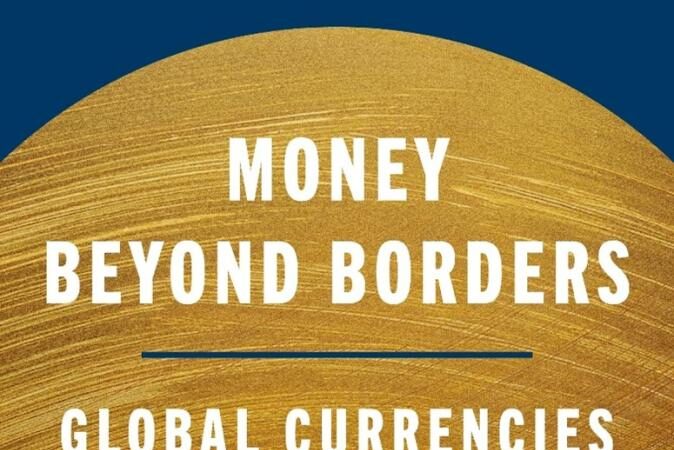
Money Beyond Borders: Global Currencies from Croesus to Crypto, by Barry Eichengreen. Princeton: Princeton University Press, 2026. 344 pp., £25 hardcover.
In this powerful work covering 2,500 years of international currencies, Barry Eichengreen shows the financial and geopolitical factors shaping reserve currency status, or seigniorage, with the “exorbitant privilege” that comes with the right to mint the coin of the realm and borrow in one’s own currency.[i] Noting tensions between a currency’s national and international status, he begins with Nixon’s ending dollar convertibility into gold at $35 an ounce underpinning the post-World War II global monetary order, and turn to floating exchange rates. Treasury Secretary John Connally famously quipped “it’s our currency but your problem.” Reports of the imminent demise of the dollar at the time were greatly exaggerated. Like world-empires such as Rome, global hegemonies aren’t born, nor fall, in a day. What follows is an investigation of international currencies, including economic, financial and geopolitical preeminence and innovation, strategic alliances, liquidity availability, world money as a store of value, unit of account and means of payment, and the role of ultimate guarantor.
From King Croesus of Lydia to today, Eichengreen focuses on the interrelationship of money and power, from ancient Athens, with its silver mines, leading navy, the Delian League military alliance, allied adoption of the Athenian currency, and the coming of the Peloponnesian War. Here, the size and scope of cross-border transactions, questions of stability and reputability all carry weight. Demonstrated too is the close connection between geopolitics and high finance, going back to the payment of Roman legions in gold solidis – solid gold – under Constantine. During Byzantium, this currency functioned as “the dollar of the Middle Ages.” Yet, overlapping with the flowering of Islamic civilization, this period also saw the international rise of the Muslim gold dinar. The demise of each were sealed by defeat in battle.
 If the origin of modern capitalism goes back to the Italian city-states, high finance was born in Florence, its gold florin serving as “the greenback of the Renaissance.” Here, as before, currencies were diffused through commercial and military expansion, in this age of the Medicis, simultaneous with the invention of “renaissance diplomacy.” But the world of the Italian city-states gave way to the Spanish empire and the Dutch Republic. With the conquest of the Americas, silver became the coin of the realm in Spain’s expanding empire, and the discovery of silver and gold, from the city of Potosi – modern-day Bolivia – to the gold of Minas Gerias – today’s Brazil – expanded the capitalist world-economy, with silver in great demand in Chinese-led East Asia. During this period, characterized by Spain’s bid for world empire, and related overlapping wars, the Dutch Republic’s Bank of Amsterdam “created a pure fiat currency, as distinct from bank money convertible into specie.” With the renewal of mercantilist rivalry right through the Napoleonic wars, the Bank of England, going back to 1694, modeled after and displacing the Dutch, gave way to the dominance of the pound sterling made possible by the entwined Financial and Glorious Revolutions. Britian’s Free Trade Imperialism, unmentioned here, became the basis for a world trading system and international currency under British hegemony.
Eventually, as Eichengreen explains, England’s imperial overexpansion, during the period Eric Hobsbawm dubbed “the age of empire” leapt ahead of England’s ability of pay for it. Thus, during the Anglo-Boer War beginning in 1899 England turned towards the New York money markets, this being the first time the UK had to borrow abroad since the Seven Years War (1756-63). And so began the passing of world money and power from London to New York and Washington DC. At the time, though, the US was hobbled by the lack of a national bank, it having been destroyed in the battle against the Money Power during the Jacksonian period, only to be reborn with the creation of the Federal Reserve in 1913, reaching new heights of power with US financing of the allied forces during World War I and America’s entry into the Great War in 1917 and thereafter. Subsequent loans by the House of Morgan and others to fascist Italy, Japan, and Germany in the 1920s and to a varying extent beyond – something just briefly touched upon, and only in Germany – with the crash of 1929, led to the curbing of loans to the latter. With the Great Depression, fascism and political extremism spread from Italy to Japan and Germany, ushering in the collapse of the Weimar Republic, the formation of the Axis powers, and the coming of World War II.
US hegemony and the dollar’s supremacy as global currency emerged out of this chaos. And though the Marshall Plan is mentioned, neglected here is the role of international military Keynesianism in overcoming the dollar gap within the framework of the creation of US-led military alliances such as formation of NATO in 1949 and during the Korean War boom. With ever expanding global military commitments, the dollar gap turned into a dollar glut, and America’s subsequent strategy of retrenchment via the Nixon Doctrine collapsed when America’s client regime, Iran, was overthrown in the 1979 Islamic Revolution. To restore the confidence of Wall Street and global markets in this era of stagflation and geopolitical reversals, including a crisis of confidence in the dollar, President Carter appointed Paul Volcker head of the Federal Reserve, whereupon he abruptly raised interest rates. Accompanied by America’s turn to the capital markets for financing the new Cold War, this ushered in the crisis of debt-financed development in the Second and Third Worlds, helping lead to the Eastern European revolutions and the collapse of the USSR. Predictably, abandoning regulated markets and embracing neoliberalism led to successive regulatory failures, as in 2008 global financial crisis followed by rising political extremism. With the European Union’s emergence and the reemergence of Chinese-led East Asia in more recent years, dilemmas of dollar dominance only increased.
Despite this, the European Union, China and the BRICs confront formidable challenges in replacing the dollar. The invention of a single European currency, the Euro, and internationalization of China’s renminbi sought to address this, though Europe’s fragmentation and lack of democratic checks and balances in China are obstacles. Yet as Eichengreen argues, echoing Oona A. Hathaway, and the late David Calleo, resisting US decline through global tariffs, attacks on science, immigration, open disdain for checks and balances, multilateralism, the rule of law at home and international law abroad, and increasing debt – expected to reach 40 trillion soon – risks global catastrophe. Indeed, Trump’s policies seem dangerously akin to leading Nazi-jurist Carl Schmitt’s focus on eliminating perceived political enemies, including through fascist ethnic cleansing at home, and the embrace of “Nazi-era thinking on international law and global order” abroad.[ii] If the dollar collapses without a replacement, the specter of another Great Depression – and though Eichengreen doesn’t state it explicitly – a global war, perhaps between the US and China, and this time with thermonuclear weapons, not to mention the catastrophic climate change the current administration seems determined to increase – looms large. Paraphrasing Eichengreen, if these scenarios can’t be ruled out, neither are they inevitable. Eichengreen’s brilliant and sober assessment is essential reading for those seeking better alternative futures for the 21st century.
Thomas Ehrlich Reifer is Professor and Chair at the Department of Sociology, University of San Diego, and Associate at the Transnational Institute (Amsterdam).
[i] See also Brett Christophers, Financial Times, “Money Beyond Borders – The Making and Breaking of Global Currencies: The US Dollar’s Future is explored in Barry Eichengreen’s Well-Informed History on Purchasing Power in the Monetary Market,” March 5, 2026.
[ii] See Jan-Werner Mueller, “A Nazi Jurist’s Second Life: It’s Carl Schmitt’s World, and We’re All Just Living In It,” Foreign Policy, Summer 2025, 51-53.