
Preliminary Examination: Economic and Social Development-Sustainable Development, Poverty, Inclusion, Demographics, Social Sector Initiatives, etc.
Main Examination: General Studies-III: Indian Economy and issues relating to planning, mobilization, of resources, growth, development and employment.
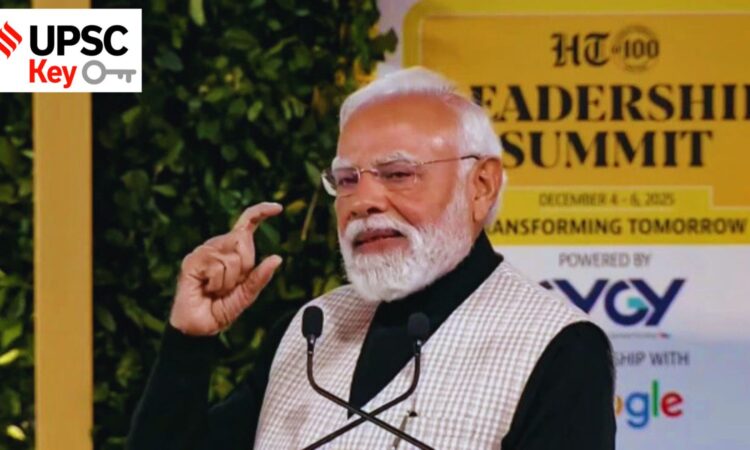
What’s the ongoing story: Prime Minister Narendra Modi Saturday urged people to completely rid the country of the “slave mentality” in the next 10 years, which he termed as the biggest hindrance to the country’s development journey, while hitting out at the “so-called intellectuals” for trying to malign an entire civilisation by terming years of sluggish economic growth as Hindu rate of growth.
Key Points to Ponder:
— What is the “Hindu rate of growth”?
— Who coined the phrase Hindu rate of growth?
— When did India outgrow the Hindu rate of growth?
— Read about the next generation GST reforms.
— Who was Macaulay?
— What was Macaulay’s Minute on Indian Education?
— What is the Downward Filtration Theory?
Key Takeaways:
— “Today, the world is filled with uncertainties but in this era, our Bharat appears in a different league altogether. India is overflowing with self-confidence,” the Prime Minister said at the Hindustan Times Leadership Summit, adding that the country was scripting “the story of growth”. India, he said, is becoming a pillar of trust.
— Referring to the country’s 8.2% growth in Q2 this fiscal, PM Modi said, “… This is a message that Bharat is today becoming a growth driver of the global economy… Bharat has become a model of high growth and low inflation.”
Story continues below this ad
— The PM said, “Our Northeast, our villages, our Tier-2 and Tier-3 cities, Nari Shakti, innovative youth power, naval power, blue economy, the space sector—all held immense potential which couldn’t be used in earlier decades. Bharat is now moving forward with the vision of tapping this vast and previously unrealised potential.”
— Terming next-gen GST the biggest of all reforms in 2025, he said there has also been a significant reform in the direct tax system with zero tax on income of Rs 12 lakh.
— “… Today Bharat is the world’s fastest growing economy; some call Bharat a global growth engine, some a global powerhouse… but did you hear anyone call it ‘Hindu rate of growth’?” he said, and reminded the audience that the term was used at a time when India struggled even to reach a growth rate of 2-3%.
— “The message being pushed was that India’s slow growth was somehow the consequence of Hindu civilisation itself. And those who now communalise every issue had no objection to this term then. This term became part of books and research papers,” he said, adding that an entire society was reduced to a synonym for poverty.
Story continues below this ad
— “The policy of Macaulay, which sowed the seeds of mental slavery in India, will complete 200 years in 2035. This means there are 10 years left. Therefore, in these very 10 years, we all must come together to free our country from the slave mentality,” he said.
— The PM said that the “slave mentality” destroyed India’s indigenous manufacturing sector. “Even during the colonial era, Bharat was a big producer of arms and ammunition. Weapons were exported from India. But after Independence, our defence manufacturing ecosystem was destroyed. The slave mentality took hold to such an extent that people sitting in government started seeing weapons being made in India as inferior, and this made India one of the biggest importers of defence equipment.”
Do You Know:
— The term “Hindu” in the Hindu rate of growth does not, in fact, have a negative connotation. According to The New Oxford Companion to Economics in India, economist Raj Krishna coined the expression as “a polemical device intended to draw attention to the meagre 3.5 per cent growth rate experienced by India over the long run. The fact that this rate of growth remained steady through changes in governments, wars, famines, and other crises, made it for him an inherently cultural phenomenon—hence the name.”
— Notably, Krishna’s views diverged from the ideologies of the Congress-led governments of the time. Fellow economist Pulapre Balakrishnan described him as “Chicago-trained and, in the political climate of the time, with a reputation for being somewhat of a right-winger” in his essay, “The recovery of India: Economic growth in the Nehru era”.
Story continues below this ad
— GDP growth data indicate that India had surpassed the Hindu rate of growth long before the 1991 liberalisation reforms were introduced. This was argued by economist Baldev Raj Nayar in a 2006 Economic and Political Weekly article. He said while liberalisation accelerates growth, “it is equally true, as more recent work by economists has shown, of the within-system economic policy reforms of the 1980s.”
— Between 1956 and 1975, India’s average annual GDP growth was 3.4%, matching the Hindu rate of growth. However, growth averaged 5.8% between 1981 and 1991, a full decade before the 1991 crisis and reforms. Economists such as Arvind Virmani and Arvind Panagariya have identified 1980, or the 1980s, as the turnaround, crediting reforms by Indira Gandhi (post-Emergency) and Rajiv Gandhi.
— Nayar argues the first liberalisation phase began in 1975, the Emergency year itself, citing GDP growth averaging 5.6% from 1976-2006, well above the Hindu rate.
Other Important Articles Covering the same topic:
Story continues below this ad
📍Worse than Hindu rate of growth
Previous year UPSC Prelims Question Covering similar theme:
(1) Increase in absolute and per capita real GNP do not connote a higher level of economic development, if: (UPSC CSE 2018)
(a) Industrial output fails to keep pace with agricultural output.
(b) Agricultural output fails to keep pace with industrial output.
(c) Poverty and unemployment increase.
(d) Imports grow faster than exports.
Story continues below this ad
FRONT
Diplomatic tightrope: Red carpet for Putin, now Delhi works on dates for Zelenskyy visit
Syllabus:
Preliminary Examination: Current events of national and international importance.
Mains Examination: General Studies-II: Bilateral, regional and global groupings and agreements involving India and/or affecting India’s interests.
What’s the ongoing story: As Russian President Vladimir Putin concluded his two-day visit to India December 5, New Delhi was preparing the next steps in a careful diplomatic balancing act: moves are afoot to schedule a possible visit by Ukrainian President Volodymyr Zelenskyy to India in the coming months, The Indian Express has learnt. The visit could take place as early as January 2026.
Key Points to Ponder:
— Read about the Ukraine-Russia war.
— What is the stand of India on Russia-Ukraine war?
— What were the major outcomes of the India-Russia annual summit?
— Know about the India-Russia relations.
Story continues below this ad
— What are the other areas of cooperation between India and Russia?
— How is the pressure from the US impacting the bilateral relationship between India and Russia?
Key Takeaways:
— A Zelenskyy visit would reinforce Delhi’s effort to stay engaged with both sides of the Russia–Ukraine war, following the same calibrated approach adopted last year. In July 2024, Prime Minister Narendra Modi travelled to Moscow and met Putin; a month later, in August, he had visited Ukraine.
— Sources said discussions between Indian and Ukrainian officials have been ongoing for several weeks, with New Delhi in touch with Zelenskyy’s office even before Putin arrived in India.
Story continues below this ad
— The timing and scope of the proposed visit will depend on multiple factors, including how former US President Donald Trump’s peace plan unfolds and developments on the battlefield. Domestic politics in Ukraine, where Zelenskyy’s government is currently under pressure embroiled in a sweeping corruption scandal, could also influence the outcome.
— Notably, Ukraine has sent Presidents to India only three times: 1992, 2002 and 2012. Putin’s visit has drawn close scrutiny from Europe, with several European envoys urging India to use its influence to push Moscow towards ending the war. Delhi, however, consistently maintained that dialogue and diplomacy remain the only viable path forward with Modi framing it as: “India is not neutral, India is on the side of peace.”
— India has stayed in touch with both Putin and Zelenskyy since the war began in February 2022. Modi has spoken to Zelenskyy by phone at least eight times, and the two leaders have met on at least four occasions.
— Their most recent conversation was on August 30, when Modi reached Tianjin, China, for the Shanghai Cooperation Organisation summit and was to meet Putin on the sidelines. Sources said India has since remained in touch with both Kyiv and Moscow on evolving peace initiatives, including the latest Trump proposal.
— The war has also begun to have a more direct impact on India. The 25 per cent penalty tariffs imposed by Trump for buying Russian oil has forced Delhi to cut its Russian crude imports since September, as secondary sanctions and tariff pressures kicked in.
— Officials pointed to the readout issued by the Prime Minister’s Office after the Modi-Zelenskyy call on August 30 this year, which said Modi had reaffirmed India’s “steadfast and consistent position for peaceful settlement of the conflict” and its readiness to extend “all possible support”.
Do You Know:
— India-Russia bilateral relations date back seven decades. The bilateral diplomatic relations have gone through several periods since their formal establishment in 1947 but have remained strong and even grown. The recent visit of Prime Minister Modi to Russia demonstrates India’s commitment to its partnership with Russia as it has been a longstanding and reliable partner for India. The India-Russia relations have been a key pillar of India’s foreign policy.
Other Important Articles Covering the same topic:
📍Putin’s visit: The long arc of India’s ties with Russia, the road ahead
📍UPSC Issue at a Glance | India-Russia Relations: 4 Key Questions You Must Know for Prelims and Mains
Previous year UPSC Prelims Question Covering similar theme:
(2) Recently, India signed a deal known as ‘Action Plan for Prioritization and Implementation of Cooperation Areas in the Nuclear Field’ with which of the following countries? (UPSC CSE 2019)
(a) Japan
(b) Russia
(c) The United Kingdom
(d) The United States of America
Previous year UPSC Mains Question Covering similar theme:
What is the significance of Indo-US defence deals over Indo-Russian defence deals? Discuss with reference to stability in the Indo-Pacific region. (UPSC CSE 2020)
NATION
Quad, US back India in war against terror
Syllabus:
Preliminary Examination: Current events of national and international importance.
Mains Examination: General Studies-II, III: Bilateral, regional and global groupings and agreements involving India and/or affecting India’s interests, Role of external state and non-state actors in creating challenges to internal security.
What’s the ongoing story: At a time when ties between India and the US are strained over punitive tariffs, New Delhi and Washington have come together to cooperate on counter-terrorism. And, the Quad members also joined in Delhi to work on ways to expand cooperation to combat terrorism under the framework of the grouping.
Key Points to Ponder:
— Read about the Quad.
— What is the significance of the Quad for India?
— India’s counter-terrorism doctrine—Know its evolution.
— Read about Operation Sindoor.
— Know about the Financial Action Task Force (FATF).
— What are the key counter-terrorism bodies globally?
— What are the challenges faced by India in preventing terrorism?
Key Takeaways:
— Officials from India, US, Japan and Australia met in Delhi for the two-day Quad Counter Terrorism Working Group meeting this week and “unequivocally condemned terrorism in all its forms and manifestations, including cross-border terrorism”.
— Separately, Indian and US officials also held a meeting of their joint working group (JWG) on counter-terrorism and ‘designations dialogue’ on December 3 in New Delhi.
— During the meeting, India and the US sought additional punitive measures like asset freeze and arms embargo by the UN against Pakistan-based terror outfits Lashkar-e-Taiba, Jaish-e-Mohammad, their proxy groups and backers.
— The two sides also called for additional designations of ISIS and al-Qaeda affiliates. These terror groups were designated by the UN and they have already been facing various punitive actions under the global body’s sanctions regime.
— In the talks, the Indian side thanked the US State Department for designating The Resistance Front (TRF), a proxy of LeT, as both a Foreign Terrorist Organisation (FTO) and a Specially Designated Global Terrorist (SDGT).
— The two sides emphasised that confronting terrorism requires concerted action in a sustained and comprehensive manner, according to a joint statement released Saturday. Against this backdrop, the two sides renewed their commitment to strengthening multilateral cooperation in countering terrorism, including in the UN, Quad and the Financial Action Task Force (FATF).
— The meetings underscored the importance of bilateral cooperation in countering terrorism, reflecting the “spirit and breadth” of the India-US Comprehensive Global Strategic Partnership, the statement said.
— It said the two sides strongly condemned the terrorist attack in Pahalgam and the recent heinous terror incident near the Red Fort, while stressing that those responsible for terrorism should be held accountable.
— India and the US also discussed strengthening law enforcement and judicial cooperation, including through information sharing and cooperation on mutual legal assistance requests.
— The Quad grouping called for bringing the perpetrators, organisers and financiers of last month’s terror incident to justice and urged all UN member states to cooperate on it.
Do You Know:
— India launched ‘Operation Sindoor’ after the terror attack in Pahalgam, hitting nine terror locations in Pakistan and Pakistan-occupied Kashmir (PoK). This marked the most expansive and widespread retaliation by India in recent years, since the Balakot airstrikes in 2019 and the surgical strikes following the Uri attack in 2016. The attacks were made at nine locations, which were terrorist infrastructure in Pakistan and Pakistan-occupied Kashmir.
— Quadrilateral Security Dialogue (Quad) is the informal strategic dialogue between India, USA, Japan and Australia. The four nations share a common objective to ensure and support a “free, open and prosperous” Indo-Pacific region.
Previous year UPSC Prelims Question Covering similar theme:
(3) Which of the following countries is/are part of the QUAD grouping?
1. India
2. Canada
3. Japan
4. United Kingdom
5. France
6. Australia
Select the correct answer using the codes given below:
(a) 2, 3, 4 and 6
(b) 1, 3, 5 and 6
(c) 1, 2, and 4 only
(d) 1, 3 and 6 only
Previous year UPSC Mains Question Covering similar theme:
Quadrilateral Security Dialogue (Quad) is transforming itself into a trade bloc from a military alliance, in present times. Discuss. (UPSC CSE 2020)
Analyse the complexity and intensity of terrorism, its causes, linkages and obnoxious nexus. Also suggest measures required to be taken to eradicate the menace of terrorism. (UPSC CSE 2021)
OPINION
Why ED’s conviction of 2 MLAs under PMLA is relevant now
Syllabus:
Preliminary Examination: Indian Polity and Governance-Constitution, Political System, Panchayati Raj, Public Policy, Rights Issues, etc.
Mains Examination: General Studies-II, III: Statutory, regulatory and various quasi-judicial bodies. Money-laundering and its prevention.
What’s the ongoing story: Chakshu Roy writes- “In March 2005, the Jharkhand police stormed an aeroplane about to take off from Ranchi’s Birsa Munda Airport. They were looking for two newly elected MLAs, Hari Narayan Rai, 42, and Enos Ekka, 35. Finding the MLAs was critical, as they were the missing pieces in deciding the new Chief Minister of Jharkhand.”
Key Points to Ponder:
— Read about the Enforcement Directorate, its functions and powers.
— What are the key laws enforced by the Enforcement Directorate?
— Know about the Prevention of Money Laundering Act (PMLA), 2002.
— What are the concerns related to the operational independence of ED?
— How does the Enforcement Directorate’s role intersect with federal principles enshrined in the Indian Constitution?
Key Takeaways:
— “The Opposition has refused to join it, stating that the legislation gives investigating agencies like the Enforcement Directorate (ED) the power to remove the PM/CMs/ministers before guilt is proven and to destabilise popularly elected governments. Rai and Ekka are the only two political personalities that the ED has convicted in the last decade.”
— “In 2005, the Centre entrusted the ED with enforcing the Prevention of Money Laundering Act (PMLA), 2002, to prevent the laundering of the proceeds of crime and to confiscate property derived from such activity. Subsequent amendments to the law would make it more stringent and give the ED more teeth. Scrutinising the 2008 PMLA Amendment, a parliamentary panel comprising MPs such as Gurudas Dasgupta, Suresh Prabhu and M Venkaiah Naidu hoped that enforcement agencies would exercise the powers granted to them judiciously.”
— “Earlier this year, the government told Parliament that in the past decade the ED has charged 193 politicians, securing convictions in only two cases.”
— “As Parliament takes up electoral reforms next week and the committee begins scrutinising the 130th Constitution Amendment Bill, MPs will confront two questions raised by the Rai and Ekka case: how to address the long interval between allegations and convictions, and the low conviction rate of prosecuting agencies in political cases.”
Do You Know:
— The ED was established on May 1, 1956, as the ‘Enforcement Unit’ under the Department of Economic Affairs within the Ministry of Finance for handling violations of exchange control laws under the now-repealed Foreign Exchange Regulation Act, 1973 (FERA). Later on, it was renamed the Enforcement Directorate and was transferred to the administrative control of the Department of Revenue, and subsequently entrusted with the enforcement of a broader range of financial laws.
— The enactment of the Foreign Exchange Management Act (FEMA), which replaced FERA in 1999, and the Prevention of Money Laundering Act (PMLA) in the early 2000s, increased the power of ED. These moves aligned its functions with international standards to combat financial crimes, notably those recommended by the Financial Action Task Force (FATF).
Other Important Articles Covering the same topic:
📍As SC raps ED, a look at agency’s powers, role and red lines
UPSC Prelims Practice Question Covering similar theme:
(4) Consider the following:
1. Exchange between virtual digital assets and fiat currencies.
2. Exchange between one or more forms of virtual digital assets.
3. Transfer of virtual digital assets.
4. Safekeeping or administration of virtual digital assets or instruments enabling control over virtual digital assets.
How many of the above are covered under the Prevention of Money Laundering Act?
(a) Only one
(b) Only two
(c) Only three
(d) All four
ECONOMY
Rupee’s journey from 80 per dollar to 90:The role of trade, FDI, and RBI
Syllabus:
Preliminary Examination: Current events of national importance and economy.
Mains Examination: General Studies-III: Indian Economy and issues relating to planning, mobilisation of resources, growth, development and employment.
What’s the ongoing story: The rupee’s exchange rate against the US dollar crossing the 90 mark this week may have grabbed considerable attention, but the underlying dynamics have been playing out for quite some time now. With plenty of uncertainty around geopolitical and trade, the Reserve Bank of India (RBI) intervened heavily – until it didn’t, or at least stepped back somewhat.
Key Points to Ponder:
— What is depreciation of a currency?
— What is the Exchange Rate?
— What are the different types of the Exchange rate system?
— How do the demand and supply of the currency affect the Exchange rate?
— What is the strengthening and weakening of a currency?
— What are the factors behind the fall of the Indian Rupee?
— What is the current account balance?
Key Takeaways:
— After breaching the 80-per-dollar mark in July 2022 following the supply chain shock caused by Russia’s invasion of Ukraine earlier that year in February, the rupee’s exchange rate has moved south pretty quickly, taking just three-and-a-half years to hit 90. This has occurred despite India’s current account balance easing sharply from a deficit of $31 billion in July-September 2022 to even being in surplus for a couple of quarters.
— India’s current account balance is largely driven by the goods trade deficit, or the excess of what the country pays for its merchandise imports over what it receives for its exports.
— Capital flows have indeed been an issue, with Foreign Portfolio Investors (FPIs) pulling out almost $18 billion on a net basis from Indian equity markets in 2025 alone. And non-equity FPI inflows, while positive, have been only half that.
— Outbound FDI by Indian companies and repatriation of money put in by foreign investors in previous years picked up sharply starting 2023, such that they total $60 billion in the first nine months of 2025, on track to reach 2024’s $80 billion, resulting in a net FDI inflow of just under $3 billion.
— Net FDI is calculated after adjusting for investments that are repatriated by foreign companies and overseas investments made by Indian companies.
— All of the above put pressure on the rupee to depreciate. If it happens too fast in the RBI’s opinion, then it intervenes in the foreign exchange market to stabilise the exchange rate by selling foreign currency – which increases its supply – to buy rupees – thus pushing up demand for it. And the RBI sold as much as $400 billion of foreign currency in 2024-25, with the central bank particularly active in the run-up and post the US presidential elections of last year that saw Donald Trump return to the White House.
— However, the RBI’s interventions have eased significantly in 2025-26 – coinciding with Sanjay Malhotra becoming the governor of the RBI – adding up to just $44 billion in the first half of the fiscal on a gross basis, indicating a “higher tolerance” for rupee depreciation, according to Gaura Sen Gupta, Chief India Economist at IDFC First Bank. Sen Gupta sees the rupee at 91 per dollar by September 2026, even if India and the US announce a trade deal by March 2026.
— Intervention by a central bank does not only show up in its foreign currency sales; it can also check the rupee’s fall by selling dollars in the forwards market – essentially creating the exchange rate impact dollar sales have without actually selling them right now, but at a later, predetermined date. This is especially useful because the act of selling dollars to buy rupees creates a shortage of the latter, driving up rupee interest rates. At a time when the RBI is busy cutting interest rates, such a move would be counterproductive. This makes forward sales particularly useful as they don’t influence the current rupee supply.
Do You Know:
— The rate at which one can swap between currencies is the exchange rate. In other words, how many rupees would buy you a dollar or a euro.
— In such a market — also referred to as the currency market — each currency is like a commodity itself. The value of each currency relative to another currency is called the exchange rate. These values can stay the same over time but more often than not they keep changing.
Other Important Articles Covering the same topic:
📍India’s rupee continue to fall against US dollar: what determines exchange rate?
📍Currency decline: What it means for retail segment, how to de-risk exposure
Previous year UPSC Prelims Question Covering similar theme:
(5) With reference to the Indian economy, consider the following statements: (UPSC CSE 2022)
1. An increase in Nominal Effective Exchange Rate (NEER) indicates the appreciation of rupee.
2. An increase in the Real Effective Exchange Rate (REER) indicates an improvement in trade competitiveness.
3. An increasing trend in domestic inflation relative to inflation in other countries is likely to cause an increasing divergence between NEER and REER.
Which of the statements given above are correct?
(a) 1 and 2 only
(b) 2 and 3 only
(c) 1 and 3 only
(d) 1, 2 and 3
ALSO IN NEWS |
|
| US negotiators in Delhi next week, trade talks may get fresh impetus | A US trade team led by Deputy US Trade Representative Rick Switzer is set to visit India next week to iron out differences such that the long-pending bilateral trade agreement (BTA) is signed before December-end, a source aware of the developments said. Switzer and Brendan Lynch, the US chief negotiator for the trade deal with India, are expected to meet Commerce Secretary Rajesh Agrawal for the final talks ahead of the agreement. Negotiations with the US had commenced after Prime Minister Narendra Modi visited the US in February this year. The meeting comes close on the heels of Russian President Vladimir Putin’s two-day visit to India when the two countries decided to boost bilateral trade to $100 billion by 2030 from $64 billion now, and increase domestic currency trade. |
| Bengal Tiger makes surprise visit to Bageshwar’s subalpine zones | A government project has revealed the presence of the Bengal Tiger at an altitude of 3,010 metres in Bageshwar district’s Sunderdhunga glacier valley. A camera trap captured the image of a tiger moving through dense subalpine forest. The project “Securing Snow Leopard Habitat and Alpine Ecosystems in the Kumaon Himalayas” is being undertaken under the Uttarakhand Forest Department, supported under the National Mission for Green India of the Ministry of Environment, Forests and Climate Change. A camera trap with a timestamp from May 16 captured a Bengal tiger, making it one of the highest verified records of the species in this region. Forest officials estimate that this is the second sighting of a tiger in the Bageshwar division. |
| PRELIMS ANSWER KEY |
| 1. (c) 2. (b) 3. (d) 4. (d) 5. (c) |
Subscribe to our UPSC newsletter. Stay updated with the latest UPSC articles by joining our Telegram channel – IndianExpress UPSC Hub, and follow us on Instagram and X.
🚨 Click Here to read the UPSC Essentials magazine for November 2025. Share your views and suggestions in the comment box or at manas.srivastava@indianexpress.com🚨