India Currency in Circulation Hits ₹40 Lakh Crore as UPI Transactions Reach Record ₹28.3 Lakh Crore in January 2026 SBI Research Highlights Digital Shift
So is India becoming more cash-heavy or more digital?
In the latest Ecowrap report released February 16, SBI Research highlights that the apparent contradiction masks a deeper structural shift: incremental GDP growth is increasingly being financed by digital payments, even as absolute currency levels rise alongside economic expansion. But it also sounds a warning — never disincentivise digital payments or UPI.
Currency at record high — but context matters
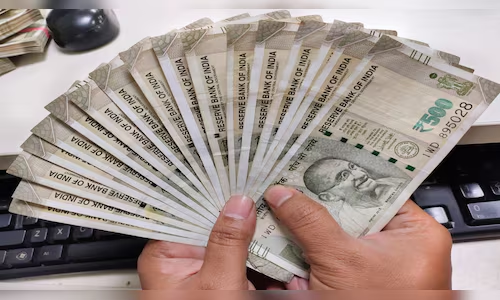
According to SBI Research, currency in circulation rose 11.1% year-on-year to ₹40 lakh crore in January 2026, compared with 5.3% growth in the same period last year. On a year-to-date basis (April 2025–January 2026), CiC expanded by ₹2.76 lakh crore — more than three times the ₹88,817 crore increase seen in the corresponding period last year.
Currency with the public (CWP), which constitutes nearly 97.6% of CiC, also climbed to ₹39 lakh crore, growing 11.5% YoY. If current trends persist, incremental CWP growth in FY26 could surpass the post-pandemic FY21 spike of ₹4.6 lakh crore.
Yet, cash as a percentage of GDP has declined to 11% in FY26 from 14.4% in FY21. ATM withdrawals as a share of GDP are also falling.
This means that while the stock of cash is expanding in nominal terms, its relative importance in the economy is shrinking. SBI’s estimated money demand model confirms this structural transition: GDP growth has a positive but statistically insignificant coefficient in explaining money demand, while UPI transaction value is significantly negative — indicating that digital payments are substituting cash at the margin.
In other words, the direction of change in GDP and currency may be aligned, but incremental growth is increasingly being financed through UPI rather than cash.
Why is cash still rising?
SBI Research identifies four key reasons behind the rise in currency, even amid record digital adoption.
- GST notices and behavioural shifts
In July 2025, Karnataka reportedly issued around 18,000 GST demand notices to small traders based on UPI transactions exceeding the ₹40 lakh registration threshold.
To test whether this triggered a shift back to cash, SBI Research used an intensity-based Difference-in-Differences (DiD) framework across Karnataka and four other states — West Bengal, Kerala, Bihar and Chhattisgarh — using district-level ATM withdrawal data from January 2025 to January 2026.
The findings are telling. In Karnataka, districts with above-average pre-July ATM withdrawals saw an additional ₹37 crore per month increase in ATM withdrawals after the GST notice announcement, relative to low-intensity districts.
Even excluding Bengaluru Urban, the incremental rise was ₹10 crore per month and statistically significant.
Significant effects were also observed in West Bengal and Kerala, suggesting a signalling effect beyond Karnataka. Bihar and Chhattisgarh showed insignificant results.
The implication is clear: policy actions perceived as penalising digital trails may nudge traders and consumers back toward cash — even if temporarily.
For a country that has built a globally admired digital payments infrastructure, this is a sensitive balancing act.
- Lower interest rates and sluggish deposits
As of end-January 2026, deposit growth stood at 10.6% — modest compared with the pace of currency expansion.
SBI’s augmented money demand function shows that demand for money is negatively correlated with interest rates and positively correlated with GDP. Lower interest rates reduce the opportunity cost of holding cash, particularly in rural areas where precautionary demand remains strong.
Tax cuts and rising consumption may have further supported transactional cash demand in urban areas, suggesting that some of the increase in cash reflects cyclical liquidity preferences rather than structural reversal from digital.
- Precious metals and liquidity recycling
India’s gold imports have surged in FY25 and FY26, reaching levels not seen since FY13. Silver imports have also spiked sharply.
SBI Research argues that unlike the 2010-13 phase — when rising gold imports were associated with large cash purchases and financial “definancialisation” — this time households may be cashing out gold and silver amid elevated prices.
Such recycling of precious metals into liquidity could temporarily boost currency in circulation and household consumption.
This dynamic reflects financialisation in action — assets being monetised to fund spending — rather than a shadow cash economy.
- Denomination Shift After ₹2000 Withdrawal
Following the withdrawal of ₹2000 notes (announced on May 19, 2023), India’s currency mix has shifted decisively.
As of March 2025:
1.) ₹500 notes account for 86% of total currency value.
2.) The share of ₹2000 notes has collapsed to 0.02% from 11.3% in FY23.
SBI’s analysis of currency chest data indicates that the value share of ₹500 notes may have risen another 4.4% in FY26 (April–January).
Meanwhile, RBI has directed banks to increase the availability of ₹100 and ₹200 notes in ATMs, targeting 96% ATM coverage by March 2026.
However, according to NPCI data cited in the report, 86% of person-to-merchant (P2M) UPI transactions by volume are below ₹500.
This means UPI is primarily substituting lower denomination notes — ₹50, ₹100 and ₹200 — rather than the ₹500 note. High-value cash transactions remain relatively resilient.
What does this mean for the economy?
The coexistence of high cash and high UPI reflects a growing, diversifying economy rather than a reversal of digitalisation.
With nominal GDP expanding, the absolute demand for currency naturally rises. RBI, which follows the Minimum Reserve System, calibrates currency issuance based on nominal GDP projections, replacement of soiled notes and seasonal demand.
But the declining cash-to-GDP ratio and the strong negative relationship between UPI value and money demand indicate a structural digital deepening.
For the economy, this implies:
- Formalisation is still progressing, as evidenced by digital transaction dominance.
- Liquidity preferences remain influenced by interest rates and behavioural signals.
- Regulatory messaging can materially alter payment choices.
For citizens and small businesses, the message is equally nuanced:
- Digital payments are entrenched in low-ticket transactions.
- Cash retains relevance in higher-value and precautionary contexts.
- Policy certainty around digital compliance matters.
The bottom line
India’s ₹40 lakh crore currency headline should not be misread as a retreat from digitalisation.
UPI at ₹28 lakh crore per month underscores the scale of digital adoption. The fall in cash-to-GDP ratio reinforces the structural shift.
But SBI Research’s warning is unambiguous: any perceived disincentive to digital payments can trigger measurable behavioural responses.
In a system where incremental growth is increasingly financed through UPI, policy must reinforce trust in digital rails — not undermine it.
The puzzle of “high cash and high UPI” may define India’s transition phase. The direction of travel, however, remains decisively digital.