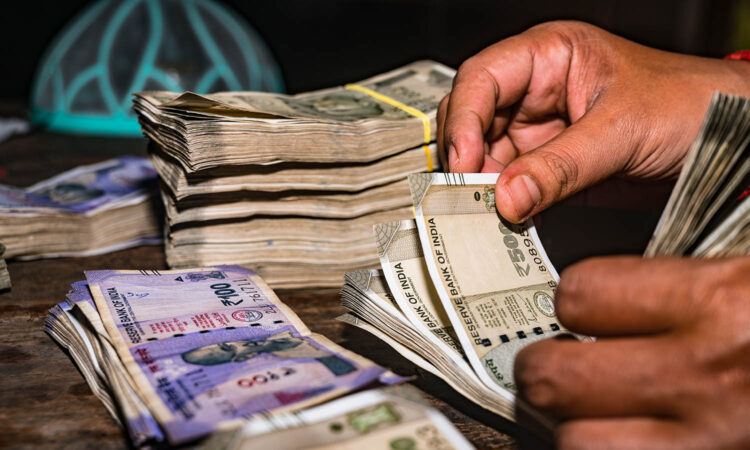
The central banks of Nepal and India are exploring the possibility of using the interbank market—one of the most important segments of the foreign exchange system—to allow the transfer of Indian currency between banks in the two countries in large volumes.
Although Nepal formally allowed the circulation of Indian currency notes above INR100 up to a limit of INR 25,000 per person by publishing a notice in the Nepal Gazette on January 12, Nepal Rastra Bank (NRB), the country’s central bank, has yet to issue a circular implementing the provision for banks and financial institutions.
Guru Prasad Paudel, spokesperson for Nepal Rastra Bank, said that NRB and the Reserve Bank of India (RBI), the central bank of India, are in discussions to allow Indian currency to be transferred in any amount through the banking systems of the two countries.
Nepal’s central bank awaits formal response from the Indian central bank after the latter committed to simplifying the process.
“This will be a big breakthrough,” Paudel said. “It will ensure that deposits of Indian currency do not create a burden on Nepal’s banks, while Nepali banks will be able to get Indian currency in any amount through digital transactions.”
He said the arrangement would also ensure that Indian currency deposited in Nepali banks—regardless of volume—can be transferred to Indian banks. Likewise, Nepali banks would be able to receive Indian currency in any amount from Indian banks upon request.
The move is significant for Nepal, particularly in light of the estimated INR50 million worth of Indian currency that remains stacked at Nepal Rastra Bank after India refused to exchange the notes following its demonetisation drive.
Officials say the proposed interbank transfer facility would ensure that even if large volumes of Indian currency accumulate within the Nepali banking system, it would not disrupt financial stability as banks would have a mechanism to move the funds across the border.
On November 8, 2016, the Indian government demonetised INR500 and INR1,000 notes, citing the need to “unearth unaccounted wealth and fight corruption.” The demonetised notes were later replaced with new INR 2,000 notes.
Following India’s move, Nepal’s Cabinet decided on December 13, 2018 to ban Indian currency notes above INR100. Nepal Rastra Bank subsequently issued a circular on January 20, 2019 prohibiting Nepali travellers, banks and financial institutions from holding or transacting in such notes.
Paudel said NRB has kept on hold the issuance of a new circular allowing banks and financial institutions to handle Indian currency above INR100, even though the provision was published in the Nepal Gazette three weeks ago.
“As soon as the central banks of both countries agree on the fund transfer mechanism, we will issue the circulars,” he said.
Despite the absence of a circular for banks, individuals are legally allowed to carry Indian currency within the limits prescribed by law, and there is no blanket restriction on possession by the public, he said.
India’s central bank amended its Foreign Exchange Management (Export and Import of Currency) Regulations on November 28 last year, with the changes published in India’s official gazette on December 2.
According to the amended regulations, individuals may take Indian currency notes of any amount in denominations up to INR100 to Nepal and bring them back to India. In addition, they may carry notes of denominations above INR100 up to a total value of INR 25,000 per person in either direction.
Nepal, for its part, allows tourists—including Indian nationals—to bring in up to US$5,000 or its equivalent in other convertible currencies without declaration. Amounts above that threshold must be declared at customs, and visitors are not allowed to take more than $5,000 out of Nepal.
According to the Nepal Gazette, Nepali and Indian citizens may carry or send from Nepal to India an unlimited amount of Nepali and Indian coin currency and banknotes, except Nepali coins made of gold, silver or mixed silver. This effectively means that Nepali and Indian citizens may carry or send unlimited amounts of Indian currency in denominations below INR100.
However, no person is allowed to export or import foreign currency or Nepali currency beyond the prescribed limit without prior approval, except in cases permitted by prevailing laws and regulations.
Foreign nationals entering Nepal may bring foreign currency as allowed under existing rules. When leaving the country, they may take out only the amount declared at entry or legally exchanged within Nepal, subject to verification.
Any person importing currency above the prescribed limit must truthfully declare the amount at customs checkpoints. Failure to declare, false declaration, or carrying currency beyond the permitted threshold is considered an offense under prevailing law, and such currency is subject to confiscation along with other legal penalties.
The law also clearly states that no person is allowed to transact in Indian currency notes of denominations of INR500 and INR1,000 that were in circulation prior to November 9, 2016.
Indian currency notes of denominations of INR200 and INR500 that have been issued and are in circulation since November 9, 2016 may, however, be brought into Nepal from India or taken from Nepal to India by Nepali or Indian citizens, subject to a ceiling of INR25,000 per person.