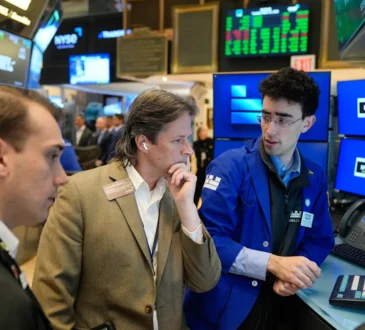
Dow, S&P 500, Nasdaq slip, chip stocks rise as Wall Street ends volatile week lower
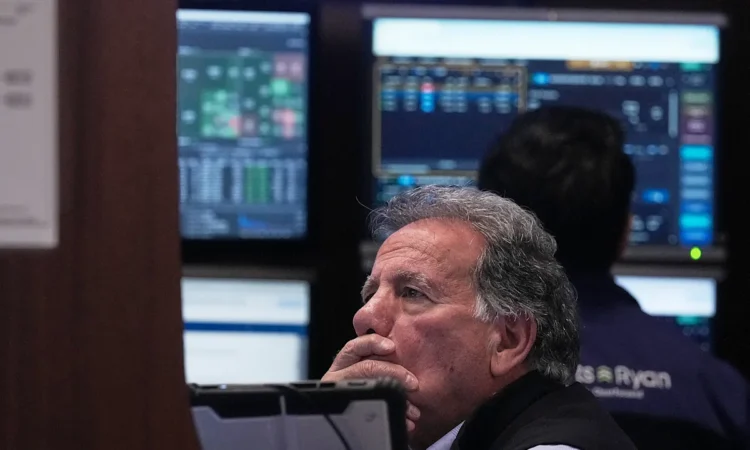
US stocks were little changed on Friday despite growing uncertainty over the next Fed chair, while strong bank earnings and ongoing geopolitical tensions capped a volatile week.
The tech-heavy Nasdaq Composite (^IXIC) fell below the flat line, while the S&P 500 (^GSPC) was little changed. The Dow Jones Industrial Average (^DJI) declined slightly, with all three major averages losing less than 1% for the week.
The Russell 2000 (^RUT) closed at a record high as the small-cap index extended year-to-date gains to 8%.
Stocks gave up earlier gains on Friday after President Trump expressed fresh reluctance to name Kevin Hassett as the next Fed chair, fueling speculation that the central bank may not be as dovish as the market expected once Jerome Powell steps down in May.
“I actually want to keep you where you are, if you want to know the truth,” he told Hassett at a White House event.
Wall Street is regrouping after a switchback week, marked by escalating Iran tensions, a dispute over Greenland, and a criminal probe risking the Federal Reserve’s independence — all with Trump behind them. Investors have a long weekend to digest those events, as stock and bond markets are closed on Monday for Martin Luther King Jr. Day.
TSMC (TSM) and Nvidia (NVDA) rose, thanks in part to a US-Taiwan trade deal that promises a $250 billion boost to American chip and tech manufacturing. On Thursday, shares in TSMC popped following a strong quarterly report that revived AI enthusiasm to buoy related stocks more widely.
Shares of regional banks such as PNC (PNC) and Regions Financial (RF) rose on the heels of quarterly results following strong performance from Wall Street majors. Goldman Sachs (GS) and Morgan Stanley (MS) shares rose Thursday after posting profit gains, giving a lift to financial stocks.
Meanwhile, silver (SI=F) fell as the threat of US tariffs eased, but prices were still up more than 15% for the week after a long-lived blistering rally for precious metals.
LIVE COVERAGE IS OVER 23 updates
-
Stocks post weekly loss as Trump wavers on Kevin Hassett as next Fed Chair
Stocks ended the slight losses as the tech-heavy Nasdaq Composite (^IXIC), the S&P 500 (^GSPC) also the Dow Jones Industrial Average (^DJI) all shed less than 1% for the week.
The major averages opened with gains but dipped into red territory mid-morning after President Trump expressed reluctance about naming Kevin Hassett as the next Fed chair, putting into question how dovish the Fed will be once Fed Chair Jerome Powell’s term ends in May.
Semiconductor stocks ended the week with gains, but software names were hit over the threat of AI on their businesses.
Meanwhile, the Russell 2000 small-cap index (^RUT) Russell 2000 closed at a record high as the small-cap index is up 8% year-to-date.
The New York Stock Exchange, Nasdaq, and bond markets will be closed on Monday, Jan. 19, in observance of Dr. Martin Luther King Jr. Day.
-
Are US markets closed on MLK Day?
The New York Stock Exchange, Nasdaq, and bond markets will be closed on Monday, Jan. 19, in observance of Dr. Martin Luther King Jr. Day.
You can still place orders to buy and sell stocks and exchange-traded funds (ETFs) during extended trading hours, though there is added risk. And unlike the stock and bond markets, investors can trade crypto around the clock.
When there’s a major holiday, chances are that stock markets will close. Here’s a look at the remaining stock market holidays for 2026:
-
‘Structure trend of AI’ will power stocks: UBS
The AI tech trade is intact, and expected to power stocks this year, say UBS strategists.
“We maintain our conviction that the structural trend of AI will continue to power equity performance in the years ahead, and believe exposure to AI-related stocks is essential for long-term wealth preservation and appreciation,” wrote Ulrike Hoffmann-Burchardi, global head of equities at UBS Global Wealth Management in a note.
The AI trade has powered the market gains in 2025, but catch-up companies are expected to also benefit from the application of artificial intelligence in their businesses.
“Our top picks in this regard remain financials and health care, which are also supported by favorable fundamentals,” said Ulrike Hoffmann-Burchardi.
-
Small-cap stocks on track for record high. Is it time to get on board?
After being out of favor for a long time, small-cap stocks are finally having their moment.
The Russell 2000 small-cap index (^RUT) rose 0.5% on Friday and is on track to close the week with a record high. The index has outperformed the S&P 500 (^GSPC) for 11 days in a row, its longest streak since 2008.
Year to date, the Russell 2000 has gained 8.4%, while the S&P 500 large-cap index is up 1.6%.
According to Royce Investment Partners co-chief investment officer Francis Gannon, the earnings-driven setup for small caps is ideal. Lower interest rates also help, Gannon said, noting that 40% of the debt within the Russell 2000 is variable.
“I think that leadership shift continues, and it’s going to be driven by the fact that small-cap earnings, which have been in an earnings recession for two years and change, are actually just at the beginning of taking off,” Gannon said.
“The opportunity in small caps is quite large,” he added, “and typically when you see small caps begin to outperform, it can last over a decade. So get on board.”
-
Fed’s Bowman sees risks to job market, says Fed ‘should be ready’ to cut rates
Yahoo Finance’s Jennifer Schonberger reports:
-
Walmart overhauls executive ranks, John Furner set to take CEO role at month’s end
Walmart (WMT) announced a slew of executive changes just two weeks before its CEO transition that will see John Furner take over from Doug McMillon.
The shakeups started late Thursday, when the company announced that its CEO of Walmart International, Kathryn McLay, would depart on Jan. 31. McLay will stay through the first quarter “to help ensure a smooth transition,” the company said.
Taking Furner’s role as Walmart US CEO will be David Guggina, who currently oversees all US e-commerce operations. Before joining Walmart, Guggina held various roles at Amazon (AMZN) for nearly a decade.
Current Sam’s Club CEO Chris Nicholas was named CEO of Walmart International. Nicholas joined Walmart in 2018 and served as CFO for Walmart International and CFO of Walmart US, as well as chief operating officer for its US operations.
Taking Nicholas’s role leading Sam’s Club will be Latriece Watkins, who is currently the Walmart US chief merchandising officer. Watkins joined the company as an intern in 1997.
Other changes include a new role of chief growth officer for the entire company, which will be taken up by Seth Dallaire, who holds the same role for Walmart US. The company is set to report its fourth quarter and full-year earnings results on Feb. 19.
-
Trump says he may use tariffs in pursuit of Greenland
President Donald Trump said on Friday that he may apply tariffs on countries “if they don’t go along” with his plan to acquire Greenland.
He made the comments at a White House event.
“I may put a tariff on countries if they don’t go along with Greenland, because we need Greenland for national security,” said Trump.
Trump has stated in the past that the US should control Greenland, saying a negotiated deal would be “easier,” but also insisting the United States will get it “one way or the other.”
-
Homebuilder sentiment unexpectedly declines as affordability ‘takes a toll’
Homebuilder sentiment unexpectedly fell in January in a sign of a cooling housing market to start 2026 as affordability concerns remain top of mind for builders, buyers, and sellers.
The National Association of Home Builders/Wells Fargo Housing Market Index declined by two points to 37 in January. It marked the index’s first drop in five months and the 21st month the index has remained below the neutral reading of 50.
Economists were expecting homebuilder sentiment to tick up one point to 40.
“While the upper end of the housing market is holding steady, affordability conditions are taking a toll on the lower and mid-range sectors,” NAHB chairman Buddy Hughes said. “Buyers are concerned about high home prices and mortgage rates, with downpayments particularly challenging given elevated price to income ratios.”
Homebuilders have been trying to entice buyers by offering more sales incentives. According to the latest NAHB survey, 40% of builders reported cutting prices in January with an average price reduction of 6%, up from 5% price cuts in December.
Homebuilder stocks D.R. Horton (DHI), Lennar (LEN), and PulteGroup (PHM) slipped during afternoon trading Friday.
-
Stocks turn negative after Trump hints he may not pick Kevin Hassett as next Fed Chair
Stocks erased gains by mid-morning on Friday and slipped into the red territory after President Trump expressed reluctance about naming Kevin Hassett as the next Fed chair.
The tech-heavy Nasdaq Composite (^IXIC) dropped 0.4%, while the S&P 500 (^GSPC) also swung from gains to losses. The Dow Jones Industrial Average (^DJI) dropped 0.3%.
The drop came after President Trump said he’d like to keep Hassett as director of the National Economic Council rather than picking him to replace Fed Chair Jerome Powell when the central bank chair’s term ends in May.
“I actually want to keep you where you are, if you want to know the truth,” Trump said to Hassett during a White House event. “If I move him, these Fed guys — certainly the one we have now — they don’t talk much. I would lose you. It’s a serious concern to me.”
Hassett has been viewed as a top contender for the job, with the market anticipating a dovish Fed if Trump were to select him.
-
Spotify will net an eye-popping amount of money by raising prices again
Yahoo Finance’s Brian Sozzi writes:
-
Stocks climb at the open
US stocks climbed Friday to reverse or, at the very least, pare losses for the week.
The tech-heavy Nasdaq Composite (^IXIC) rose roughly 0.5%, while the S&P 500 (^GSPC) added nearly 0.3%. The Dow Jones Industrial Average (^DJI) nudged up about 0.2% after stocks came back from a two-day losing streak on Thursday.
With Friday’s early gains, major indexes are set to see mixed results for the full week. The S&P 500 is roughly flat for the five trading sessions through Friday, the Nasdaq is off about 0.2%, and the Dow is eyeing a 0.2% gain.
-
State Street expands revenue, but earnings miss, sending the stock lower
A day after launching its institutional digital asset platform to push further into crypto, asset manager and custody bank State Street (STT) reported fourth quarter results that showed solid underlying trends.
But a repositioning charge weighed on earnings — and shares in premarket trading. State Street’s stock fell more than 2% ahead of the opening bell on Friday.
The asset manager reported rising revenue of $3.7 billion in the fourth quarter, driven by increased fee revenue and topping Wall Street analyst expectations for $3.6 billion in revenue, according to S&P Global Market Intelligence data. Net interest income increased by 7% year over year.
State Street’s assets under custody increased 16% year over year to $53.8 trillion, primarily due to higher market levels and flows. Assets under management in the fourth quarter, meanwhile, increased 20% to $5.7 trillion.
However, net income of $747 million declined 5% year over year. State Street’s GAAP earnings per share of $2.42 missed expectations of $2.45 per share.
State Street’s overall expenses increased 12%, which the company largely attributed to a $226 million repositioning charge.
-
PNC Financial earnings beat revenue estimates
PNC Financial (PNC) stock rose 3% before the bell after reporting fourth quarter earnings on Friday. The bank’s earnings per share (EPS) came in at $4.88, beating analysts’ estimates of $4.19. Revenue for the quarter also topped estimates, coming in at $6.1 billion, compared to the consensus estimate of 5.95 billion.
Investing.com reports:
-
China’s $1.2 trillion windfall quietly seeps into global markets
Bloomberg reports:
A record trade surplus racked up by China is washing up around the world, as export earnings that once ended up in state coffers instead fund massive private purchases of overseas securities and business expansion abroad.
Rather than leaving most of last year’s $1.2 trillion windfall in the hands of the central bank, some two-thirds of the foreign assets sourced primarily from global trade ended up with companies, individuals and state lenders. That brings with it the risk of a sudden capital reversal that China doesn’t immediately control, especially in a world where the yuan is allowed to strengthen.
Investors comprising China’s so-called non-official sector saw their holdings of assets abroad soar by more than $1 trillion in the first three quarters of last year — according to the latest available data from China’s currency market regulator — more than double the annual average growth in the past decade.
Putting that money to work last year resulted in a $535 billion surge in Chinese private purchases of overseas securities like US stocks, European bonds and mutual funds, Bloomberg calculations show, though a more detailed geographical breakdown of the investments isn’t available. The increase through September outpaced any full-year increase over the past two decades and was far more than poured out of China in the form of direct investments used to build factories and warehouses or expand staffing abroad.
-
Premarket trending tickers: Micron, J.B. Hunt Transport Services, and Coupang
Micron (MU) shares edged higher by 6% in premarket. The rise follows the news that former TSM co-CEO Mark Liu had bought Micron stock. Micron’s director, Teyin Liu, also purchased 23.2K shares of common stock.
J.B. Hunt Transport Services, Inc. (JBHT) stock fell 5% during premarket trading on Friday after reporting lower quarterly revenue. The logistics company said its cross-country shipments had declined.
Coupang (CPNG) stock rose 4% before the bell on Friday. The online retail giant was hit by a cyberattack at the end of last year, which forced its CEO to step down.
-
‘Real nightmare scenario’: How Nvidia’s China struggles could hurt its competitive edge
Nvidia’s (NVDA) China business continues to feel the strain despite President Trump allowing Nvidia to sell its advanced H200 chips to Beijing; the AI heavyweight still grapples with geopolitical hurdles that could harm its competitive advantage.
Yahoo Finance’s Laura Bratton and Daniel Howley look at the latest problem to plague the Mag 7 giant.
-
Silver falls after US pauses tariffs, but still heads for hefty weekly gain
Silver dropped on Friday after the US held off from putting import tariffs on critical minerals, but was still up more than 15% for the week on surging demand for precious metals.
Bloomberg reports:
-
Canada, breaking with US, agrees to cut tariff on Chinese EVs in return for lower tariffs
Canadian Prime Minister Mark Carney announced on Friday that Canada and China have reached a deal for Beijing to cut tariffs on its canola by March 1, in a sign that the countries’ trade rift, which disrupted crop flows, is starting to thaw.
In return, Canada agreed to cut tariffs on Chinese electric vehicles. Canada will allow up to 49,000 Chinese EVs at a tariff of 6.1%, Carney said after talks with China’s leader, President Xi Jinping.
This is the first visit from a Canadian prime minister since 2017, as Canada seeks to build its strategic alliances with its second-largest trading partner after the US.
It is also a sign that China may start to rebuild some of its strategic allies, as well as a that Canada may be breaking from the US.
Bloomberg News reports:
-
Treasury market’s historic inertia is making investors anxious
Bloomberg reports:
The 10-year Treasury note’s (^TNX) yield is headed for a fifth straight week of minimal change, rivaling its longest stretch of inertia in the past two decades.
Since 2006, the median weekly range for 10-year yields has been 16 basis points. For the past five weeks, it’s been less than 10 basis points, the longest comparable stretch since 2020.
The trend — a function primarily of expected stability in US monetary policy — is stoking anxiety among bond-market investors because previous instances of constricted yield ranges have been followed by selloffs.
The 10-year note’s yield range of between 4.1% to 4.2% since mid-December has survived risk events including the December employment data, the US Justice Department’s actions against Fed Chair Jerome Powell and the prospect of American military action in Iran, Ian Lyngen, interest-rate strategist at BMO Capital Markets, observed in a report.
“Investors have been left to ponder what would be required to push 10-year yields to 4.25% or 4.05%,” Lyngen wrote.