Winston Churchill has just arrived in New York City. It is October 6 1929. Travelling with several members of his family, the British statesman checks into the Plaza Hotel, synonymous with wealth and celebrity – and certainly not cheap. But that’s no concern for Churchill: the cost of his stay – along with his cigars and brandy – are being covered by his old friend, financier Bernard Baruch.
After eight weeks of crisscrossing North America, after being wined and dined by his affluent contacts and business acquaintances, it’s no wonder Churchill became “swept up in stock market fever”, writes journalist Andrew Ross Sorkin in his riveting new book, 1929: The Inside Story of the Greatest Crash in Wall Street History.
The anecdote is an insight into conditions in the US in the weeks leading up to the October 1929 Wall Street Crash. The first day of real panic, October 24 – known as Black Thursday – came just a few weeks after Churchill’s visit. A record 12.9 million shares were traded on the exchange that day, marking the beginning of the Wall Street Crash. Over two trading days, US$30 billion of the market’s US$80 billion value disappeared.
Review: 1929: The Inside Story of the Greatest Crash in Wall Street History – Andrew Ross Sorkin (Allen Lane)
The release of this book seems timely: many are making parallels between 1929 and now. “The 1920s economy boomed while America recovered from a deadly pandemic, the flu of 1918,” wrote William A. Birdthistle, a former director of Investment Management at the US Securities and Exchange Commission, in the New York Times last month. “Automobile and telephone stocks were the high-flying tech investments of their day; Tesla and Apple are two of ours.”

Bettman/GettyImages
And consider the breathless hype surrounding artificial intelligence. Michael Burry, made famous by The Big Short for making money on the 2008 financial crisis, “announced he was shorting Nvidia and Palantir stock – and warned of an AI bubble – before abruptly winding down his investment company, Scion Asset Management”, the Guardian reported last week.
Jamie Dimon, chair and chief executive of giant Wall Street bank JPMorgan Chase, has recently predicted a serious market correction in the next six months to two years. In the meantime, those at the top continue to fill their coffers and carry on as if nothing is amiss.
Prosperity to poverty
Back in October 1929, “Churchill saw moneymaking opportunities in Canada and the United States seemingly everywhere he turned,” writes Sorkin. A cable Churchill sent to his wife bears this out. His message home describes “a stock exchange in every big hotel. You go and sit and watch the figures being marked up on the slates every few minutes.”

Stock market speculation had wormed its way into everyday life. Finance was no longer the fiercely guarded preserve of bankers and brokers; it had become something close to a national pastime.
Ticker tapes clattered away in hotel lobbies and kitchens. Easy, fast and seemingly endless credit was available at the stroke of the pen. Buying and selling stock had become almost routine – a cheeky flutter here, a hopeful punt there – as ordinary Americans bought into the idea that the market’s dizzying ascent would continue forever; that the good times of the Roaring Twenties would roll effortlessly over into an equally dazzling thirties. Onward and upward.
But within weeks of Churchill’s visit, the collective fantasy of what we would now characterise as irrational exuberance would collapse like a house of cards. The bright and buoyant world that so enamoured him would give way to years of mass unemployment, snaking breadlines and tinpot shantytowns known as Hoovervilles.

Churchill, a dabbler in the market, lost a small fortune. Born into wealth and privilege, he was able to weather the subsequent storm. But countless ordinary Americans, who had basically been tricked into believing the boom could only continue, weren’t so fortunate. Swathes of the population were left totally destitute.
America went from a nation drunk on the dream of perpetual prosperity to one struggling through the nightmare of the worst economic crisis in history, its ramifications felt across the globe.
It is impossible to engage with Sorkin’s painstaking reconstruction of those final, feverish weeks without thinking of our own times.
How did the stock market crash play out?
1929 brings to life the furious disputes between brokers and policymakers, the frantic attempts to keep the economic ship on an even keel and the blunders that helped tip the entire financial system into freefall.
“Gradually and then suddenly.” That is how Ernest Hemingway famously described the process of going broke. This line can easily be repurposed to speak to the events of 1929.
Stock prices had been driven to ludicrous heights by unchecked speculation, mountains of borrowed money and underhand banking practices that actively encouraged people to overextend on credit. Once confidence faltered, margin loans (loans that allow investors to buy shares with borrowed money, using the shares themselves as collateral) were called in, precipitating even more selling and triggering a vicious downward spiral – one that could not be stopped.
What emerges is a picture that feels uncannily familiar: a financial and political elite convinced the Federal Reserve was being too cautious, too meddlesome and far too willing to spoil the party.

Picryl
The Federal Reserve plays a crucial role in Sorkin’s narrative, much as it does today. In 1929, its leaders were caught between competing pressures: on the one side, financiers urging them to loosen control over credit and keep speculation humming along; on the other, mounting signs the market was dangerously overheated.
Sorkin points to the warning delivered on September 2 1929 by economist Roger Babson, who argued several key indicators were suggesting the American economy was beginning to soften, even as share prices hit new heights. He noted that production and freight figures had started to dip and the numbers of declining stocks were quietly rising – a sure sign the market’s apparent strength masked growing fragility.
That tension, it seems, has never really been resolved.
Reading this, I immediately thought about the pressure being placed on the Federal Reserve by Donald Trump. He has repeatedly urged the Fed to slash interest rates, accused its leadership of deliberately stymieing growth and expressed a desire to bring the system more directly under his control.
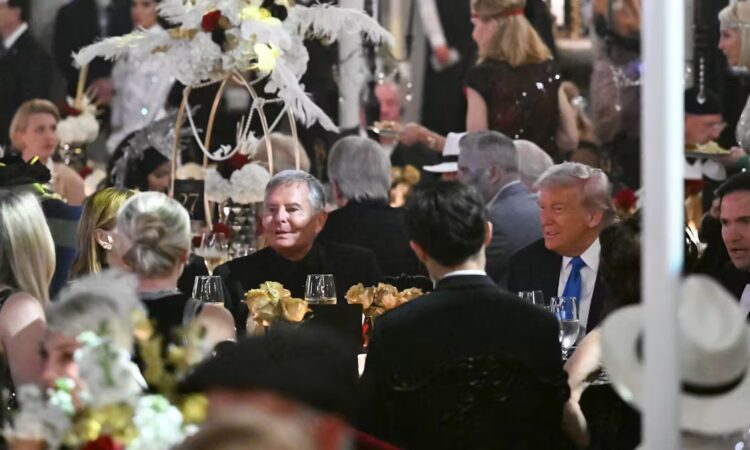
And it was hard not to notice the symbolism when, mere hours before millions of Americans in need had their food benefits stripped away from them, Trump hosted a Great Gatsby-themed Halloween party at Mar-a-Lago. It was a lavish tribute to the very era of excess, delusion and speculative mania that contributed to the catastrophe of October 1929.

Manuel Balce Ceneta/AAP
Records public for the first time
In 2009, Sorkin published Too Big to Fail, a book built on first-hand testimony from key figures inside the major banking institutions and the regulatory authorities at the heart of the 2008 financial crisis.
In Sorkin’s own words, that study was “a chronicle of failure – a failure that brought the world to its knees and raised questions about the very nature of capitalism.”
Similar questions animate 1929, though this time, the story is based on extensive archival research. During a visit to Harvard’s Baker Library, Sorkin discovered a trove of papers belonging to Thomas Lamont, a leading partner at J.P. Morgan. That afternoon in the archive, he says, convinced him he might write for 1929 what he had for 2008: “a fly-on-the-wall narrative that immerses readers in the moment”.
The project well and truly took off when Sorkin secured unprecedented access to the minutes of the Federal Reserve Bank of New York. One of 12 regional banks established under the Federal Reserve Act of 1913, the New York Fed originally served as a sort of nationwide operational hub, executing monetary policy through open market operations and acting as a key conduit between Wall Street and Washington.
In 1929, its influence was even greater than it is today. This means its minutes hold an outsized significance in helping us understand how the crisis unfolded.

Picryl
These records, covering the most critical months of 1929, had never before been made public. After providing a set of redacted versions, the Fed – prompted by Sorkin’s request – ultimately chose to release the full documents.
The insights they offered proved invaluable, confirming “the internal tempo of the moment” and becoming “one of the clearest anchors for telling this story”. They “added time stamps to key decisions, and provided a grounding that helped verify or challenge the public record”.
If this all sounds a bit dry and dense, rest assured: it is anything but.
This storm is ‘progress’
Much like the financiers of 1929, today’s tech barons and cheerleaders insist the AI boom represents a once-in-a-lifetime leap forward: an innovation so important and transformative it simply must be classed as (again) too big to fail.
These hucksters and hustlers, blowhards and boosters, are always on hand and quick to reassure. Don’t worry, they say. And don’t ask too many questions. This storm is what we call progress.
All this brings to mind the old Marx adage about history repeating itself: tragedy, then farce. However, when I stop to think, it doesn’t feel quite right, given how often these cycles recur. Instead, 1929’s epigraph seems much closer to the mark:
The ordinary human being does not live long enough to draw any substantial benefit from his own experience. And no one, it seems, can benefit by the experiences of others. Being both a father and teacher, I know we can teach our children nothing. We can transmit to them neither our knowledge of life nor mathematics. Each must learn its lesson anew.
Those words belong to Albert Einstein, taken from an interview he gave to The Saturday Evening Post. Einstein was talking about parenthood and mathematics, not financial markets.
Yet the interview appeared in print on October 26 1929, just two days after Black Thursday. Read today, his words carry an unmistakable air of prophecy.
He is right. As a species, we seem wholly unable to learn from our mistakes, let alone the mistakes of others. And it is hard to escape the feeling that we may be reminded of this again before long.