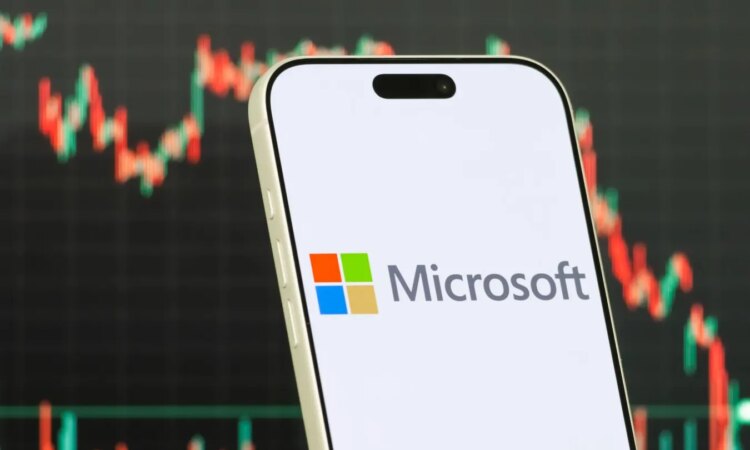

CHONGQING, CHINA – JANUARY 22: In this photo illustration, a smartphone displays the logo of Microsoft Corporation (NASDAQ: MSFT), a U.S.-based technology company best known for its software, cloud computing and artificial intelligence businesses, in front of a screen showing the company’s latest stock market chart on January 22, 2026, in Chongqing, China. (Photo illustration by Cheng Xin/Getty Images)
Getty Images
Microsoft stock has declined by 5% this week due to two converging factors. First, analysts are lowering price targets ahead of earnings reports, and second, investors are becoming hesitant about AI spending. The immediate reason for this change is evident—Wall Street is adjusting its expectations. However, the more profound concern is whether Microsoft’s substantial investments in AI infrastructure will yield returns in the near future.
How poor has Microsoft’s performance truly been?
To put it plainly: mediocre. A 3% return over the last twelve months compared to 14% for the S&P 500 constitutes significant underperformance for a major tech leader. While this isn’t disastrous, for a stock that usually trades at a premium, trailing the market by 11 percentage points indicates a shift in investor sentiment.
Nevertheless, if you are looking for potential upside with less volatility than holding a single stock like MSFT, you might consider the High Quality Portfolio. This portfolio has consistently outperformed its benchmark—a combination of the S&P 500, Russell, and S&P MidCap indexes—achieving returns greater than 105% since its launch. What accounts for this? As a collective group, HQ Portfolio stocks have provided superior returns with lower risk compared to the benchmark index; they have been less volatile, as shown in HQ Portfolio performance metrics. Additionally, see – Oracle Stock: Is The Panic Overdone?
If the stock decreases another 20-30% to $311, should investors be concerned?
History suggests not—but with crucial exceptions. Microsoft has shown impressive resilience across four significant downturns.
During the 2020 Covid crash, it declined less than the S&P 500 (28% compared to 34%) and bounced back in just four months. Even amid the severe 2022 inflation crisis, when it dropped 38%, it fully recovered within 19 months and subsequently reached new peaks.
The exception? The financial crisis of 2008, during which Microsoft dropped 59% and took over six years to recover. That serves as a cautionary tale—in genuinely systemic crises, even resilient stocks may experience prolonged hardships.
What distinguishes Microsoft’s current scenario from earlier downturns?
The fundamental strength is indisputable: $294 billion in revenue growing at 15.6%, operating margins of 46.3%, and almost no debt (0.02 debt-to-equity ratio). This is a cash-generating entity, not a speculative gamble.
However, here lies the tension: Microsoft is currently trading at a P/E of 32.2 and P/EBIT of 26.0. These multiples are justifiable only if AI investments convert into accelerated earnings growth. If they do not—if margins tighten or revenue growth slows—the valuation may be at risk.
So what’s the real downside risk?
The risk does not lie in Microsoft becoming a poor business. The risk resides in multiple compression. With current earnings, a market-average P/E around 25 would position the stock approximately at $350—a 20% drop from present levels. While this is not a prediction, it illustrates the consequences when “relatively expensive” meets underwhelming AI returns.
What’s the verdict?
Microsoft’s operational foundation is exceptionally robust, and its historical resilience during downturns is truly noteworthy. Nonetheless, that 32x P/E ratio is pricing in optimism regarding an AI monetization strategy that has yet to be realized. If you are comfortable holding through potential 20-30% declines while AI investments mature over the next 2-3 years, the long-term proposition remains intact. Conversely, if you require short-term returns or cannot handle volatility, that valuation provides limited safety margin.
The real question is not whether Microsoft is a good company. It is whether the market has already accounted for the AI scenario—and what occurs when reality unfolds more slowly than anticipated.
Consider this, investing in a single stock without thorough analysis can be risky. Take a look at the Trefis Reinforced Value (RV) Portfolio, which has surpassed its all-cap stocks benchmark (a combination of the S&P 500, S&P mid-cap, and Russell 2000 benchmark indices) to deliver robust returns for investors. Why is this the case? The quarterly rebalanced mix of large-, mid-, and small-cap RV Portfolio stocks has provided a responsive approach to capitalizing on favorable market conditions while mitigating losses when markets decline, as elaborated in RV Portfolio performance metrics.