Stock Markets Are Doing Something They’ve Only Done Once Since the 1870s. Should You Be Worried?
The S&P 500 has hit record highs in 2025. One valuation metric suggest there might be some trouble ahead.
Well, folks, it happened again. For the third consecutive year, the S&P 500 has closed with a double-digit gain.
In 2023, it ended the year 24.23% higher (26.06% with dividends reinvested). In 2024, the annual gain was 23.31% (24.88% with dividends reinvested). And last year it gained about 16.4% (or about 18% with dividends reinvested).

Today’s Change
(0.62%) $42.77
Current Price
$6944.82
Key Data Points
Day’s Range
$6904.02 – $6948.69
52wk Range
$4835.04 – $6948.69
Volume
3.3B
If you had invested $10,000 in an S&P 500 index fund three years ago, your investment would be worth about $18,600 today, which is anything but mediocre.
The market’s strong run, driven by solid corporate earnings and the continued advancement of artificial intelligence (AI), could reasonably continue in 2026.
And yet investors can’t risk exhibiting irrational exuberance today. The market is doing something it’s only done once in the last 150 years. And the last time it happened, it was followed by one of the worst market crashes in history.
Image source: Getty Images.
A warning sign from a handy metric
The crash I’m referring to is the dot-com bust of March 2000. And the “once-in-a-150-years” warning sign is a record-high value in a gauge called the CAPE ratio, which hit an extreme of about about 44 just before the market crashed.
The CAPE (cyclically adjusted price-to-earnings) ratio measures how expensive the stock market is relative to how much companies are earning. The heuristic works as a reality check: When CAPE is high, stocks are richly priced and future returns have been historically lower. When CAPE is low, stocks tend to be cheaper.
In 2025, the CAPE hit its second highest level (about 40) since records began in 1871. The only other time it entered that territory was 1999, just ahead the dot-com crash.
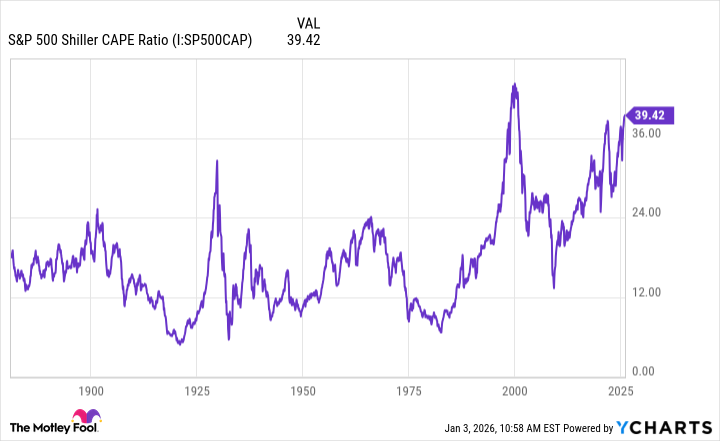
S&P 500 Shiller CAPE Ratio data by YCharts
Now, don’t get me wrong. A high CAPE in 2025 doesn’t necessarily mean the stock market will crash in 2026. But it does suggest that stocks are expensive. A high CAPE doesn’t mean selling your stocks today, but it is a reminder to think rationally and pick high-quality stocks that could survive a market stutter.
Steven Porrello has no position in any of the stocks mentioned. The Motley Fool has no position in any of the stocks mentioned. The Motley Fool has a disclosure policy.