The Stock Market Just Flashed a Warning Not Seen in 12 Months. History Says Investors Should Do This Now.
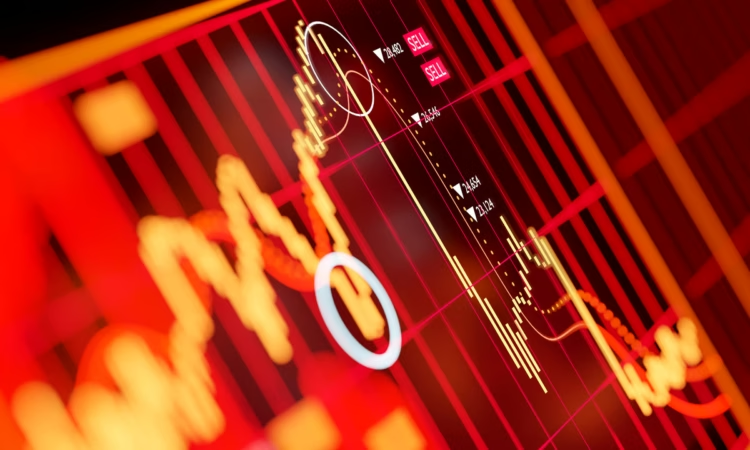
The S&P 500 (^GSPC 1.51%) has declined in four consecutive weeks due primarily to concerns about rising oil prices, though economic uncertainty surrounding the Trump administration’s trade policies has also added to the decline.
More concerning, the benchmark index formed a bearish breakdown on March 19, a technical pattern in which it falls below the 200-day moving average. The last one occurred in March 2025, shortly after President Donald Trump began announcing tariffs.
Unfortunately, history says the situation will get worse before it gets better. But there is some good news. The S&P 500 has typically recovered quickly from bearish breakdowns in the past. Here’s what investors should know.
Image source: Getty Images.
History says the S&P 500 will fall further before it recovers
The S&P 500 has dropped below its 200-day moving average 28 times over the past decade. Following those incidents, the index’s average peak-to-trough decline was 17% in the next year. In other words, history says the S&P 500 will close 17% below its record high at some point in the next 12 months.
Here’s what that means for investors: The S&P 500 is already 6% below its high due to concerns about President Trump’s tariffs and rising oil prices. The index last peaked at 6,797 in January 2026. Declining 17% from that level would put the S&P 500 at 5,642, which implies 13% downside from its current level of 6,506.
Fortunately, there is a silver lining: The S&P 500 has usually recovered quickly from bearish breakdowns. Following the 28 incidents in the last decade, the index added an average of 16% over the next year. In other words, history says the S&P 500 will advance 16% to 7,612 by March 2027, no matter how far it falls in the interim.
Of course, past performance is never a guarantee of future results, but another historical data point hints at a similar trajectory.
The S&P 500 typically falls sharply during midterm election years
Since its creation in 1957, the S&P 500 has consistently performed poorly during midterm election years due to policy uncertainty. The political party in charge tends to lose seats in Congress, especially in the House, which raises questions about whether the president’s agenda will stall in the aftermath.
Some investors sidestep that uncertainty by pulling money out of the stock market. In turn, the S&P 500 has suffered an average peak-to-trough decline of 18% during midterm election years. That closely aligns with the 17% drawdown implied by the S&P 500 slipping below its 200-day moving average.
However, policy uncertainty disappears after the midterms, and stocks usually recover quickly. Indeed, Carson Research says the six-month period after a midterm election (November through April) is the strongest interval of the four-year presidential cycle. The S&P 500 has returned an average of 14% during those six months. That nearly matches the average 12-month return of 16% following a bearish breakdown.
Some investors may be tempted to sell their stocks today and buy them again in November. But attempts to time the market often backfire. Famous fund manager Peter Lynch once warned, “Far more money has been lost by investors trying to anticipate corrections, or trying to time the market, than has been lost in corrections themselves.”
Smart investors should do this right now
The U.S. stock market faces several headwinds: Tariffs have slowed gross domestic product (GDP) and jobs growth, and Moody’s chief economist Mark Zandi believes rising oil prices could lead to a recession if the U.S.-Iran war continues much longer. Meanwhile, midterm election years are usually volatile, and some investors are concerned that artificial intelligence spending is unsustainable.
So, what should investors do? The S&P 500 could fall much further in the coming weeks and months. But the index has always recovered from past declines, and there is no reason to think this one will be different. In that sense, this situation is a buying opportunity. Investors should be readying cash to buy stocks (or an S&P 500 index fund). It’s fine to deploy some cash now, but I would hold some back in anticipation of further declines.