The Stock Market Sounds an Alarm as Wall Street Gets Bad News About President Trump’s Tariffs. History Says This Will Happen Next.
The S&P 500 (SNPINDEX: ^GSPC) has essentially traded sideways in 2026, but history says the benchmark index could decline sharply in the coming months.
Several recent studies show President Trump’s tariffs are siphoning money away from U.S. companies and consumers, and the S&P 500 just flashed a warning last seen during the dot-com crash in October 2000.
Will AI create the world’s first trillionaire? Our team just released a report on the one little-known company, called an “Indispensable Monopoly” providing the critical technology Nvidia and Intel both need. Continue »
Here’s what investors should know.

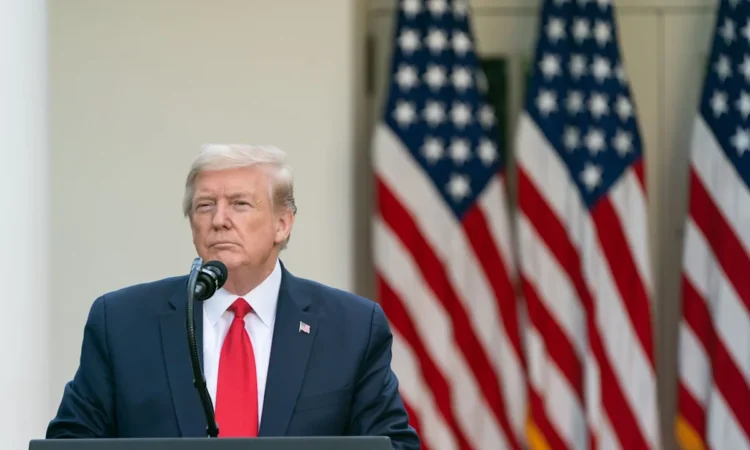
President Trump has repeatedly argued that foreign exporters will pay his tariffs for the privilege of doing business in America. He went further last month in an editorial published by The Wall Street Journal, claiming foreign companies were “paying at least 80% of tariff costs.” He even linked a study from the Harvard Business School to validate his claim.
What’s the problem? The study Trump linked made no such claim. In fact, the researchers arrived at the opposite conclusion. The report states, “Our results suggest that U.S. consumers paid up to 43% of the tariff burden, with the rest absorbed by U.S. firms.”
Those results roughly align with research from other institutions. Goldman Sachs economists report that U.S. companies and consumers collectively paid 84% of tariffs in October 2025. And they estimate consumers alone will bear 67% of the burden by July 2026.
Similarly, the Kiel Institute examined shipments totaling $4 trillion between January 2024 and November 2025, and the researchers concluded, “Foreign exporters absorb only about 4% of the tariff burden.” The other 96% is passed along to U.S. importers and consumers.
Trump’s tariffs are effectively a tax on consumption, which means they reduce buying power for consumers and raise input costs for businesses. That’s a problem because consumer spending and business investments account for approximately 85% of GDP. By siphoning money away from consumers and businesses, tariffs threaten to slow economic growth.
The S&P 500 recorded an average cyclically adjusted price-to-earnings (CAPE) ratio of 39.9 in January 2026, marking the fourth consecutive monthly reading above 39. Prior to that, the S&P 500 last recorded a monthly CAPE ratio over 39 during the dot-com crash in October 2000. The CAPE ratio is used to determine whether entire stock market indexes are overvalued, and multiples above 39 have historically correlated with dismal future returns.