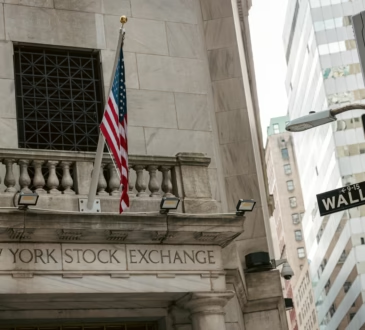
The US stock market, typically considered the engine of the global economy, has struggled to find its footing through the first months of 2026, even as the rest of the world has surged ahead.
As a result, US stocks are off to their worst start of the year since 1995 against the global market, according to data from Goldman Sachs.
While the S&P 500 (^GSPC), tracking the largest US companies, has fallen by 1% since the start of the year, an index tracking market returns throughout the rest of the global economy (ACWX) has returned 8%. The trend holds true over the past year, too, where the ex-US index has risen by 30%, triple the 10% return from the US over the same period.
And in an environment where geopolitical risk increasingly comes from inside the US — whether from the Trump administration’s tariff regime, comments about an annexation of Greenland, or other moves — investor attention has turned toward the rest of the world.
“For global investors, the re-pricing of [the US dollar] and erosion of the spread between US’s [equity risk premium] and others was brutal” in 2025, Viktor Shvets, the head of global desk strategy at Macquarie, wrote in a recent note to clients.
At the same time, even as the US market has far underperformed the rest of the world, US stocks just keep getting more expensive.
In the years following the global financial crisis, according to Apollo chief economist Torsten Sløk, price-to-earning ratios in the US versus the rest of the world remained broadly similar. (Disclosure: Yahoo is a portfolio company of funds managed by affiliates of Apollo Global Management.) But through the last 10 years, as Big Tech’s explosion has driven valuations sky high, US price-to-earnings ratios are now an average of 40% higher than those throughout the rest of the world market.
The US stock market has also become heavily concentrated in the tech sector.
As of December, the top 10 largest companies in the US — the “Magnificent Seven” Big Tech stocks, plus Broadcom (AVGO), Eli Lilly (LLY), and Visa (V) — accounted for 40% of S&P 500 holdings, according to data from the investment brokerage Lord Abbett, far above the roughly 20% weight of the top 10 holdings a decade ago. That premium leaves US equities more vulnerable if expectations around the AI trade slip.

Canadian Prime Minister Mark Carney visited Chinese President Xi Jinping in Beijing in January. As Canada’s trade relations with the US have frayed, Carney’s government has leaned toward China, one of the key drivers of global economic growth outside of the US. (VCG/VCG via Getty Images)
(VCG via Getty Images)
“The US market trades above a 20x P/E — even excluding the ‘Magnificent 7,'” Goldman Sachs strategists wrote in a recent client note. “This is unusually high.”
Historically, investors have been willing to pay a premium for US stocks on the assumption that domestic earnings growth would consistently outpace the rest of the world. But as growth abroad has stabilized and emerging markets have rebounded, the valuation gap has started to look harder to justify.
“We point out all the time that valuations are not good timing tools,” LPL Financial chief equity strategist Jeff Buchbinder and chief equity strategist Adam Turnquist wrote in emailed commentary.
“However, once a trend changes that is based on fundamentals or technical factors, the moves tend to be bigger if they have valuation support.”
The shift is already showing up in the dealmaking market. After more than a decade in which M&A capital flowed into the US more than it flowed outward, 2025 data from Goldman Sachs shows a reversal, with “clear net cross-border M&A outflows” from the US.
In other words, US companies are now deploying more acquisition capital overseas than foreign buyers are bringing into American markets.

The US saw “clear net cross-border M&A outflows in 2025,” according to Goldman Sachs.
(Goldman Sachs Global Investment Research)
To be clear, foreign ownership of US assets hasn’t begun to meaningfully decline. Yet, over the past four years, global investors’ share of US equities has largely flatlined after nearly two decades of consistent growth, according to the most recent data from the US Treasury Department.
That doesn’t signal an exodus from US markets, but strategists say it marks the first real pause in years in America’s dominance of global capital flows.
“The US stock market looks high-priced, top-heavy, and low-yielding compared with international counterparts … but stock- and sector-specific risk in the US has risen to scary levels,” said Morningstar index strategist Dan Lefkovitz.
“In contrast to the US, international equities carried low valuations coming into 2025. They have underpromised and overdelivered.”
Jake Conley is a breaking news reporter covering US equities for Yahoo Finance. Follow him on X at @byjakeconley or email him at jake.conley@yahooinc.com.
Click here for in-depth analysis of the latest stock market news and events moving stock prices
Read the latest financial and business news from Yahoo Finance