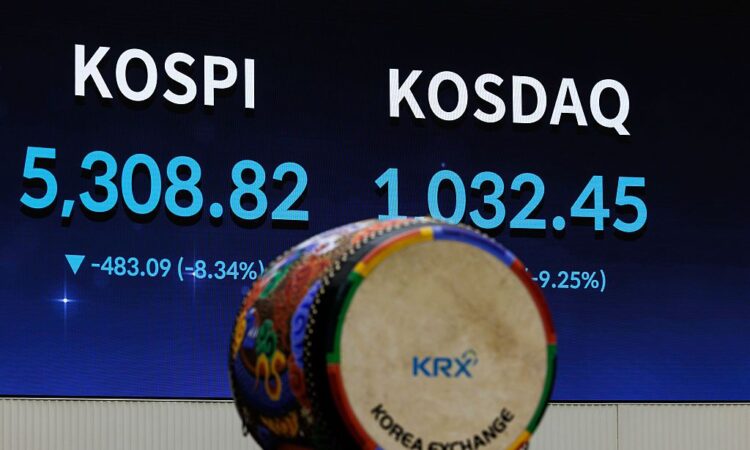
South Korean stocks fell 12% on 4 March, and the country’s main stock exchange was forced to temporarily stop trading, following heightened volatility in response to the conflict in the Middle East.
The Korea Exchange (KRX) activated a twenty minute circuit breaker on both the Korea Composite Stock Price Index (KOSPI) and its tech-heavy Korea Securities Dealers Automated Quotations (KOSDAQ) market, after the KOSPI fell 8.1% within hours of the market opening.
Shares on the KOSPI “dived into freefall mode”, said Susannah Streeter, chief investment strategist at Wealth Club. “The index ended 12% lower as investors fretted about the impact of high energy prices, given how reliant the country is on imports.”
Sign up to Money Morning
Don’t miss the latest investment and personal finances news, market analysis, plus money-saving tips with our free twice-daily newsletter
Don’t miss the latest investment and personal finances news, market analysis, plus money-saving tips with our free twice-daily newsletter
The disruption caused stocks across Asia to sell off. Japan’s Nikkei 225 fell 3.6% and Taiwan’s Taiex fell 4.4%
What is a stock market circuit breaker?
The twenty minute pause that KRX implemented isn’t as unusual as you might think.
Most stock exchanges have a mechanism in place that halts trading temporarily in the event of large, sudden price movements in an index (or in certain circumstances, individual stocks), in order to manage volatility and protect against disorderly selloffs.
They were originally designed following the ‘Black Monday’ stock market crash in 1987 that saw a year’s worth of gains wiped out within hours, thanks in part to automated trading programs that were, at the time, relatively new.
Circuit breakers are triggered on the S&P 500 if it falls 7%, 13% and 20% in a single session.
The theory is that circuit breakers halt panic selling and thereby slow the decline of the index.
Can Korean stocks recover?
This was the largest one-day fall in the KOSPI’s history, but it is worth noting that, despite falling more than 20% since 27 February, the index closed 4 March up 21% through 2026, and over 100% up over the last 12 months – underscoring the fact that these investments offered a convenient source of liquidity at a moment when investors flew into a panic.
Where Korean stocks go from here depends much on how and when the situation in the Strait of Hormuz resolves.
“The downward pressure on stocks is likely to continue until this crucial trade route is made safe,” said Emma Wall, chief investment strategist at Hargreaves Lansdown. “Once secured however, we expect markets to return to optimism – with the volatility we have come to anticipate as the norm under a Trump presidency.”