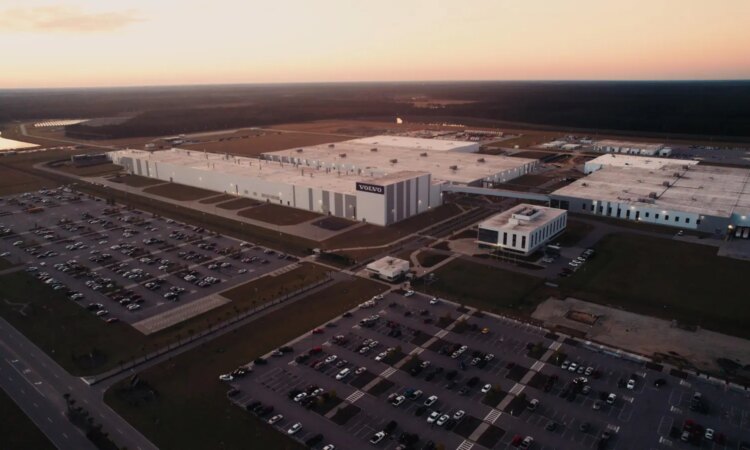

Volvo Cars announced in September it’s adding a hybrid model to a factory in South Carolina.
Volvo Cars
Auto industry investments are moving to fewer but larger projects, a report issued Thursday said.
“The global automotive industry is undergoing a structural reset that materially changes how and where capital will be deployed,” the report by Global Location Strategies said.
Since 2020, Greenville, South Carolina-based Global Location said, auto industry investment is “defined by fewer, larger, and more execution-critical commitments.”
Industry “capital deployment has remained resilient and increasingly concentrated in a limited number of high-stakes investments that now determine production capacity, supply-chain alignment, and long-term competitive position,” according to the report.
Global Locations said the change is being felt by industry chiefs.
“For corporate executives, this reset has fundamentally altered the risk profile of automotive investment,” according to the report. “As capital intensity rises and project counts fall, the risk to schedule, cost, and long-term operations associated with the misalignment of a location decision has increased sharply.
“Projects that cannot be executed on schedule or scaled reliably face heightened exposure to delay, underutilization, and stranded capital,” the report added.
In the 1980s, an auto factory valued at $500 million was a big deal. Increasingly, that’s just the price of admission.
The new report says projects of $1 billion or more each account for 43% of all capital spending. That’s up from 18%10 years ago. The average capital project each rose 24% on an inflation-adjusted basis between 2015 and 2024, the report says.
Volvo Cars, which had already invested $1.3 billion in a South Carolina plant, said in September it’s investing even more to add a hybrid model.
The shift to bigger projects also is changing the calculus for executives.
Factors such as “power availability, workforce delivery, permitting certainty, infrastructure scalability, and institutional coordination now determine whether large automotive investments can proceed on schedule and reach sustainable utilization,” according to Global Location.
The company said in a statement that the increase in investment size “is closely tied to what automakers are building. Investment is increasingly concentrated in next-generation vehicle platforms, including battery-electric vehicles (EVs), hybrid systems, advanced battery manufacturing, and large-scale retooling of existing internal-combustion-engine plants.”
Since 2020, automakers have prepared for increased deliveries of EVs. That expansion has slowed but EV demand still is projected to grow overall.
General Motors Co. CEO Mary Barra said in January that electric vehicles remain the future amid headwinds slowing EV adoption. “Once we have more affordable EVs…I think people will pick EVs,” Barra said at that time time during a “fireside chat” held by the Automotive Press Association at the automaker’s new headquarters in downtown Detroit.
A $7,500 U.S. tax credit for EVs expired last year. The administration of President Donald Trump is unenthusiastic about EVs compared the previous Biden administration.
The new report by Global Location also says traditional incentives, such as tax breaks, matter less than they have in the past.
Power supply and demand comprise one major factor.
According to the company, big automotive investments “compete directly with data centers, semiconductor fabrication plants, and other energy-intensive users. Interconnection delays and grid constraints are increasingly stalling projects nationwide.”