Trump says the US secured at least $18 trillion worth of investments this year. That’s wrong
President Donald Trump has often said that since he took office in January, the U.S. has received trillions of dollars in promises of investments, and the dollar amount he cites changes.
On his second day in office, Jan. 21, Trump said the U.S. had “already secured nearly $3 trillion of new investments.”
By May 8, that figure rose to “close to $10 trillion.” It eventually peaked Oct. 29 during a meeting with South Korean Prime Minister Kim Min-seok: “I think by the end of my first term, we should have $21 or $22 trillion dollars invested in the United States from other people and countries,” Trump said.
Since then, Trump has reported varied investment figures:
Sometimes Trump has phrased the commitments as approaching a dollar figure; other times, he’s said they’ve already hit that number.
In May, when Trump said, “We have now close to $10 trillion” in investments, we rated that False. The White House had documented at least $4.9 trillion less than what Trump claimed.
That $10 trillion number has about doubled in the seven months since, according to Trump, but it’s unsubstantiated. On the higher end, $22 trillion would be equal to about three-quarters of the United States’ entire 2024 annual gross domestic product, an extraordinary total for the richest country in the history of the world.
The White House website documents $9.6 trillion, and not everything cited on the website was newly pledged during Trump’s second term. Experts say there’s no guarantee the full amounts promised will come to fruition, and some of this investment would have occurred regardless of who was president.
The White House did not respond to PolitiFact’s questions about Trump’s statements.
Trump’s remarks vs. the White House website
One way to benchmark Trump’s investment figure is to look at what the White House officially documented.
The White House launched a web page in April that includes a list of countries and companies it said have announced investments during Trump’s second term.
Using the internet archive Wayback Machine, we tracked the amount of investment the White House website cited over time. The figures Trump has used were usually at least double the amount listed on the website.
In recent weeks, as Trump cited figures from $18 trillion to $22 trillion, the White House website reported $9.6 trillion.
Is Trump accurately framing the foreign and corporate investments?
The White House website’s figure includes aspirational goals over multiple years and counts future purchases of products rather than capital investments. For some of the biggest line items — such as commitments by the governments of the United Arab Emirates and Qatar — the pledges are multiple times those countries’ annual gross domestic product, which calls their feasibility into question.
A Bloomberg Economics’ analysis found that of the $9.6 trillion the White House listed on its website in late November, $7 trillion could be considered “real investment pledges.” The remaining $2.6 trillion included countries’ agreements to purchase items such as natural gas or to expand future trade. The analysis characterized some of the investment pledges by other countries as “amorphous.”
More than 80% of the investments from private companies stemmed from artificial intelligence-related spending.
“Many of the pledges cited by the White House are part of overlapping multi-company projects, making it difficult to determine how much may be counted more than once,” Bloomberg said.
Ten items on the White House’s website accounted for the vast majority of the $9.6 trillion the White House detailed. Some of the White House’s documentation includes details such as specific companies getting involved and the types of facilities or infrastructure envisioned; other examples are more vague. Some involve conventional investments, while others have to do with projected trade increases.
1. United Arab Emirates: $1.4 trillion. The White House says this investment focuses on AI infrastructure, semiconductors, energy, quantum computing, biotechnology and manufacturing. Companies cited in a White House news release include Boeing, GE Aerospace, Emirates Global Aluminum, ExxonMobil, Occidental Petroleum, Qualcomm and Amazon Web Services. It’s unclear how much of this investment would come from new investments.
The UAE’s 2024 gross domestic product was $537 billion, making the pledge equal to three years of the country’s entire economic output.
2. Qatar: $1.2 trillion. The White House press release described this as an “economic exchange,” rather than one-way investment. It cited the involvement of companies including Boeing, GE Aerospace, Raytheon, General Atomics, ExxonMobil and Chevron Phillips. The announcement described a mixture of trade deals, purchase agreements and investment intentions — items that analysts say often include future-looking efforts rather than capital injections.
In 2024, Qatar’s gross domestic product was $218 billion, making this pledge equivalent to nearly six years of the country’s entire economy.
3. Japan: $1 trillion. The White House has said Japan is moving toward $1 trillion, following an initial agreement to invest $550 billion in sectors such as semiconductors, shipbuilding, energy, pharmaceuticals, metals and minerals by the end of Trump’s term. Japan also disputes that this will be a one-way flow of cash into the U.S. Bloomberg News quoted Japanese trade negotiator Ryosei Akazawa saying, “It’s not that $550 billion in cash will be sent to the U.S.” but rather a combination of investments, loans and loan guarantees provided by financial institutions backed by the Japanese government.
4. Meta: $600 billion. The White House and the social media company said $600 billion is tied to Meta’s U.S. AI infrastructure and workforce expansion plans through 2028.
5. Apple: $600 billion. Apple’s long history of multi-year domestic investment pledges means the $600 billion figure incorporates prior commitments plus recent accelerations. Apple’s news release described a new $100 billion boost to bring its total U.S. commitment to $600 billion over several years. The release cites a new American Manufacturing Program, supplier investments and training programs.
6. Saudi Arabia: $600 billion. The administration said $600 billion from Saudi Arabia would involve the energy, critical minerals and defense sectors. (The most recent White House news release says this figure has increased to $1 billion, but this is not yet reflected on the White House investment web page.)
The amount cited would be equal to about half of Saudi Arabia’s 2024 gross domestic product.
7. European Union companies: $600 billion. The EU said in August that “European companies are expected to invest an additional $600 billion across strategic sectors in the United States through 2028.” However, the statement frames this as aspirational, not as a commitment.
8. Stargate: $500 billion. This consortium between SoftBank, OpenAI and Oracle was unveiled during a Jan. 21 White House event. Stargate said $100 billion will be invested “immediately” and that the consortium “intends to invest” a total of $500 billion over the next four years. OpenAI among others published blog posts describing its plans for five new sites that would bring the project to “over $400 billion” in near-term investment, positioning it on a path to the $500 billion target.
9. NVIDIA: $500 billion. The White House said NVIDIA has pledged to build $500 billion worth of AI infrastructure in the U.S. over the next four years. NVIDIA has said it is pursuing “ambitious” manufacturing and server production in the U.S., but the $500 billion figure remains a goal.
10. India: $500 billion. What is being called “Mission 500” aims to reach $500 billion in annual bilateral trade by 2030. But it is a trade goal, not an investment pledge, and its end date would come after the end of Trump’s term. Further, the framework seems to allow U.S. purchases of Indian goods to count toward the goal, which does not foster U.S. investment and production.
Importantly, experts said, some of these pledges won’t materialize.
“Historically, large-scale investment announcements often overpromise and underdeliver,” Roman V. Yampolskiy, an AI specialist at the University of Louisville told PolitiFact in May. “There is a performative element to them, especially in politically charged contexts. They function as political theater as much as economic commitment.”
Trump isn’t the first to overstate new investments. President Joe Biden said in 2024 that his bipartisan CHIPS and Science Act had attracted $640 billion in private investments; economists told PolitiFact that Biden’s numbers were based on what companies had announced, which is not the same as dollars already spent.
Our ruling
Trump says the U.S. has received investment commitments totaling $18 trillion to $22 trillion since he took office in January.
The number Trump cites is about double what the White House’s website lists. And experts say the website’s current figure, $9.6 trillion, should be viewed with caution.
It includes aspirational, multi-year goals that might or might not come to fruition, and some items are future purchases or sales of products, rather than capital investments.
For the two biggest line items — commitments from the United Arab Emirates and Qatar — the amounts are multiple times those countries’ annual gross domestic product.
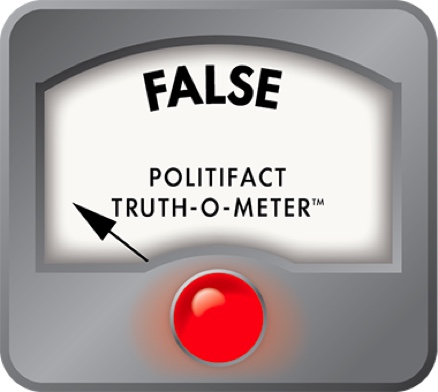
We rate Trump’s statement False.