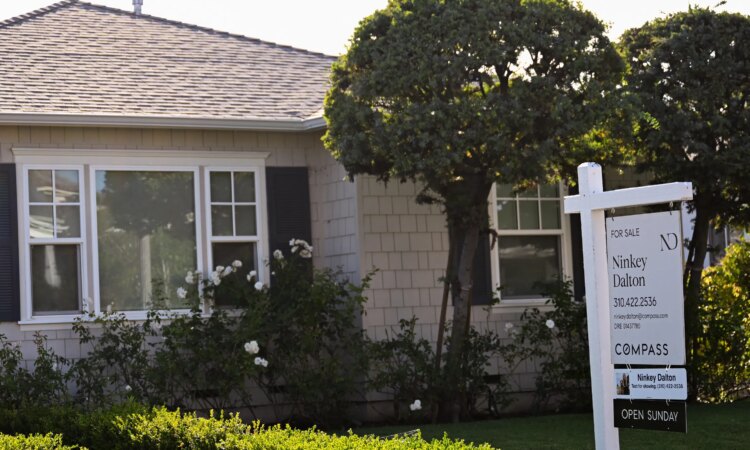
Clear lines were drawn in Florida’s battle over property taxes when a House panel passed eight bills to drastically cut homeowners’ bills.
Cities, counties and local taxing districts fear their budgets will be slashed, causing them to cut services or raise other fees and taxes. But Republicans and supporters of the measures argued lawmakers must do something to lower homestead residents’ property taxes, which have skyrocketed above increases in population and inflation in recent years.
“Local government property tax is increasing at an unsustainable rate,” said Rep. Toby Overdorf, R-Palm City, chairman of the House Select Committee on Property Taxes, on Nov. 20. “It is time to put money back in the hands of Floridians.”

Of the eight bills passed by the panel, seven are constitutional amendments that would be placed on the November 2026 ballot and would need no less than 60% approval from voters to pass.
The largest (HJR 201) would eliminate non-school property taxes for those with a homestead exemption. State economists estimate it would save homeowners – and cost local governments – $14.1 billion in the 2027-28 fiscal year and $18.3 billion in future years.
For many cities and counties, especially in rural areas with small budgets and a small property tax base, that’s a massive dent in their spending plans.
“If any of these were to pass … we would have to raise taxes or fees, which shifts the burden onto renters, small businesses,” Trish Pfeiffer, commissioner of the City of Bartow, told the committee. “There’s no scenario where we remove a large portion of a revenue source and keep the same services.”
Jolien Caraballo, vice mayor of Port St. Lucie, argued her city has been fiscally responsible and isn’t gouging homeowners on property taxes, which make up 49% of their $212.5 million general fund.
Significantly reducing that revenue stream could impact their credit rating, making it more expensive to borrow money and hurting residents in the long run, she said.

“I urge you to think like a surgeon using the precision of a scalpel doing the least amount of harm,” Caraballo said.
The bills passed along partisan lines, with Republicans in favor and Democrats opposed.
Although all the measures exempt school taxes from the cuts and ban cities and counties from cutting law enforcement, Democrats said they were concerned police budgets wouldn’t keep up with population increases if the measures were to pass. They also noted firefighters and emergency response budgets weren’t included in the law enforcement budget cut ban.
“Ultimately we are cutting our cities and counties off by the knees,” said Rep. Michelle Rayner, D-St. Petersburg.
Republicans defended the measures, saying they are needed to help homeowners deal with rising tax bills.
“This is not local governments’ money. This is the taxpayers’ money and they have the right to decide how its spent,” said Rep. Monique Miller, R-Palm Bay.

The bills, though, don’t have the backing of Gov. Ron DeSantis, who spearheaded the push to cut property taxes earlier this year. Not that it matters: The Legislature doesn’t need his approval to place constitutional amendments on the ballot, though they do need to get a three-fifths majority in each chamber.
Still, he’s called the proposals “milquetoast” and criticized the House plan to put so many measures on the ballot next year.
He prefers one standalone measure that removes all property taxes for homesteaded properties, including the portion that pays for K-12 public schools. DeSantis has also said the state can use funds to backfill the budgets of 29 rural counties whose coffers would be slashed.
But he hasn’t released a detailed plan on how to do that, which House leaders have criticized. When asked if the House plans to backfill revenues for rural counties, Overdorf said he’s still waiting on DeSantis to release his plan.
Overdorf also said he hasn’t had any discussions with the Senate, which doesn’t yet have any companions to the bills.

One Republican vying to replace the term-limited DeSantis next year, former House Speaker Paul Renner, released his own plan to cut property taxes Nov. 20.
Most property tax cut proposals require a constitutional amendment, which wouldn’t benefit homeowners until 2027, but Renner wants the Legislature to pass a law requiring cities and counties to revert to the “rollback” rate. That’s the tax rate needed to achieve the same amount of revenue as the prior year.
Here’s a rundown of the House proposals:
- HJR 201 – All non-school property taxes for those with homestead exemptions would be eliminated starting Jan. 1, 2027.
- HJR 203 – Non-school property taxes for homestead properties would be phased out over 10 years. The exemption would increase $100,000 in assessed property value each year.
- HJR 205 – Non-school property taxes for residents over 65 with a homestead exemption would be eliminated.
- HJR 207 – The current homestead exemption for non-school taxes would be increased to 25% of the assessed value of the home.
- HJR 209 – Those with a homestead exemption who also have property insurance will see their exemption increased by $100,000.
- HJR 211 – The $500,000 cap on transferring the homestead exemption from one property to another would be eliminated.
- HJR 213 – The current 3% cap on the annual growth in assessed value for homestead properties and 10% cap on non-homestead properties would be lowered to 3% over three years for homestead properties and 15% over three years for non-homestead properties.
- HB 215 – Any vote to increase a property tax rate would require a two-thirds vote. Newly married couples could combine their Save Our Homes benefit (the difference between their just value and their assessed value, up to the $500,000 cap) to a new home.
Gray Rohrer is a reporter with the USA TODAY Network-Florida Capital Bureau. He can be reached at grohrer@gannett.com. Follow him on X: @GrayRohrer.