Gotrade News – Forbes recently ranked the Indonesian rupiah as the fifth weakest currency in the world as of April 7, 2026. The assessment has sparked pushback from Indonesian economists who argue that Forbes used an overly simplistic methodology.
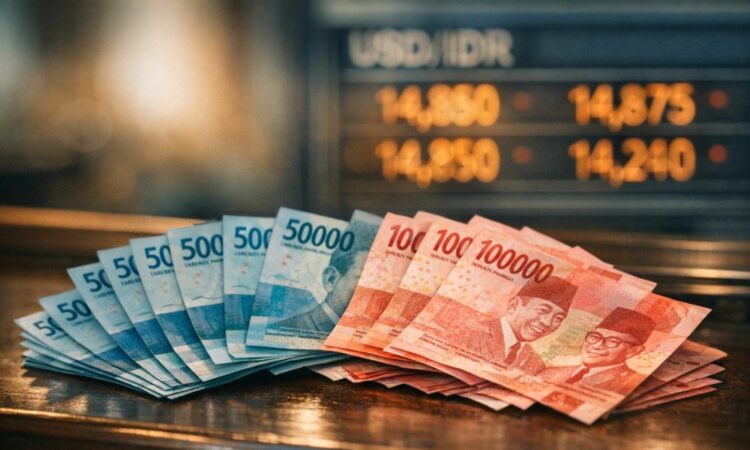
- Forbes ranked the rupiah fifth globally based on nominal exchange rate of Rp 17,066 per USD
- Bank Permata’s chief economist called the ranking “misleading” as it ignores economic fundamentals
- The rupiah could weaken toward Rp 17,300 if geopolitical tensions at the Strait of Hormuz escalate
Where the Rupiah Stands on the Forbes List
According to Kompas Money, Forbes used Open Exchange data from April 7, 2026 as its benchmark. The rupiah was trading at Rp 17,066 per USD when the data was compiled.
Four currencies ranked weaker in nominal terms were the Iranian Rial, Lebanese Pound, Vietnamese Dong, and Lao Kip. Notably, Vietnam and Laos are also ASEAN member states with currencies weaker than the rupiah.
Forbes stated that despite Indonesia having the largest GDP in ASEAN, its currency has been sliding. The publication cited a combination of high inflation and recession concerns as the main drivers.
As reported by Detik Finance, the rupiah traded at Rp 17,182.45 per USD on Friday (April 17). This represented further weakening compared to the Forbes data collected 10 days earlier.
On Tuesday (April 15), the rupiah briefly touched Rp 17,130 per USD, marking a record low. A stable US dollar amid global geopolitical uncertainty was identified as the primary pressure factor.
Economists Challenge the Forbes Narrative
Bank Permata’s Chief Economist Josua Pardede directly called the Forbes assessment “misleading” in his response. He argued the ranking is only accurate in the narrowest sense of nominal exchange rate per one US dollar.
Josua explained that the REER, or Real Effective Exchange Rate, actually shows the rupiah is undervalued by 2-5%. This measure uses the 2020 base year and better reflects a currency’s real purchasing power.
Indonesia’s economic fundamentals showed solid resilience throughout 2025 by multiple measures. GDP growth reached 5.11% while foreign exchange reserves stood at USD 148.2 billion according to Bank Indonesia data.
Inflation in March 2026 came in at 3.48%, still within Bank Indonesia’s target corridor. Investment realization throughout 2025 also exceeded targets, surpassing the Rp 1,931.2 trillion mark.
In the banking sector, credit growth registered a positive 9.37% on a year-over-year basis. Deposits also grew 13.18%, indicating that domestic liquidity conditions remain healthy.
Josua emphasized that the rupiah is under pressure from global sentiment, not from broken fundamentals. The distinction between temporary pressure and structural weakness is key to reading this situation correctly.
Recent projections suggest the rupiah could touch the Rp 17,300 per USD level in the near term. Escalating tensions at the Strait of Hormuz involving Iran remain the primary risk being monitored by market participants.
The context of this rupiah weakness differs fundamentally from the 1998 crisis driven by structural collapse. Indonesia’s macroeconomic fundamentals are considerably stronger than that era according to economist consensus.