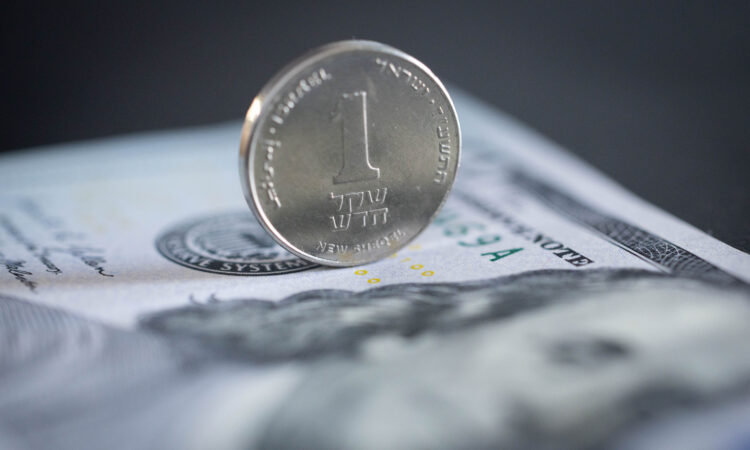
As Israeli nonprofits struggle to address the country’s urgent needs following yet another war and as the government devotes more resources to national defense and less to the social safety net, many are finding themselves squeezed not only by the challenges of the security and budgetary situations but by a new financial foe: a strong shekel.
For many Israeli organizations, support from foreign donors — particularly American Jewish ones — is critical to their operations. For many organizations, fundraising trips to the States are not a luxury but a necessity. But now, as the shekel is gaining strength against the dollar, those fundraising efforts are not going nearly as far. This currency crunch also comes as many donors are feeling the pain of nearly three years of intense giving through terror attacks, wars and ceasefires.
“As the shekel strengthens, every dollar raised in the U.S. translates into less impact on the ground in Israel,” said David Metzler, director of international relations at the IDF Widows & Orphans Organization.
The Israeli nonprofit sector is navigating a severe fiscal contraction caused by a perfect storm of currency shifts. With the NIS/USD exchange rate plummeting to 2.96 this past Friday, after weeks of hovering above 3.00, the sector is facing a nearly 19% drop from the 3.68 shekels-to-the-dollar level seen just one year ago.
Metzler noted that the shift requires a total rethink of how costs are presented to partners. “In the past, we would fundraise in the donor’s currency. Today, we lead with the actual cost in new Israeli shekels. That helps anchor expectations in the real cost of delivering programs in Israel, rather than a moving target tied to currency markets.”
This strengthening of the shekel — driven by what some are calling a “ceasefire dividend,” surging tech exports and foreign investment — acts as a hidden tax for the overwhelming majority of Israeli nonprofits that fundraise in dollars. This currency shift has effectively gutted the sector’s purchasing power by nearly a fifth while domestic costs remain high.
This fiscal squeeze is compounded by intense internal pressures. With the government prioritizing a 5.1% deficit target to fund massive reconstruction and a record NIS 143 billion ($47.6 billion) defense budget, public funding for social services is often stagnating or decreasing. Simultaneously, an aggressive private-sector labor market is driving up the cost of retaining talent, leaving mid-sized nonprofits trapped between a shrinking dollar and rising operational costs.
This gap is more than just an accounting headache; it is a threat to the sector’s workforce both in quality and quantity. Israel’s so-called “third sector” accounts for roughly 14% of its labor market. However, nonprofits are losing the talent wars as they struggle to compete with a private sector that is growing aggressively. As nonprofit funding is largely tied to a depreciating dollar, organizations cannot raise salaries to match corporate benchmarks, threatening to create a slow but steady “brain drain” from the social sector into the business world.
One potential antidote to this dollar-dependency is a more aggressive focus on domestic Israeli corporate giving — a strategy that centers on building a shekel-based operational floor. Joseph Gitler, founder and chairman of Leket Israel, has long been a proponent of weaving the nonprofit mission into Israel’s corporate fabric.
“We are all feeling the pain whether in dollars, euros or Canadian dollars,” Gitler told eJP.
“This is why we spent time building our fundraising capacity in Israel. Our shekel donors have become even more vital,” he said. “It’s a wake-up call that everyone has to be diversified and put in the effort in Israel as well. We can’t just count on overseas support, even if it’s growing.”
Gitler noted that this local strategy requires understanding the macroeconomic realities of Israeli businesses as well. “Our corporate partners donate in shekels, but depending on their business, their expenses could also be in shekels while their revenues are in dollars,” he said.
Despite the growing financial challenges facing Israeli civil society, many nonprofit leaders are loath to speak up publicly. Many CEOs and development professionals who spoke with eJP were reluctant to address the “dollar gap” on the record out of concern that they would be perceived as ungrateful for the generosity that their foreign donors have shown them, particularly since the Oct. 7 terror attacks.
In an era of donor fatigue, many nonprofit leaders worry that explaining the currency shortfall will be misinterpreted as simply “asking for more,” rather than a transparent report on the eroding value of existing gifts.
If the economic environment has fundamentally shifted, the way foundations and strategic donors support their partners must shift as well, according to Maya Natan, CEO of Keshet, the Israeli donor-advised fund.
To navigate this volatility, Natan advises a shift in how grants are structured. “Funders should not discard at least a 10% line for unforeseen costs in an organization’s budget, because this allows the flexibility needed in order to not be surprised by changes in the financial landscape,” she said.
Natan added that the current environment underscores the critical need for formalized grant agreements, making it clear how much is being provided in what currency. Unless the pledge is explicitly made in shekels, she warned, “funders giving more than $100,000 must have formalized agreements to avoid issues and misalignments with grantees in the future.”
The crisis is further compounded for organizations that rely on government partnerships, according to Lawrence Kasmir, deputy development director at the Society for the Protection of Nature in Israel.
“A lot of nonprofits get government funds through tenders that require a match,” Kasmir said. “If we are getting less money because of the exchange rate, we have less money to commit to that match, and then the funds aren’t unlocked. We are losing our leverage.”
The irony of a strong currency hurting the country’s civil society is not lost on leading Israeli economists. In a recent interview with the Israeli financial newspaper Globes, Leo Leiderman, chief economic advisor to Israel’s Bank Hapoalim, noted that the current currency pressures may only be the beginning.
Assessing the potential for regional stability and a “ceasefire dividend,” Leiderman projected: “Such a situation would lead to a massive flow of capital to Israel, a sharp drop in Israel’s risk premium, economic growth in the region and investment at historically high levels.”
For the third sector, this success triggers a localized “Dutch Disease” — in which one flourishing export sector wreaks havoc on the rest of the economy. In Israel, tech exports can make it increasingly difficult for dollar-dependent nonprofits to deliver services.
According to Kasmir, the social sector has reached a breaking point, where a $3 billion global funding pool is now worth over NIS 2 billion ($670 million) less than it was just two years ago. This, he said, is putting more “pressure on the nonprofit ‘Hunger Games,’ as we all are competing for a piece of the same pie.”
And yet, Kasmir said that he believes this moment calls for doubling down on donor transparency and, at times, organizational vulnerability. “We need to remain focused on the impact of the gift, and there is no easy answer for this, other than viewing our donors as partners in our work,” he said. “We need to be honest with our partners about the implications of the strengthening of the shekel.”