
Global Commitment to Local Impact: The Honourable Jill McKnight Details Defence Investments at CFB Esquimalt
Archana Cini, Lookout Newspaper; with files from the Government of Canada
-
Minister of Veterans Affair Jill McKnight visited CFB Esquimalt following Canada reaching NATO’s 2% defence spending target.
-
Major ongoing and upcoming investments include jetty replacement, military housing expansion, and improved CAF compensation and benefits.
-
Funding will continue to support long-term fleet readiness, modernization, and operations across the Pacific region.
–
For those serving on the West Coast, the future of defence is already under construction.
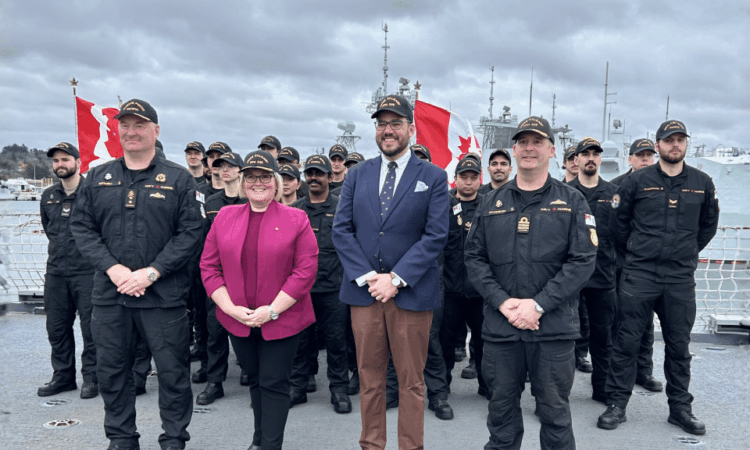
On April 1, the Honourable Jill McKnight, Minister of Veterans Affairs and Associate Minister of National Defence, visited Canadian Forces Base (CFB) Esquimalt to deliver remarks on the flight deck of His Majesty’s Canadian Ship (HMCS) Calgary. Joined by Victoria Member of Parliament Will Greaves and Rear-Admiral (RAdm) David Patchell, Commander of Maritime Forces Pacific/Joint Task Force Pacific (MARPAC/JTFP), McKnight spoke to Defence team members and media representatives gathered at B Jetty.
The visit followed Prime Minister Mark Carney’s announcement that Canada has now reached NATO’s two per cent defence spending target in the 2025-26 fiscal year, marking a significant milestone in Canada’s approach to national defence and collective security. For the Defence community of Vancouver Island, the announcement carries direct and visible implications. As such, McKnight’s visit turned this nationwide milestone into a clear explanation on how this national investment will be felt locally — through infrastructure; Defence personnel and community support; and operational readiness.
“Here on the west coast, readiness is essential,” said McKnight. “As such, following Prime Minister Mark Carney’s historic announcement, we’re making targeted investments in personnel. This includes key capabilities and infrastructure that underpin operations in the Pacific.”
One of the most significant local investments is the $1.1 billion investment to replace the aging A and B jetties at CFB Esquimalt, supporting Royal Canadian Navy (RCN) operations and future fleet requirements. With B Jetty commissioned in early 2025 and now fully operational, work is currently underway to replace A Jetty . In addition to supporting future Defence operations and requirements, the project is expected to support approximately 1,280 jobs during construction, which is scheduled to run from 2027 to 2031.
“This is more than infrastructure,” said McKnight. “It’s equally about ensuring that our Pacific fleet is ready, today and into the future, to safeguard Canada’s interests and respond where it matters most.”
Additional investments include expanded military housing, with Esquimalt among 25 locations nationwide slated to benefit from a program delivering 7,500 new units. A second phase of the initiative, valued at over $3.7 billion, aims to provide greater stability for Defence team members and their families. This is in addition to the $2 billion being leveraged to deliver improved compensation and benefits packages to Canadian Armed Forces (CAF) and RCN members.
“Meeting the two per cent commitment is not just about defence spending,” said McKnight. “At its core, it is about people — ensuring you have what you need while you serve, and that you are supported when your service concludes.”
McKnight continued to share that the investment also had meaningful implications for veterans, including the National Veteran’s Employment Strategy, which is focused on ensuring that former members can pursue and thrive in rewarding civilian careers of their choosing. With a budget of more than $7.5 billion, Veterans Affairs Canada is the second largest contributor to meeting NATO’s expenditure targets.
“Over 90 per cent of that funding goes directly to benefits and services for veterans and their families,” said McKnight. “We received more than 80,000 applications for pain and suffering compensation last year, and through the Veteran’s Emergency Fund, supported nearly 1,000 veterans. Behind every one of these numbers is a person, a family, and a transition that may or may not be easy.”
RAdm David Patchell, Commander of MARPAC/JTFP, also spoke during the engagement, emphasizing the growing importance of these investments in an increasingly complex global environment.
“The world is dynamic, and it is dangerous,” he said. “Canada needs a military that is ready to respond, to defend Canada, and to defend our interests.”
As such, RAdm Patchell highlighted the scale of maritime responsibility facing Canada, noting that the country’s coastline spans more than 240,000 kilometres. Ensuring awareness and control of those waters, noted RAdm Patchell, requires sustained investment in both personnel and modern capabilities.
“We are a maritime nation,” said the RAdm. “We need to be ready to understand what is happening in our waters and respond when required. CFB Esquimalt in 2026 will not look the same as CFB Esquimalt in 2036 or 2046.”
This level of operational readiness is being built through a range of major Canadian procurement projects, including the construction of River-class destroyers, joint support ships, and future submarine acquisitions that will provide the RCN with advanced, modern combat capability for decades to come. Together, these efforts represent what RAdm Patchell described as “…the most significant period of military recapitalization since the Second World War.”
As Canada meets its NATO commitment, the message delivered aboard the flight deck of HMCS Calgary was clear: this is not the finish line, but rather a milestone of progress in the ongoing effort to invest in national defence.
“Canada’s commitment to NATO is about more than meeting a target,” McKnight said. “It is about building a future worthy of your sacrifice — and ensuring that in defending Canada, you know that Canada stands firmly behind you.”



