10
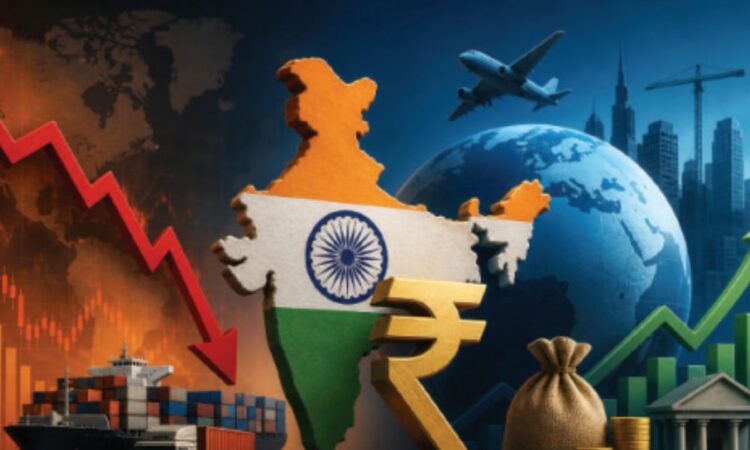
During the fiscal year 2025-26, based on market exchange rates, India had emerged as the world’s fourth-largest economy. India’s nominal GDP was estimated at rupees 357 lakh crore, and—based on a rupee-dollar exchange rate of Rs 85.40 per dollar—it was valued at $4.18 trillion. By that time, surpassing Japan’s GDP—which stood at just $4.10 trillion—the Indian economy had secured the fourth position globally.
The next milestone for India was to become. D the world’s third-largest economy. However, in the interim, due to two specific events, India’s GDP slipped two notches, falling to the sixth position globally. According to the International Monetary Fund’s (IMF) World Economic Outlook released in April 2026, Japan’s GDP stood at $4.38 trillion and the United Kingdom’s at $4.26 trillion; consequently, with India’s GDP standing at $4.15 trillion, the country temporarily slipped to the sixth position in terms of GDP size.
WHAT ARE THE REASONS BEHIND INDIA’S SLIDE?
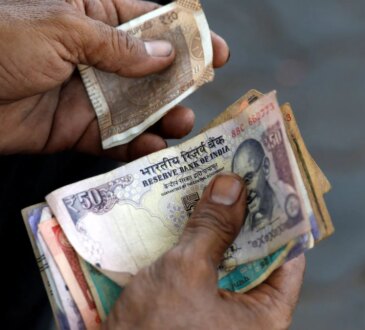
During the year 2025-26—when India’s GDP had reached the fourth position globally—the country’s nominal GDP was estimated at Rs 357 lakh crore. However, the base year used for measuring India’s GDP was recently revised from 2011-12 to 2022-23. Due to this change in the base year, India’s GDP for 2025-26 was re-estimated at a lower figure of Rs 345 lakh crore. Furthermore, in the wake of the conflict involving the U.S., Israel, and Iran, the value of the rupee witnessed a sharp decline against the dollar, resulting in significant depreciation of the Indian currency. As a result of these factors combined, India’s GDP contracted to $4.15 trillion. In other words, the value of India’s GDP—when denominated in dollars—declined for two reasons: first, due to a change in the base year, and second, due to the depreciation of the rupee. Conversely, Japan and England—which previously lagged behind India in terms of GDP—have witnessed a surge in their nominal GDP; this occurred because, despite their currencies also weakening against the dollar, rising inflation within these nations boosted their monetary GDP figures. However, this surge does not reflect an increase in their real GDP.
It is understandable that the revision of the base year is merely a procedural step; however, in reality, the primary reason for India slipping two notches down in terms of GDP ranking can be attributed to the depreciation of the Rupee. Some economic experts suggest that if India’s Balance of Payment’s deficit continues to widen at the present rate, and if Foreign Institutional Investors continue to exit Indian stock markets at the current pace, the Rupee could slide even further. Under such circumstances, it must be recognized that India’s global ranking—based on GDP—could drop even lower.
WHAT IS THE SOLUTION?
It is noteworthy that for quite some time, India’s nominal GDP has been growing rapidly; between 2014 and 2026, the nominal GDP recorded an average annual growth of approximately 10 percent. During the same period, however, the value of the Rupee relative to the US Dollar witnessed an annual depreciation of 3.5 to 4.0 percent. Consequently, India’s GDP—when measured in US Dollars—recorded a growth rate ranging from 6.2 to 7.0 percent. In other words, to establish itself as a strong nation on the global stage, it is imperative to halt the depreciation of the Rupee. Significantly, while the Rupee’s depreciation was recorded at 1.2 percent, 1.6 percent, and 2.2 percent—respectively—during the years 2023-24, 2024-25, and the first three quarters of 2025-26, this depreciation surged to 2.0 percent within the single quarter spanning January to March alone. In April—the first month of the 2026-27 fiscal year—the value of the Dollar has already risen from Rs 92.80 to reach Rs 95. It is precisely this depreciation that has caused India’s GDP ranking to slip from the fourth to the sixth position globally. It is possible, however, that this depreciation may subside once the war concludes and geopolitical conditions return to normalcy.
However, under current circumstances, it can be said that to increase India’s GDP in dollar terms, growth in the GDP measured solely in rupees is not sufficient; it is also necessary to keep the value of the rupee as strong as possible.
HOW CAN THE RUPEE BE STRENGTHENED?
It is noteworthy that, under the current global economic framework, the value of a currency is generally determined by the forces of demand and supply. Consequently, in the Indian context, the value of the Rupee—relative to the US Dollar and other currencies—is contingent upon the demand for and supply of Dollars. The supply of Dollars in the country comes from the export of goods and services, remittances from Non-Resident Indians (NRIs), and foreign investments (comprising both Foreign Direct Investment and Foreign Portfolio Investment).
Conversely, the demand for Dollars arises from the import of goods and services, the repatriation of investments by foreign investors, and overseas investments made by Indians. Over a considerable period, driven primarily by a surge in India’s imports—particularly those from China—our foreign trade deficit expanded from US$ 137 billion in 2014-15 to reach US$ 333 billion by 2025-26, out of which, trade deficit with China alone was US$ 112.1 billion in 2025-26. Despite a substantial surplus generated from the trade in services, India’s Current Account Balance of Payments deficit grew from US$ 26.9 billion to US$ 88.4 billion between 2014-15 and 2025-26.
The inflow of Foreign Direct Investment (FDI) into India from the rest of the world rose from US$ 45.15 billion in 2014-15 to US$ 82.4 billion in 2025-26; however, due to a significant surge in investments made by Indians abroad during the same period, the ‘net’ inflow of FDI into India declined from US$ 40.9 billion to US$ 10.2 billion.
Another source of foreign exchange for India has been institutional investors—specifically, those investors who participate in the stock market. However, this particular source has proven to be the most volatile one. During this period, Foreign Institutional Investment (FII) in India has fluctuated between US$ 41 billion and (minus) US$ 14.1 billion. Due to its inherent volatility, FII has also served as a significant source of instability for the Rupee. All forms of foreign investment have resulted in a substantial outflow of foreign currency in the form of income payments. This outflow manifests as dividends, interest, royalties, and technical fees. In the year 2024-25, this income outflow and inflow amounted to 101.8 billion US dollars and 53.4 billion US dollars respectively, meaning thereby a net outflow of 48.4 billion US dollars.
The sole reliable source of foreign exchange, has been the remittances sent by Indians residing abroad (NRIs and Persons of Indian Origin). While remittances from abroad stood at US$ 70 billion in 2014-15, they are expected to doubled to US$ 140 billion by 2025-26. These inflows have been growing steadily and consistently.
Today, as India navigates a phase of Rupee volatility—which poses a risk of rising inflation within the country and is causing India’s global standing to slip—we must take every possible step to curb this instability. To this end, we can restrict unnecessary imports by adopting additional tariff and nontariff measures.
It is imperative to recognize that imports into India are also rising unnecessarily due to foreign dumping practices. Various measures must be implemented, including curbing speculation in foreign currency and reining in the activities of Foreign Institutional Investors.
Although Foreign Direct Investment (FDI) is often deemed essential, it should be permitted only in hightechnology sectors and critical economic activities, so as to ensure the long-term stability of the Rupee.
Dr Ashwani Mahajan is National Co-convener, Swadeshi Jagran Manch. Former Professor, PGDAV College, University of Delhi.