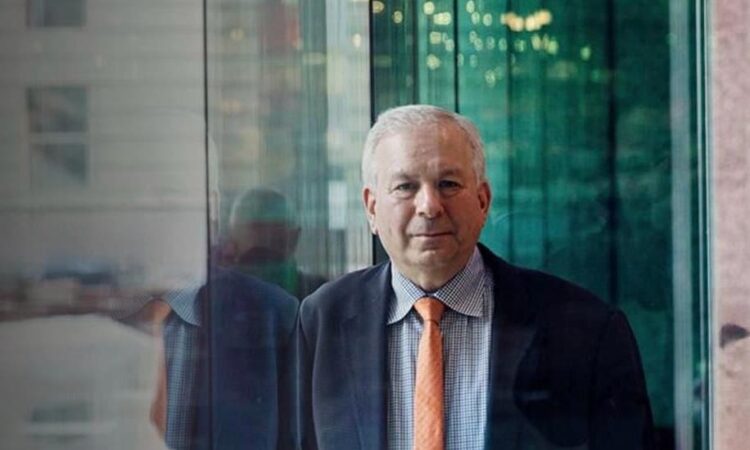
In U.S. equity markets, signs of exuberance are mounting. David Rosenberg, chief strategist and founder of Rosenberg Research, advises caution. He explains why the economic consequences of the war in the Middle East should not be underestimated and why he likes Asian equities and hard assets.
The rally seemed to materialize out of thin air: since late March, U.S. stocks have surged roughly 17%. Led by a phalanx of tech giants, the benchmark S&P 500 is hitting record highs almost daily. Investors are betting that the boom in artificial intelligence is only in its infancy, that oil prices will soon retreat, and that the economy remains on a path of robust growth.
David Rosenberg is not buying it. The chief strategist and founder of Rosenberg Research warns that the gargantuan capital expenditures fueling the AI boom will eventually carry a steep price. «I’m hamstrung by the ebullience and enthusiasm that has suddenly reemerged in the stock market,» he says of the record-chasing environment on Wall Street. «I wouldn’t necessarily say that I am outright bearish, but I remain cautious, and that’s strictly because of what I consider to be excessive valuations.»
The unwavering contrarian, whose daily «Breakfast with Dave» note is a staple for professional investors, and who, according to his own statements, will soon have exciting news to share, also weighs in on the war in the Middle East, the trajectory for oil prices, overlooked vulnerabilities in the economy, and the leadership transition at the Federal Reserve.
In this in-depth interview, which has been lightly edited for length and clarity, he further explains why he remains fully invested and identifies the sectors and global regions where he sees the most attractive opportunities.

«One theme coming out of this war is a necessity for countries around the world to stockpile – and that’s very good news for basic materials.»: David Rosenberg.
The S&P 500 is hitting one record after another. How are you reading this impressive rally?
What is truly remarkable about the market action is how suddenly investors have become so unconcerned about the renewal of tit-for-tat attacks between Iran and the U.S. The narrative is now dominated almost entirely by the AI boom, which shows no signs of slowing and is actually accelerating. The stock market also seems encouraged by the fact Wall Street analysts continue to raise their earnings forecasts despite rising energy prices and disrupted supply chains.
AI is overshadowing everything right now. Is this a healthy trend?
Looking closely, it is evident that the market is once again heavily concentrated in the AI trade. Virtually the only sector hitting new all-time highs are stocks connected to AI, primarily within technology. Since the end of March, nearly half of the S&P 500’s gains have been driven by a single subsector: semiconductors. The group now accounts for a record 18% of the index. By comparison, that share was 8% at the 2000 tech bubble peak, 4% in October 2022, and 11% a year ago. We have returned to a period of intense speculation that the hyperscalers will deliver on future returns despite their massive CapEx spend.
Amazon, Alphabet, Microsoft, and Meta Platforms are set to invest roughly $700 billion this year, an 80% jump from 2025. How long can this continue?
This scale of capital spending is unheard of. It leaves these companies with less cash on their balance sheets than at any point in the past decade. The combined free cash flow of these four hyperscalers is now projected to fall by minus $4 billion in Q3; a massive decline from a quarterly average of $45 billion over the past six years. We have reached the stage of the AI spending cycle where companies are compelled to fund their immense buildout through cash burn, massive debt issuance, and job cuts. What comes next in this trade-off is a compression in shareholder returns, a reality most investors underappreciate.
What leads you to that conclusion?
This is not normal corporate spending. It’s a major industrial build-out dressed up as a technology story. With the exception of Amazon, these have been relatively asset-light companies with high free cash flow. But now, they begin to look no different than their Old Economy capital-heavy industrial counterparts of yesteryear. And that means their free cash flow is dwindling.
What does this mean for the general outlook for U.S. equities?
As I said, I am hamstrung by the ebullience and enthusiasm that has suddenly reemerged in the stock market. My investment philosophy is inherently contrarian; when herd mentality surfaces, I tend to move in the opposite direction.
How is that reflected in your portfolio?
I wouldn’t necessarily say that I am outright bearish, but I remain cautious, and that’s strictly because of what I consider to be excessive valuations in the S&P 500. I always look at the equity risk premium, as one must evaluate stock market valuations relative to the risk-free interest rate. In this regard, my favorite multiple is the CAPE, the cyclically adjusted price-earnings multiple. It spans more than a century, and I like the fact that it smooths out the fluctuations in the economy. On a CAPE multiple basis close to 40, this remains one of the most expensive stock markets on record.
However, valuations are usually not very helpful when it comes to identifying market turning points.
I agree with that, but the starting valuation really tells you whether you have the wind at your back or in your face. My dilemma is this: The real yield on the S&P 500, based on the CAPE, is 2.7%. The real yield on the long bond – since one must match a long-duration asset class with a long-duration asset class – is also 2.7%. Ergo, the equity risk premium is zero. I am trying to wrap my head around that, because the equity market is effectively telling you that the S&P 500 has somehow emerged as a riskless asset class. Philosophically, I must push back on that.
Investor confidence is also tied to robust economic data. GDP expanded by 2% in the first quarter. Given the supply shock resulting from the war, isn’t that good news?
To that, let me just say that 70% of GDP growth in the first quarter came from AI CapEx. However, when you strip out three areas of the U.S. economy – AI CapEx, financial services which are linked to the stock market, and healthcare – the rest of the economy is actually in recession. So in aggregate, nearly three-quarters of GDP just posted a back-to-back decline. However, few seem to recognize that when looking at GDP on a diffusion basis, the broader economy is in a state of serious deterioration.
The key question is how the rise in energy prices will affect consumption in the coming months. What do you think?
We have not seen the full effects of the energy price shock yet. That is simply because we are currently seeing the impact on household cash flow from higher income tax refunds. However, that only provides a buffer for two or three months, while the negative consequences of the war steadily increase. I don’t see how this impasse between the United States and Iran is going to be broken; both sides now seem to be digging in their heels. My sense is that the White House sees the Iranian economy is collapsing. Iran is losing a tremendous amount of revenue due to the blockade. So it could well be that the strategy of the Trump administration is to wait until the Iranian economy collapses to such an extent that it reignites the kind of uprising seen in January.
What are the chances of this strategy succeeding?
That is hard to say. It may be the endgame, but it could take several months to play out. The one thing we know about Iran is its ability to withstand a tremendous amount of pain. Remember that Iran endured an eight-year war with Iraq in the 1980s, in which 500,000 lives were lost. Even though Saddam Hussein proposed a truce after two years of that conflict, Iran continued fighting for another six years.
What does this mean for oil prices?
There is still a pervasive belief that this war will end soon, and that once it does, oil prices will retreat. I think that is where the surprise will be: over the next three months, oil prices may continue to hit new highs. Even if traffic begins to flow through the Strait of Hormuz again, the damage to energy infrastructure is extensive. Furthermore, the world is severely supply-constrained, especially given that spare production capacity is quite thin. So there is a risk that if this situation is not resolved, we could be sitting here within a few months with oil at $180 a barrel. That is a level that would definitely tip the global economy into a recession, and that would finally break the back of this bull market in stocks.
Then again, the resilience of the U.S. economy has consistently defied expectations in recent years. Like many market observers, you anticipated a post-pandemic recession that never materialized. Why should this time be any different?
Yes, I did call for a recession. All the classic signs were there: aggressive Fed tightening, an inverted yield curve, and so on. But the recession never came. That was a blown call. What I missed was the fact that we had $2 trillion in pandemic-era stimulus still in the system, and all that money was spent. This time, however, we don’t have that $2 trillion cushion. If oil prices reach $170 or $180, which I believe is a very real possibility, recession risks will certainly rise. And while the AI CapEx boom is providing a significant glow, this is not a rising tide lifting all boats. It is highly unlikely that it can offset the crunch on the consumer from a further spike in crude prices. So, I am not calling for a recession today, but I am on recession watch.
How will the Fed react? It seems that Kevin Warsh, who takes over as Fed Chair this week, faces a difficult task.
They’ve already told us what they’re going to do: adopt a wait-and-see approach. Don’t forget that a lot of this is about preserving credibility. I don’t think we’d be hearing as much from the FOMC hawks if it wasn’t for the miserable memory of blowing the inflation call with «transitory» back in 2021 and 2022. They simply don’t want to appear to be letting their guard down.
Jerome Powell, the previous Fed Chair, intends to remain on the Board of Governors for the time being. This, until the Trump administration has fully settled the investigation against him regarding cost overruns in the renovation of the Fed building in Washington D.C. What does this unusual situation mean for monetary policy?
There’s an ironclad guarantee that Donald Trump will continue to badger Jay Powell. There’s just a lot of animosity there. For his part, Powell has shown a lot of class by not biting. So, while Trump will likely continue his attacks, I think most people are just going to tune that out. Meanwhile, Kevin Warsh is very well respected. As a former Fed governor, he’s intimately familiar with the process of setting monetary policy, and I don’t think he will upset the apple cart. However, if he wants to cut interest rates, he has his work cut out for him to build a consensus on the FOMC, and as we saw at the last meeting, there is no consensus right now.
The disagreements stem from the uncertain effect of the Iran war on inflation. How great is the risk of a sustained surge in prices on every day goods?
Of course, numerically, we’re going to have several months of higher CPI prints because of higher energy prices. But I don’t think inflation expectations will become unhinged. We have a template thanks to the effects of tariffs on inflation: everyone thought the U.S. effective tariff rate going from 2% to 15% last year was going to produce a whole lot of inflation in the product sector, but that didn’t happen.
Does that mean the effect of energy prices is being dampened by other factors?
Yes, because much more important for the overall picture is that we’re going to have significant disinflation coming in the shelter components of the CPI, and that will be the dominant impact since the housing market is in a recession of its own. But the main reason I’m not worried about interest rates going up is because of the labor market. This is a completely different labor market than back in 2021 and 2022; it’s not nearly as tight as it was back then. This is most evident in wages: real average weekly earnings fell by 0.2% month-over-month in April, on top of a 0.9% slide in March. That’s not exactly what I would call a «solid» economy.
Against that backdrop, what is your outlook for interest rates?
The economy will dictate where interest rates go, and I think they will be going down, though probably not until later in the year. Let’s keep one more thing in perspective: In Gulf War I, which started with Operation Desert Shield in the summer of 1990 and morphed into Operation Desert Storm in the winter of 1991, the oil price more than doubled from below $20 a barrel to $40. Yet, Alan Greenspan, who was Fed chairman at the time, cut rates five times during that period, even though headline inflation went from 4% to 6%.
How come?
Greenspan cut rates because inflation expectations didn’t become unhinged against the backdrop of the recession at that time. There was no sign that higher energy prices were filtering into core inflation. So, once we get more evidence of a similar development today, you’re going to hear a much less hawkish tone out of the Fed. That’s why I believe the next step will be a cut, and I think there will be more than one.
What are the implications for the dollar?
In all likelihood, I expect the dollar is going to be weaker rather than stronger. The one part of the world where there is still a lot of optimism being priced in is the U.S., and that optimism is going to face a very serious challenge in the second half of the year. As expectations reverse course, we will get back to the situation before the war where the market thought we were going to get a couple of rate cuts and the dollar was weak. I think that trend will resume sometime in the second half of the year. So, I’m not a monumental dollar bear, but I am a dollar bear nonetheless.
What do you advise investors under these circumstances?
In our model portfolio, we’re 40% in the equity market and 40% in the bond market, but mostly in the front end of the US, Canada, Australia. So as long as you speak English, I like your bond market. The remaining 20% is in hard assets; whether it’s uranium, rare earths, energy infrastructure or gold. Generally speaking, I would say we’re gravitating our portfolio towards a hard asset strategy that spins off a cash flow stream. I expect that trend is going to continue because one theme coming out of this war is a necessity for countries around the world to stockpile – and that’s very good news for basic materials. They are also very good inflation hedges, in case I’m wrong and inflation doesn’t end up coming down.
Where else do you see opportunity?
Defense stocks have pulled back, which makes them look even more attractive. Moreover, we’ve recently added another winner coming out of the war: clean energy. But the bottom line is that we’re fully invested. To me, there’s no rationale for holding cash right now because there are better opportunities elsewhere. I’d rather be in North American pipelines that deliver nice cash flow and dividend streams. In this space, we’re investing without necessarily making a call on the price of oil. We’re really making a call on the revamping of the power grid and what we see as the future of a bull market in energy infrastructure.
How is your portfolio positioned geographically?
Regarding equities, we truly like Asia. China is the biggest component of the MSCI AC Asia ex Japan Index, and valuations are much more compelling than in the US. In addition, China’s position is likely to be strengthened internationally by the war, without Beijing having to lift a finger. They built up enough oil reserves to withstand the impact of this war. Also, in clean energy, they’re so far ahead of everybody else, and that is where the world is heading. In bonds, Latin America is also well represented in our portfolio, as there are attractive real yields there.
In our last interview, you said that gold would rise to $6,000 per ounce. At that time, the price was around $3,300, after which it climbed to $5,400 by the end of January. It now stands at $4,700. Do you stand by your original forecast?
Yes, of course. This is not the first time that gold has corrected in the midst of a crisis. It largely occurs because investors tend to sell their winners to meet their margin calls. The same thing happened, for example, after Lehman collapsed in the fall of 2008.
What keeps the bull case for gold alive?
In secular bull markets, correction phases occur every now and then. I started as a Wall Street economist on October 19, 1987, known as Black Monday. The Dow plummeted 22.6% that day, the largest one-day percentage loss in its history, and that was in the context of a bull market in equities that had started in the summer of 1982. Today, gold remains in a secular bull market. It will end when we start hearing that central banks have completed their process of normalizing their bullion reserves. That hasn’t happened yet, so the overall trend in the gold price remains up – and if we go through that $6,000 threshold, it would not surprise me in the least.
David Rosenberg