
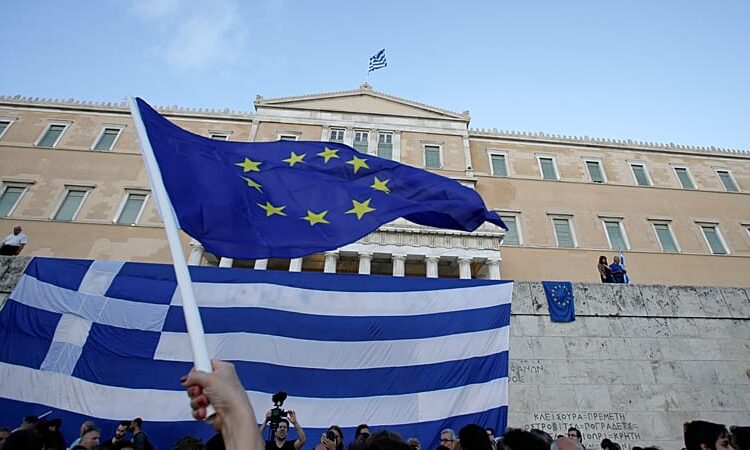
On the morning of 29 June 2015, Greeks woke up to find their banks closed.
ATMs were limited to €60 a day. The Athens Stock Exchange did not open for trading.
Capital controls, the kind associated with crisis-era emerging markets rather than members of a developed-economy currency union, had arrived.
Five years earlier, in April and June 2010, Standard & Poor’s and Moody’s had cut Greek sovereign debt to junk, the first eurozone member to lose investment grade.
By February 2016 the Athex Composite had bottomed at 516.7 points, a fall of more than 90% from its October 2007 high of 5,334.5. The FTSE Athex Banks index, the country’s lenders, had collapsed by 99.6%.
Greek equities had ceased to function as an asset class.
They had become an obituary.
A decade on, the obituary needs rewriting. The Athens Composite Index has returned roughly 146% over the past five years on a total-return basis.
The Nasdaq 100, riding the artificial intelligence supercycle that has dominated global equity narratives, returned 116% over the same window. The S&P 500 delivered only about half of Greece’s gains, while European large-cap equities – tracked by the Euro STOXX 50 – achieved barely one-third.
This is the story of how Europe’s cautionary tale became one of the best turnaround trades of the modern era.
Greek stocks beat Nasdaq 100 over 5 years: Here is why
To understand the rally, start with the lenders. National Bank of Greece, Eurobank, Piraeus Bank and Alpha Bank carried the heaviest load through the crisis decade.
By late 2016 their combined non-performing loan ratio peaked near 47%, the worst in the European Union. For perspective, most other troubled European banking systems peaked at between 5% and 8%.
Greek lenders were not facing a credit problem. They were carrying a depression on their balance sheets.
The clean-up unfolded in two stages.
The Hellenic Asset Protection Scheme, known as Hercules, allowed the banks to securitise and offload roughly €57bn of bad loans through state-backed guarantees on the senior tranches.
The second leg was the slower work of organic profitability: stabilising deposits, restructuring cost bases, restoring net interest margins.
From bailout to bull market: The Athens turnaround
Combined net profits of the four largest Greek banks reached close to €5bn in 2025.
Shareholder payouts followed suit. Piraeus, Eurobank and Alpha Bank distributed around 55% of earnings, while National Bank of Greece pushed its total payout ratio to 86%, supported by aggressive buybacks.
Konstantinos Hatzidakis, then Greece’s minister of economy and finance, captured the moment in the IMF’s Finance & Development journal in June 2025.


