
Upcoming Investments

‘I’m 70 and selling my buy-to-let. Can my investments replace my lost income?’


Would you like Victoria to rate your portfolio? Email money@telegraph.co.uk with the subject line: “Rate my portfolio”. Please include a breakdown of your portfolio, your age and what your investing goals are. Full names will not be published.

Dear Victoria,

I’m 70 years old. I own two houses – one I live in and another I rent out.

I’m in the process of selling the rental property for £185,000 at a discount to my tenants. I receive the state pension and have two local government pensions. My total income from these and with rent from the property comes to around £45,000. My wife has a state pension and a small local government pension.

I’m looking to use my investments to replace the rental income I’ll be losing. Last year, I earned around £8,000 in dividends, some within an Isa and others out of wrapper.

Kind regards,

– John

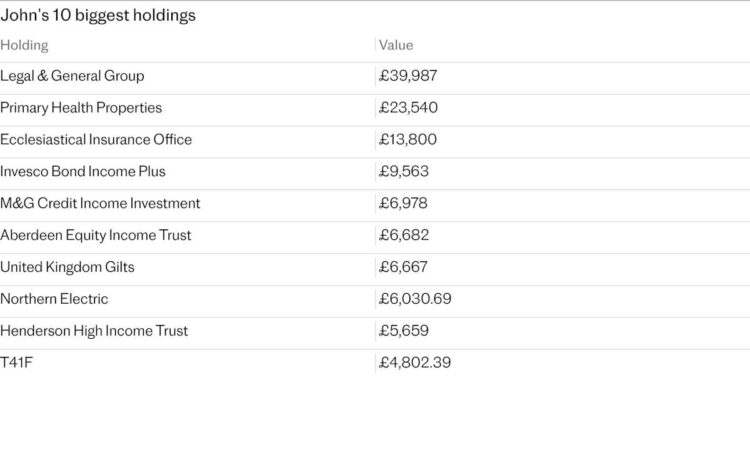
John's 10 biggest holdings
John’s 10 biggest holdings

Dear John,

Before tackling your investments, make sure you have an up-to-date will which aligns with your latest wishes and check your inheritance tax position.

Generally, a couple can pass on up to £1m inheritance tax-free, assuming you leave your house to children or grandchildren. That’s because you can combine two sets of allowances – the £325,000 nil-rate band and the £175,000 residence nil-rate band.

If you expect an inheritance tax liability, a simple way to reduce your bill is to make gifts of up to £3,000 each per tax year, which are then immediately considered outside the estate for inheritance tax purposes.

Moving on to your portfolio. Your holdings are spread across direct equities, real estate investment trusts and income-focussed investment trusts and gilts, providing your portfolio with a trailing 12-month yield of 7.5pc, which aligns with your goal to derive income from your investments.

However, 15 holdings are quite a lot to keep track of, especially the single stocks which typically require a bit more attention.

There is no magic number of investments in a portfolio but I’m sure you will want to keep things simple, giving you time to relax and enjoy retirement.

You’ve got quite a few small positions such as Jubilee Metals Group, Aberdeen Asian Income Fund, Genel Energy and BlackRock World Mining Trust, which each account for less than 1pc of your portfolio, making them too small to impact your overall returns.

Therefore, they could be worth either letting go of or you could top some of them up to build more conviction holdings.

At the other end of the size spectrum, one company Legal & General accounts for a whopping 30pc of your overall portfolio.

No doubt its more than 8pc dividend yield is highly alluring and explains why it is consistently one of the most popular stocks on the Interactive Investor platform. However, this allocation is risky, as almost a third of your wealth is tied to the fortunes of a single business.

Stocks can be very volatile and there’s no way to rule out the chance of a negative shock that heavily punishes shares. Don’t forget that a company can always cut its dividend. Since nothing is guaranteed, diversification is critical.

I also notice a heavy home bias, with UK investments accounting for 94pc of your portfolio. That compares to just 3pc for several global equity indexes.

While the UK market is undeniably an attractive destination for dividend investors like you, having such a heavy domestic weighting lands you with significant single-country risk and going global could help solve this.

To achieve this while keeping a focus on generating income, you might consider Fidelity Global Dividend. This fund is designed to give investors a smoother ride through market cycles, investing in companies from across the globe that offer a healthy dividend yield and the potential for capital growth.

Companies that demonstrate pricing power and robust balance sheets are favoured and companies with large amounts of debt are avoided. The fund boasts an excellent track record since its inception. While it has around a 15pc allocation to the UK, you would also be gaining exposure to a number of other markets globally such as Switzerland, Germany, France and Taiwan.

In your asset allocation, you are holding 80pc in equities, 16pc in bonds and about 4pc in cash. The Pimfa income investor asset allocation has 47.5pc in equities, 32.5pc in bonds and the rest in cash, real estate and alternatives. This benchmark can be a useful comparison and suggests that an income investor like you might benefit from a higher allocation to bonds.

In certain market environments, particularly during equity drawdowns, bonds typically (not always) provide a stabilising effect.

However, recent inflation fears have prompted a bond market sell-off, highlighting how the asset class offers less diversification benefit during inflation-led shocks. In the longer term, they still have value in reducing portfolio volatility. Plus, the market’s weakness arguably created better entry points and the potential for higher returns.

One fund worth exploring is the Pimco GIS Global Investment Grade Credit Fund.

The fund is led by Mohit Mittal with the aim of maximising total returns and outperforming the Bloomberg Global Aggregate Credit Index via top-down duration and sector positioning as well as in-depth issuer analysis.

The fund comprises more than 1,400 issuances, diversified across geographies, credit ratings and duration (allowing up to 15pc in below-investment-grade issuances). The current yield of 4.6pc is attractive and the charge of 0.49pc is compelling given the resources and experience behind the management team.

Victoria is head of investment at Interactive Investor. Her columns should not be taken as advice or as a personal recommendation but as a starting point for readers to undertake their own further research.

Try full access to The Telegraph free today. Unlock their award-winning website and essential news app, plus useful tools and expert guides for your money, health and holidays.


Source link

Leave a Response