
Africa faces new competition for critical minerals investment as U.S. secures Greenland rare earth deal in bid to cut China reliance
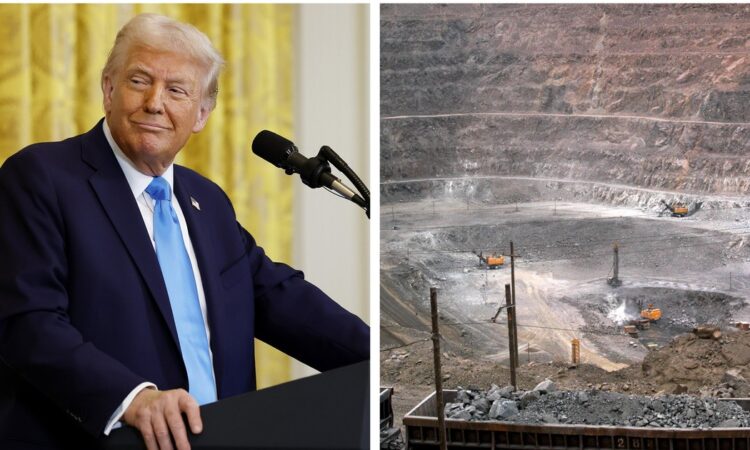
REalloys, a Florida-based rare earth materials company, has signed a 15-year offtake agreement with Critical Metals Corp. covering 15% of Phase 1 production from the Tanbreez project in southern Greenland.
The deposit is among the world’s largest known sources of heavy rare earth elements, including dysprosium and terbium, two minerals essential for fighter jets, missile systems, radar platforms, drones and other advanced defence technologies.
The deal comes as the United States seeks alternative rare earth supplies ahead of a Pentagon requirement due to take effect in 2027 that will restrict the use of Chinese-origin materials in key defence applications.
It also strengthens Washington’s efforts to diversify critical mineral supply chains at a time when its ambitions in Africa face challenges ranging from insecurity in key mining regions to China’s entrenched presence across much of the continent’s critical minerals sector.
Africa’s rare earth ambitions face new competition
Recent reports citing the South China Morning Post said the United States may have only about two months of certain rare earth supplies available for military use amid increased demand linked to the conflict with Iran.
The situation has added urgency to Washington’s efforts to secure supplies of critical minerals used in missile systems, defence equipment and other advanced military technologies.
Reflecting those concerns, Ukrainian President Volodymyr Zelensky warned on X that: “There is not enough anti-ballistic missile production in the United States and this could lead to a crisis in different parts of the world.”
The urgency is heightened by China’s dominance of the global rare earth industry, with the International Energy Agency estimating that the country accounted for about 60% of global mining production and approximately 91% of refining capacity in 2024.
Reducing that dependence has become a priority for the Trump administration, which has pursued critical mineral opportunities across both Africa and Greenland as part of a broader effort to build supply chains independent of China.
Although President Donald Trump’s proposals to acquire Greenland were rejected by both Greenland and Denmark, with Danish Prime Minister Mette Frederiksen insisting that “Greenland is not for sale,”
At the same time, the United States was deepening its engagement with Africa, home to an estimated 30% of the world’s proven critical mineral reserves.
Africa’s rare earth ambitions face new competition
In December 2025, Washington signed a strategic minerals agreement with the Democratic Republic of Congo (DRC), home to some of the world’s richest critical mineral deposits
Similar challenges exist elsewhere on the continent, with political instability and security threats linked to armed groups continuing to complicate mining operations and investment planning in Mali.
Likewise, the insurgency in Mozambique’s Cabo Delgado province has raised risks for major resource investments, including projects linked to the Balama graphite mine, one of the world’s largest graphite operations.
Meanwhile, regulatory and permitting challenges have also complicated the development of critical mineral projects in parts of Africa.
Kenya’s Mrima Hill project has been delayed for years by licensing disputes and court battles, while several mining ventures in Madagascar have encountered permitting and regulatory hurdles.
Africa’s rare earth pipeline continues to expand
Despite those challenges, Africa remains one of the world’s most promising regions for rare earth development.
Other advanced projects include Australia’s Peak Rare Earths’ Ngualla project in Tanzania, Canada’s Mkango Resources’ Songwe Hill project in Malawi and South Africa-based Rainbow Rare Earths’ Phalaborwa project in South Africa.
New discoveries are also expanding Africa’s pipeline. On May 27, Australian company Sovereign Metals announced the discovery of high-grade heavy rare earth elements at its Kasiya graphite and rutile project in Malawi.
In Botswana, Canadian-listed Tsodilo Resources recently confirmed significant rare earth mineralisation at its Gcwihaba Metals Project, while fellow Canadian company Mkango Resources continues to expand its exploration activities in the country.
Namibia’s Lofdal project, being developed by Canada’s Namibia Critical Metals in partnership with Japan’s JOGMEC, remains one of Africa’s most promising heavy rare earth deposits.
Benchmark Mineral Intelligence estimated in 2024 that Africa could account for about 9% of the global rare earth market by 2029 if projects currently under development proceed as planned.
However, while the United States and other Western governments continue to invest in Africa’s emerging critical minerals sector, security, regulatory and operational challenges across parts of the continent have increased the appeal of politically stable jurisdictions such as Greenland as alternative sources of long-term supply.


