
When Brian Schaefer returned to the family business in 2004, he didn’t arrive with a blueprint for where Troymill Wood Products should go. He did, however, reach one conclusion fairly quickly.

“What my grandfather did worked for him, but it didn’t really work for my father,” Schaefer said. “What my father did worked for him, but it wasn’t going to work for me. The business changes too quickly.” It is an approach that Troymill continues to embrace.
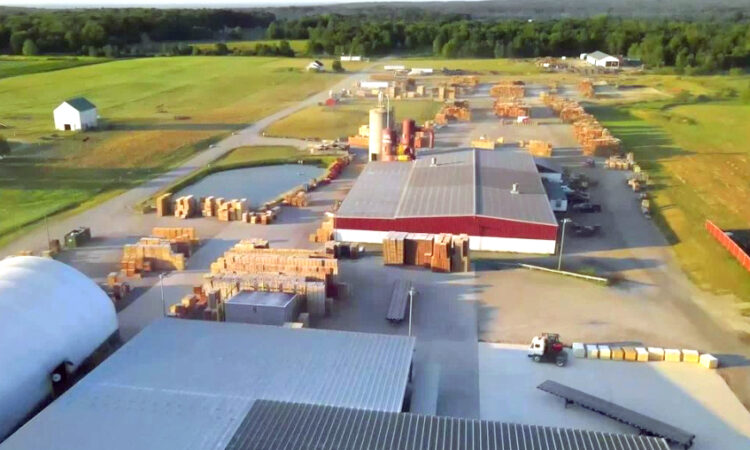
Today the Middlefield, Ohio-based company operates three manufacturing facilities, produces more than 50,000 pallets each week, and serves customers ranging from steel mills, consumer products companies and automotive manufacturers to aerospace and defense contractors. Along the way, it has continued to add capabilities through acquisitions, new equipment, expanded manufacturing capacity and, most recently, artificial intelligence.
“We’ve grown to a size that none of us thought was possible,” Schaefer reflected. “We saw opportunities here and there, followed our customers, followed the growth spots, and when you look back, you realize you’ve gone a lot farther than you thought you could.”

Building on Three Generations
Troymill’s roots reach back to Brian Schaefer’s grandfather, who entered the lumber business during the 1950s. Brian’s father and uncle joined the business during the 1970s before eventually acquiring a small pallet and crate manufacturer in Middlefield that would become Troymill Wood Products.
Brian returned to northeast Ohio in 2004 after graduating from the University of Wisconsin in 2001 and spending three years as a commodity trader at the Chicago Board of Trade. In ’04, he began graduate studies at Case Western Reserve University. He spent his days learning the business while working toward his MBA at night.
Looking back, Schaefer laughs about those first years. “I was young and didn’t know anything,” he recalled. “I had the luxury of making a lot of mistakes. Being the boss’s son, I probably wasn’t going to get fired as long as my intentions were good.”
Those years also reinforced another lesson. “You can’t get married to your inventory,” Schaefer said. “You can’t get married to a type of customer or a type of pallet or a way of doing things. You have to keep an open mind and let the business tell you what you’re doing right, what you’re doing wrong and what you should be doing next.”
Although pallets are Troymill’s largest product category, they currently represent only about 60% of the company’s business. The balance comes from industrial lumber, dunnage, blocking, custom crates, heavy timber products and specialty wood components serving a wide variety of industrial customers. That diversity has become one of the company’s biggest strengths.

Broad Customer Base
“When we hear other manufacturers are slow, it’s often because they’re focused on one thing,” said Jesse Kleinman, now in his tenth year with Troymill. “They’re overly focused on a 48×40 GMA pallet. We’re not.”
Instead, Troymill may be producing hardwood dunnage for a steel mill, oversized crates for industrial machinery, specialty packaging components or custom products built to exact customer specifications. Some specialty orders are shipped across the country. One order during the COVID years even came from SpaceX. “We kept telling them there had to be somebody between Ohio and Florida that could build those pallets cheaper,” Schaefer said with a laugh. “They just didn’t care.”
The same flexibility applies to raw materials. Whether customers need hardwoods, Southern yellow pine, SPF, plywood, OSB or imported eucalyptus, Schaefer said Troymill can usually source the material or already has it in stock.
Troymill typically stocks between three and four million board feet of hardwood cants, along with another one to two million board feet of Southern yellow pine, SPF, plywood and OSB at its flagship operation. Those totals do not include inventory at the company’s other facilities. Schaefer is quick to point out, however, that inventory has to keep moving. “We’re not collectors,” he said. “We buy and we sell.”

Turning a Boom Into an Opportunity
Like much of the pallet industry, Troymill experienced extraordinary demand during the COVID years. Sales volumes were brisk, and vulnerabilities were exposed.
“We had become too reliant on outside suppliers,” he explained. “While we knew that the COVID level of activity wasn’t going to be sustainable, we figured we would take some of the money we were earning then and reinvest it into the business.”
Schaefer said, “Troymill has been blessed with an amazing team, and we had put them through the ringer during the COVID craze. We felt we owed it to them to identify and improve upon areas that were overworked and under-invested, such as heat treatment, logistics, IT and machinery upgrades. We invested a lot into these areas, and we believe they led to real improvements.”
The company focused on operations that had long been operating at or near capacity. Heat treating was one. “We never had enough capacity,” Schaefer said. “We were always playing catch-up. We had one SII Dry Kiln in Middlefield and we really liked how it operated, and we enjoyed working with the team at SII, so we decided to buy another.” Troymill doubled its heat-treating capacity with the new SII kiln. Schaefer continued, “We installed it in the spring of 2024, and we’ve been very pleased with its performance from day one.”
Another area that was quickly identified was the grooved line in the sawmill. “We do a lot of groove stock and banding block, and we could just never keep up,” he recalled.
Initially as part of a broader investment program, Schaefer simply planned to build another saw line, but the team’s thinking quickly evolved. “We started designing it in 2022,” he said. “We decided not only to expand the groove processing, but also asked ourselves, ‘What do we wish we had in the current lines now? Let’s do it on this line.’”
The company turned once again to Keystone Machinery, a relationship that dates back to 2005-2006 when Keystone designed a custom line after a devastating fire forced Troymill to rebuild part of its operation. “We already had one and we liked the product,” Schaefer said. “We’ve had a long relationship with Keystone, and they’ve always been willing to work with us on custom solutions.”
The resulting system reflects the way Troymill manufactures products rather than forcing production to fit a standard layout. Material begins on an unscrambler before entering a five-head circular cutoff saw. It then moves through a sizer head and splitter before reaching the first bank of horizontal bandsaws. Depending on the size of the cant, material may pass through as many as eight horizontal bandsaws before making two 90-degree turns and returning to nearly the same location where it entered the line on an automatic stacker.
The design also provides options. Material can bypass the second bank of bandsaws and move directly to an in-line double-head notcher, while a separate unscrambler allows the notcher to operate independently. At times, Troymill can be cutting deck boards on one end of the line while simultaneously producing runners on the other.
The new line exceeded expectations almost immediately. “It ran about 20% faster than we thought it would,” Schaefer said. Today, Troymill estimates it now cuts about 95% of the lumber it consumes internally, giving the company greater control over production scheduling while reducing its reliance on outside processors.

Three Plants, Three Different Roles
The company’s three Ohio manufacturing facilities also reflect its emphasis on flexibility. Troymill’s second Middlefield operation came through an acquisition in 2013. Although it sits only a couple of miles from the flagship plant, Schaefer said it has remained an important part of the company’s manufacturing strategy.
“It allows for a bit of redundancy,” he explained. “It’s smaller and more flexible. We can route expedited orders through there much more easily than the larger facility.” The plant includes its own resaw shop, hand assembly stations and a custom-built semi-automatic nailing machine.
The company’s Carrollton operation fills a different role. It expands Troymill’s geographic reach while giving the company access to another labor market and lumber supply. It also provides additional production capacity with its own resaw shop, heat-treating system, a Champion nailing machine and Viking 505. Troymill runs three additional 505s at its main plant and is looking to invest in new automated pallet-nailing capacity in the near future.
 Troymill relies significantly on Viking for its nailing machines. It runs four Viking 505s and a Champion.
Investing in People as Well as Equipment
While Troymill continues investing in machinery, Schaefer believes some of the company’s biggest opportunities lie elsewhere. It has begun developing internal artificial intelligence tools designed to simplify routine work while making decades of accumulated knowledge easier for employees to access.
“The philosophy behind it is we’re trying to support our people,” Schaefer said. “If we can take an hour-long task and turn it into five minutes, they can spend more time doing higher-value work.” The first project focuses on management reporting by automatically bringing information together from multiple systems into a single dashboard.
Longer term, Schaefer envisions an internal AI assistant capable of answering questions that today often depend on finding the right employee. “It’s all the things everybody knows, collectively, but they’re scattered,” he said. “We want to put it in one place.”

Opening New Markets
Troymill’s willingness to expand its capabilities extends beyond the shop floor. Brian’s older brother, Michael Schaefer, joined the company two years ago after spending much of his career working with Fortune 500 companies and other sophisticated customers. Brian said Michael has been instrumental in helping Troymill pursue more complex bids, including military, federal, state and municipal opportunities.
Some of that work has already produced memorable stories. One project began with an inquiry from an officer aboard a U.S. Navy aircraft carrier. Troymill was asked to design crates used to transfer cylinders safely from the dock onto the ship.
Communication required patience. “We’d send them a drawing,” Brian Schaefer recalled. “Then they’d tell us, ‘We’ll be back in cell phone range in about two weeks.’” Eventually the design was finalized, and the crates were delivered.
Not long afterward, another naval project followed. “We got downgraded,” Schaefer quipped, tongue firmly in cheek. “It was a smaller combat ship, so it was a little bruise to our ego.”
That order involved specially manufactured wedges that would be shipped to the West Coast before continuing into the Pacific. For Schaefer, delivering needed products to support the nation’s defense is a matter of company pride.
“It’s nice to do something for the country,” he concluded. “Selling a GMA pallet is great, but knowing something your employees built is going onto an aircraft carrier is pretty cool.”


