For decades, the U.S. dollar has been the world’s go-to currency. But as global dynamics shift and new technologies continue to emerge, experts are starting to question whether its dominance could eventually fade.
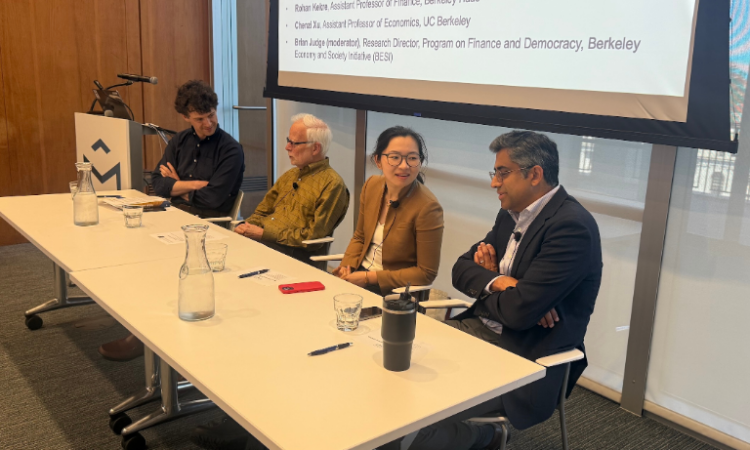
During a Social Science Matrix panel titled, “The U.S. Dollar Hegemony in Transition,” Economics and Political Science Professor Barry Eichengreen, Economics Professor Chenzi Xu and Haas Finance Professor Rohan Kekre examined the foundations of dollar dominance and what might come next.
The discussion centered around how the dollar continues to hold such a central role due to the many ways it is woven into the global financial system. The panelists explained that even though the U.S. economy makes up a smaller share of the world than it used to, the dollar remains deeply embedded in nearly every corner of the international financial system — from central bank reserves to foreign exchange markets.
Eichengreen explained that the dollar is responsible for 57% of global foreign exchange reserves worldwide, and 90% of all foreign exchange transactions worldwide.
“The dollar punches above its weight, if you will,” he said. “And the length of time in which dollar dominance has been a fact of global life is striking.”
Eichengreen traced the dollar’s dominance back to the post-World War II era and noted that it endured even after the U.S. ended its link to gold in 1971, going against what many economists at the time predicted.
According to Eichengreen, the persistence of dollar hegemony (or dominance) is multilayered: partially because of the absence of alternative currencies, and partly because of trust in U.S. governance and its global alliances. Countries, he explained, tend to hold the currencies of their allies, reinforcing the dollar’s role through decades of political and economic ties.
Still, he cautioned this dominance may not be permanent. He pointed to concern about the reliability of the U.S. as a trustworthy partner, as well as the diversification of central banks to non-traditional reserve currencies, as potential reasons.
“So what does this imply for the future?” he asked. “I do think that we’re moving away from dollar dominance. I’ve been forecasting movement toward a more multipolar, less dollar-centric global monetary and financial system for years, and I’ll keep forecasting it until I’m right!”
Echoing this perspective, Xu emphasized the scale and interconnectedness of the dollar system today. She showed that roughly 60% of global official reserves are held in dollars, compared to just over 20% in euros, which are the next closest alternative — a gap that reflects the dollar’s central role across multiple dimensions.
She explained that the dollar serves many roles — from a reserve asset to a safe haven in times of crisis. At the core of this system, she said, is the U.S.’s ability to supply large quantities of safe, liquid assets — such as stocks and bonds that can quickly be converted to cash without losing much value.
“At the heart of what I think creates this hegemony is this idea that the U.S. is large enough and stable enough to support the space of assets,” she said.
She went on to explain how this system is self-reinforcing — because so many governments, banks and firms already rely on the dollar, switching to an alternative would require replicating an entire financial infrastructure.
“Once you have hegemony in one dimension, it becomes economically advantageous to continue using the dollar in other dimensions,” she said. “It’s hard to think about a real alternative because a large number of institutions — private and public — are upholding these network effects.”
Still, she pointed to past dominant currencies — like the Dutch guilder and the British pound — to show that these transitions do happen, often driven by financial innovation, geopolitical shifts and periods of fiscal strain.
Kekre raised the possibility that demand for dollar-denominated assets may already be eroding, with implications for interest rates for U.S. dollar borrowers and the global reach of U.S. monetary policy.
Overall, the panelists offered a balanced view: while the dollar remains firmly at the center of the global financial system, the factors sustaining its dominance are evolving. New technologies like digital assets and payment systems, along with geopolitical uncertainty, could gradually reshape how the system works.