
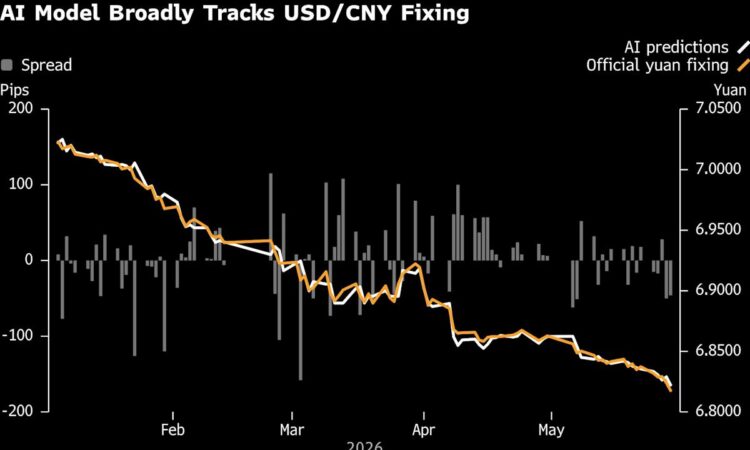
(Bloomberg) — It’s been a source of intrigue and confusion among currency traders for years. Just how does China decide each day where it’s going to set its fixing rate for the yuan — a reference point that determines its permitted trading range for the next session?
Most Read from Bloomberg
Now, a small group of traders are using artificial intelligence models in an attempt to decode the nation’s opaque currency policy.
Among them is Ding Di, who works for a Shanghai-based bank’s investment department. For the past year, Di has been working with the Gemini-powered AI model Xiao Long, also known as Little Dragon, to see if it could help him predict where the People’s Bank of China would set the daily yuan reference rate.
Di got an early taste of success on March 4. Then three days into the US war with Iran, Xiao Long computed the day’s dollar-yuan fixing at 6.9122, just two pips below the official number of 6.9124.
The model was nearly spot on because it had identified a change in how the fixing was set the day before, said Di, who declined to identify his employer as he’s not authorized to speak publicly and the AI experiment is for his personal use.
While the central bank focused on factors such as the US-China interest rate differential and the Federal Reserve’s easing mode in the months before the war, it seemed to have begun attaching more weight to the yuan’s overnight moves, Xiao Long’s findings showed. That suggested the PBOC no longer intended to let the yuan extend its appreciation since last year, at least around that time, Di said.
“The fixing is official pricing, not something arbitrary or casually disclosed,” said Di in an interview. “AI approaches things from policymakers’ perspective. It may interpret signals as a particular way of thinking by the central bank.”
Di is not alone in using AI to penetrate the thinking of the PBOC. A small group of like-minded peers say they are training AI tools in a bid to detect patterns from the minuscule changes made daily to the fixing. A tentative conclusion is that the central bank has been reining in the managed currency since the war started, after letting it appreciate against the dollar in the months before that.
The PBOC didn’t respond to a faxed request for comment.


