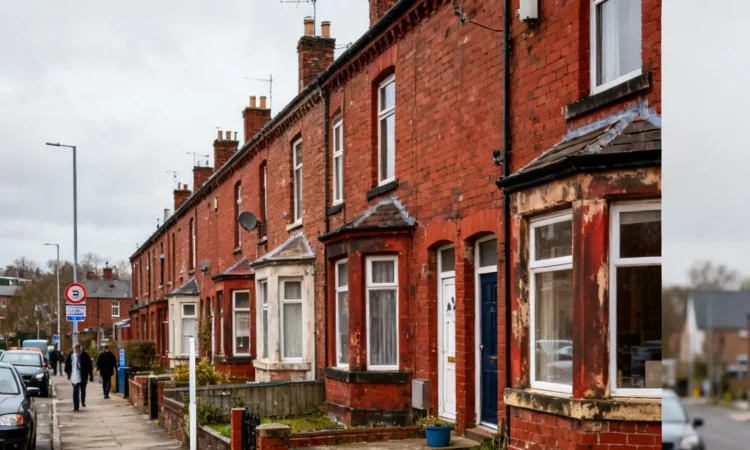
National property market indicators show resilience despite global economic pressures, but performance varies significantly by region and property type, according to analysis of the latest market indices.
Data for May 2026 reveals that areas in the North and West of England continue to perform well, while London, East Anglia and the South have yet to recover to 2022 price levels. The picture is further complicated by variations within regions themselves, with research from E.surv indicating that average London figures are being affected by weakness in the prime market and flat prices.
Market commentary highlights uncertainty
Home.co.uk drew parallels with the 2008 crisis, noting that current pricing appears to be based on expectations of a swift resolution to the Strait of Hormuz situation and a return to previous energy prices. The portal reported that sales stock has surged while London prices have declined.
The analysis suggested that money markets have already priced in two UK base rate hikes before year-end, with the possibility of further increases as the Bank of England responds to inflation. Rising bond yields have also signalled potential sovereign debt concerns for heavily indebted countries.
Robert Gardner, Nationwide’s chief economist, stated that house price growth remained resilient in April, supported by relatively strong household finances. He noted that household debt is at its lowest level relative to income in around two decades, with sizeable savings buffers built up in recent years.
Amanda Bryden from Halifax reported that house prices remained broadly stable in April, with the average price paid by first-time buyers falling slightly to £238,908, its lowest level so far this year. While slower price growth may disappoint existing homeowners, stable prices could benefit those entering the market, though affordability remains stretched due to higher mortgage rates.
Stock levels and pricing dynamics
Rightmove data showed that the number of homes for sale has reached its highest level for this time of year since 2015. Almost a third of existing listings have seen price reductions. Properties that avoided price reductions sold in 36 days, compared with 127 days for those requiring reductions.
Richard Donnell from Zoopla suggested that increased seller activity could support transaction volumes even in a lower-demand environment, provided stock is priced correctly and buyer finance is in place. The financing landscape continues to evolve as lenders adapt to market conditions.
E.surv’s analysis indicated that the market shows increasing divergence rather than broad-based weakness. Growth remains modest overall, with pressures concentrated in London, particularly in inner boroughs and the flats market, while more affordable areas continue to hold up. The report identified affordability, rather than demand, as the key constraint.
Structural differences from 2008
Current market conditions differ significantly from 2008. Mortgage lending is subject to tighter regulation, and borrowing levels are substantially lower than pre-financial crisis levels. First-time buyers have generally taken out repayment mortgages since 2014, building equity rather than relying on interest-only products.
More than half of homeowners now own their property outright, reducing the number potentially forced to sell during economic uncertainty. Many borrowers are protected by fixed-rate mortgages, while lenders and government-backed support schemes increasingly focus on helping households remain in their homes, as alternative financing options become available to support various property transactions.
The analysis emphasises that property markets remain local, with performance in individual towns, cities and postcodes varying significantly from national trends. Market participants are advised to focus on local market conditions rather than relying solely on regional or national data when making decisions.