
Introduction
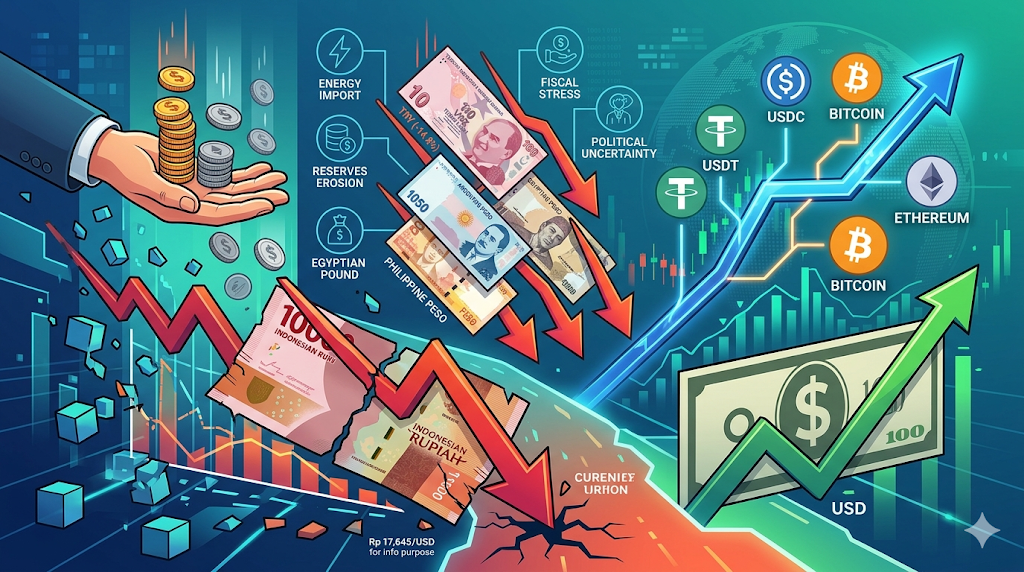
Indonesia’s rupiah hit an all-time low of Rp 17,645 per US dollar on May 18, 2026, a 1.17% slide that pushed year-to-date depreciation to 5.99% against the greenback — surpassing even the worst levels of the 1998 Asian Financial Crisis. The collapse has reignited a critical question for traders and investors: which currency is most likely to fall next?
The answer, based on the latest 2026 data, points to a small cluster of emerging-market currencies sharing the same fatal mix — energy import dependence, fragile reserves, fiscal stress, and political uncertainty. The Turkish lira, Egyptian pound, Philippine peso, and Argentine peso all sit in the danger zone, while structurally weaker economies like Venezuela and Bolivia have already partially “dollarized” through stablecoins. This article ranks the candidates, explains the warning signals, and shows how crypto has become the de facto hedge in collapsing-currency economies.
Why Did Indonesia’s Rupiah Collapse in 2026?
The rupiah collapsed because of a perfect storm of oil-driven import costs, capital outflows, and shrinking reserves. According to Asia Times, capital outflows reached US$1.6 billion in the first three weeks of January 2026 alone, and the situation deteriorated sharply through the spring.
Three forces drove the slide:
Energy import shock. According to Kompas, Brent July crude rose 1.98% to USD 111.42 per barrel and WTI June jumped 2.43% to USD 107.98, weighing on Indonesia which imports 1.5 million barrels daily. Geopolitical tensions around the Strait of Hormuz triggered the latest oil rally.
Reserve erosion. According to Bank Indonesia data, reserves fell to $146.2 billion in April 2026 from $148.2 billion the previous month, marking the fourth consecutive monthly drop, driven by debt repayments and the mounting costs of currency intervention.
Failed rate defense. According to Indoneo, Bank Indonesia raised its benchmark 7-day reverse repo rate to 5.25% on May 21, 2026, as the rupiah hit a record low of IDR 17,600 per US dollar — and the rate hike failed to stabilize the currency, which has depreciated approximately 5% year-to-date.
Importantly, this is not a repeat of 1998. According to The Diplomat, the central bank is better equipped now to deal with a weakening currency, entered March with over $150 billion in foreign reserves, and has the option of raising interest rates — tools that will likely ensure that even if the currency continues to depreciate, it does so in a controlled manner.
Which Currencies Are Most at Risk of Collapsing Next?
The four currencies most vulnerable to a 2026 collapse are the Turkish lira, Argentine peso, Egyptian pound, and Philippine peso. Each shares the structural weakness Indonesia exhibited — but in some cases the imbalances are far more extreme.
According to Bloomberg’s May 2026 analysis, the biggest losers since the start of the US and Israeli war with Iran include the Egyptian pound, the Philippine peso, the South Korean won, and the Thai baht — they’re almost all energy importers. The currency crisis has effectively become an energy crisis transmitted through the FX channel.
Turkish Lira: The Carry-Trade Time Bomb
The Turkish lira tops the watch list. According to the World Food Programme data, from May 2025 to May 2026 the Turkish Lira depreciated by 14.81% relative to the US dollar.
The fragility is structural. According to ING Research, data on daily USD/TRY trading volumes showed how crowded positions were unwound in March 2026 — the arrest of the Istanbul mayor prompted a rush to the exits from long lira positions, with state banks briefly losing control of the currency, producing an intra-day 12% drawdown in spot lira positions and much more for those positioned further out the forward curve. With roughly $47 billion in carry-trade positioning, any further political shock could trigger a stampede.
Argentine Peso: Managed Depreciation Hides Real Risk
The Argentine peso is in a different but equally fragile regime. According to ING, any play in the Argentine peso would expect the managed ARS depreciation to be less than priced into the forward curve — meaning the official rate is being held artificially firm. When Javier Milei took office in 2024, annual inflation was about 200%; a tough stabilisation programme has reduced it to roughly 30%, but a managed peg always invites a discontinuous break.
Egyptian Pound and Philippine Peso: Energy Import Vulnerability
The Egyptian pound and Philippine peso are direct victims of the oil shock. According to Bloomberg’s reporting, both currencies sit among the worst-performing globally since the Iran conflict began. Egypt’s high-yield strategy has offered nominal stability — Egypt and Nigeria are proving different propositions — these offer high yields and have delivered nominal appreciation too — but the underlying current-account dependence on imported energy and remittances remains unresolved.
What Are the Warning Signs of an Imminent Currency Collapse?
Five warning signs reliably precede a currency collapse, and traders should monitor all of them simultaneously rather than in isolation.
1. Reserve depletion exceeding 5% per quarter. Indonesia’s reserves fell from USD 156 billion to USD 146.2 billion through the intervention cycle — roughly 6% in months, a textbook red flag.
2. Failed rate hikes. When a benchmark rate increase produces no FX response, the market is signaling that the problem is no longer monetary — it’s fiscal or political. Indonesia’s May 21 hike to 5.25% failed exactly this test.
3. Rising sovereign yields. According to Indoneo, Indonesia’s 10-year government bond yield stood at 6.89% as of May 22, 2026, reflecting elevated compensation for policy and currency risk. A sustained move higher signals fiscal credibility is eroding.
4. Persistent current account deficits. According to The Diplomat, Indonesia has run a persistent current account deficit for years — even though the deficit in 2025 was modest ($1.5 billion), it makes the rupiah more vulnerable to depreciation in the event of an external shock.
5. Capital flight via ETF outflows. According to Bloomberg Technoz, the iShares MSCI Indonesia ETF (EIDO) is the cleanest proxy for foreign positioning in Indonesian equities — sustained EIDO outflows typically signal foreign caution toward rupiah-denominated assets.
Currency Risk Matrix: 2026 Snapshot
|
Currency |
YTD Move vs USD |
Primary Risk |
Reserve Trend |
|
Turkish Lira (TRY) |
-14.8% (May/May) |
Political shocks, carry unwind |
Adequate but stressed |
|
Indonesian Rupiah (IDR) |
-5.99% |
Oil imports, fiscal credibility |
Falling 4 months running |
|
Egyptian Pound (EGP) |
Among worst since Iran war |
Energy imports, debt service |
Low |
|
Philippine Peso (PHP) |
Among worst since Iran war |
Energy imports, remittance flows |
Moderate |
|
Argentine Peso (ARS) |
Managed crawl |
Peg break risk, fiscal |
Critically low |
How Does the 2026 Crisis Compare to Past EM Currency Collapses?
The 2026 episode is structurally different from past EM crises because it originates outside the banking system. According to OMFIF analyst Gustavo Pessoa writing in May 2026, the next emerging market crisis may not begin with a failing bank — instead, it may begin with a margin call, a change in collateral haircuts, a wave of redemptions from an open-ended fund or a global portfolio manager forced to cut exposure after a rise in dollar funding costs, and by the time the pressure appears on a bank balance sheet, the decisive transmission may already have occurred.
This means a single risk-off pulse from a US fund can drain a country’s currency overnight — without any local bank ever failing.
Why Has Crypto Become the De Facto Hedge in Collapsing Economies?
Crypto has become the de facto hedge because it is the only asset citizens of weakening-currency economies can access without capital controls, banking restrictions, or government approval. The pattern is now visible across every major collapsing-currency country.
Turkey. According to Chainalysis data cited by ForkLog, amid economic instability, Turks have flocked to cryptocurrencies — over the past year, transaction volumes reached $200 billion, the highest in the Middle East and North Africa. According to Paybis 2026 statistics, Turkey reports one of the highest rates globally, with approximately 25.6% of its internet population owning cryptocurrency.
Argentina. According to KuCoin News citing Chainalysis, Argentina leads Latin America in crypto adoption, with 20% usage in 2026 — around 8.6 million Argentines now use digital assets, driven by inflation hedging and yield generation. According to CoinDesk, the Central Bank of Argentina is considering lifting the ban on banks offering cryptocurrency services, potentially implementing new rules by April 2026, following the election of Javier Milei.
Venezuela and Bolivia — full dollarization via stablecoins. According to ForkLog and Chainalysis, Venezuela ranks fourth in Latin America by crypto-transaction volumes — from July 2024 to June 2025 digital-asset turnover reached $44.6 billion, and The New York Times reckons that President Nicolás Maduro has effectively “moved Venezuela’s economy onto stablecoins”. In Bolivia, annual digital-asset transaction volumes exceeded $14.8 billion, and by the summer of 2025, shops began listing prices in the stablecoin USDT, used as a more predictable unit of account than the boliviano.
Nigeria. According to ForkLog citing Chainalysis, Nigeria retains the lead in Africa by crypto-transaction volume — $92.1 billion — and in the second quarter, the share of users employing crypto to hedge inflation rose from 29% to 46%.
Will Indonesia’s Rupiah Trigger a Regional Contagion?
However, key structural buffers remain. According to Gotrade News citing Indonesian lawmakers, conditions differ fundamentally from the 1998 Asian financial crisis when private dollar debt was far larger, and Indonesia also navigated the 2008 crisis, the 2013 Taper Tantrum, and Covid-19 without a structural collapse.
According to the New York Fed’s Liberty Street Economics, over subsequent decades, Core EMs implemented reforms aimed at reducing vulnerabilities — a central reform has been the reduction in reliance on foreign currency borrowing, with Core EMs gradually expanding their domestic capital markets and broadening their local investor base, enabling governments to issue a larger share of debt in domestic currency. That structural improvement is the main reason a 1998-style cascade is improbable today — but it does not protect peripheral economies with high USD debt loads.
Conclusion
Indonesia’s rupiah collapse to a historic low of Rp 17,645 per USD in May 2026 is not an isolated event. It is the most visible symptom of a wider 2026 stress regime driven by oil prices above $110 per barrel, capital flight from emerging markets, and the limits of central bank intervention. The currencies most likely to follow — the Turkish lira, Argentine peso, Egyptian pound, and Philippine peso — share Indonesia’s vulnerabilities but in several cases lack its reserve buffers.
The warning signs are now well-defined: reserve depletion exceeding 5% per quarter, failed rate hikes, rising sovereign yields, persistent current account deficits, and accelerating ETF outflows. Where fiat fails, crypto has stepped in. Turkey, Argentina, Venezuela, Bolivia, and Nigeria have all developed mature crypto-as-hedge ecosystems, with stablecoins increasingly used as a daily unit of account.
For traders, the lesson is twofold: identify the next weak link early using the warning matrix above, and have a hedge instrument ready before, not after, the move accelerates. KuCoin’s spot, futures, and stablecoin markets provide that infrastructure in a single venue.
FAQs
1. How low could the Indonesian rupiah go in 2026?
In a base case, the rupiah stabilizes near current 17,500–17,700 levels if oil pressure eases. In a worst case, according to Asia Times scenario analysis, the rupiah could weaken to 18,000-18,300 rupiah if the Strait of Hormuz faces prolonged closure and oil prices surge beyond $120 per barrel.
2. Is the 2026 situation a repeat of the 1998 Asian Financial Crisis?
No. According to Indoneo, what has changed since 1998 is substantial: Indonesian banks are better capitalised, foreign reserves are healthier, and GDP growth has held above 5%. The risk today is slow erosion of confidence, not a sudden banking collapse.
3. Which stablecoin is safest for hedging local currency depreciation?
USDT and USDC are the most widely used dollar-pegged stablecoins on KuCoin and elsewhere. USDT has deeper liquidity in emerging markets — Bolivian shops already price goods in USDT, and Turkish stablecoin purchases alone accounted for approximately 4.3% of GDP in the year leading up to March 2024 according to Chainalysis-cited research.
4. Why didn’t Bank Indonesia’s rate hike work?
Because the market read the hike as reactive rather than committed. According to Indoneo, the next four to six weeks will determine whether the rate hike holds as a credible signal or is read as a one-off intervention — if guidance softens or the bank pauses, expect markets to test the rupiah’s lower range and reassess central-bank tolerance for depreciation.
5. Can crypto really replace a national currency?
Partially, and it is already happening in extreme cases. Crypto serves as an inflation hedge and payment rail across several emerging economies — amid weakening local currencies, digital assets have become a store of value and a means of payment across several emerging economies, including Bolivia, Venezuela, Argentina, Turkey, Iran and Nigeria. Crypto rarely replaces fiat fully, but it functions as a parallel system citizens default to when fiat fails.