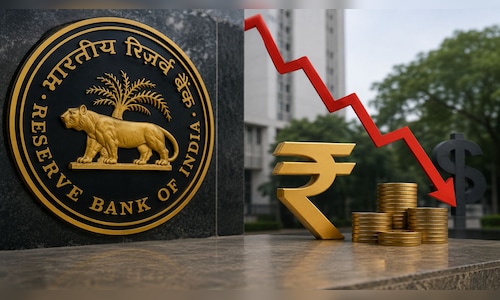
That’s exactly what happened during the global financial crisis, the COVID-19 market turmoil, and countless periods of geopolitical uncertainty such as the current West Asia crisis. Money flowed out of emerging markets and into perceived safe havens.
India is not immune to these pressures.
When foreign investors sell Indian stocks and bonds, they don’t take rupees home. They first convert those rupees into dollars. The more investors seek dollars, the stronger the dollar becomes and the weaker the rupee gets.
Normally, exchange rates fluctuate every day. But when the pressure becomes intense, the Reserve Bank of India (RBI) has a powerful tool at its disposal: the country’s foreign exchange reserves.
These reserves—consisting largely of dollars, other foreign currencies and gold—allow the RBI to intervene in currency markets and prevent sharp swings that could destabilize the broader economy.
In simple terms, India’s forex reserves are not merely a savings account. They are an active defence mechanism.
The RBI’s first line of defence
Suppose global oil prices suddenly surge because of a conflict like the one in West Asia at the moment.
India imports more than 85% of the crude oil it consumes. Oil companies now need more dollars to pay foreign suppliers. At the same time, nervous investors may also start moving money out of emerging markets.
Suddenly, demand for dollars rises sharply.
Without intervention, the rupee could fall rapidly.
This is where the RBI steps in.
The central bank can sell dollars from its forex reserves into the market. By increasing the supply of dollars, it helps meet demand and prevents panic-driven shortages. The goal is not to stop the rupee from moving altogether. Rather, it is to prevent abrupt and disorderly declines that can trigger broader economic problems.
Think of it like a fire brigade. The RBI is not trying to eliminate every spark. It is trying to prevent a small fire from becoming a city-wide blaze.
Why protecting the rupee matters
A weakening rupee affects far more than currency traders.
Because India imports crude oil, a weaker rupee makes every barrel more expensive in local currency terms. Even if global oil prices remain unchanged, depreciation can increase India’s import bill.
That eventually shows up in fuel prices, transportation costs and inflation.
A sharp fall in the rupee can also make imported electronics, machinery and industrial inputs more expensive. Businesses face higher costs. Consumers often end up paying more.
Students planning to study abroad, families travelling overseas and companies with dollar-denominated debt can also feel the impact.
In other words, when the RBI stabilizes the rupee, it is indirectly helping contain inflation and reduce economic disruption.
More than just defending the currency
Forex reserves also help India weather periods of capital flight.
Imagine foreign investors suddenly withdrawing billions of dollars from Indian markets like they are doing right now because US interest rates become more attractive. Such outflows can create stress in financial markets and raise concerns about a country’s ability to meet external obligations.
Large reserves reassure investors that India can continue paying for imports, servicing foreign debt and meeting foreign-currency commitments even during difficult periods.
This confidence can be just as important as actual intervention.
In financial markets, panic often begins when investors believe a country lacks the resources to defend itself. Large reserves reduce that fear.
The lesson from 1991
India’s focus on building reserves stems from painful experience.
In 1991, the country came dangerously close to running out of foreign currency. Reserves had fallen to levels sufficient for only a few weeks of imports. The government was forced to pledge gold to secure emergency funding.
The crisis became a turning point in India’s economic history.
Since then, policymakers have viewed strong forex reserves as essential insurance against external shocks.
Why the reserves matter now
The timing of this discussion is particularly important.
The global economy is facing heightened uncertainty. Geopolitical conflicts continue to threaten energy supplies. Trade tensions remain elevated. Global capital flows have become more volatile. Oil prices can move sharply in response to geopolitical developments.
Each of these risks has the potential to put pressure on the rupee.
India cannot control global events. But it can prepare for them.
That is precisely what forex reserves allow the country to do.
They give the RBI the ammunition to intervene when markets become disorderly, the flexibility to manage external shocks and the credibility to reassure investors that India can withstand periods of stress.
Most people will never directly see India’s forex reserves. Yet whenever the rupee avoids a panic-driven collapse, whenever inflation is contained despite external shocks, and whenever investors remain confident during turbulent periods, those reserves are quietly doing their job.
That’s why forex reserves are often described as India’s financial firewall—not because they prevent every shock, but because they help stop those shocks from becoming crises.