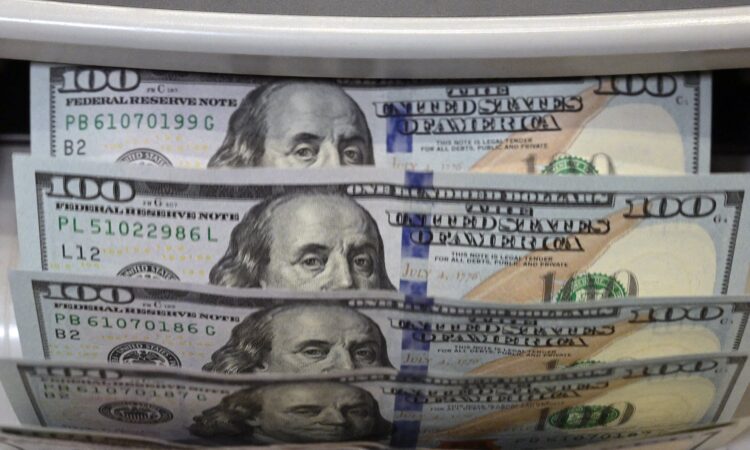
The U.S. dollar is the most widely used currency in the world.
Around 90% of all international transactions have the U.S. dollar on one side. Close to 60% of reserves held by foreign central banks are in U.S. dollars or dollar-denominated assets, and nearly two-thirds of world debt is in dollars, too.
This gives the U.S. economy and government certain advantages. It gives the United States what’s sometimes referred to as “exorbitant privilege” of cheaper borrowing costs and powerful leverage in international relations.
But in recent years, conversations about “de-dollarization” have gotten louder.
The share of non-dollar assets held in foreign reserves, such as gold, has gone up. There are efforts by countries, including China and Russia, to develop payment systems that avoid U.S. dollars. And this spring, ships have reportedly gotten through the Strait of Hormuz by paying fees in Chinese yuan.
The dollar is so ingrained in global commerce that it’s unlikely to lose its international status overnight. But if it did, what would the global economy look like?
“Marketplace” host Kai Ryssdal spoke with three economists about that hypothetical world.
“It’s not as if the world would suddenly come to an end,” said Maury Obstfeld, senior fellow at the Peterson Institute of International Economics. “But I think it’ll be different in important ways,” Jay Shambaugh, a professor of economics and international affairs at George Washington University. “Eventually we will feel it in our daily transactions,” said Zoe Liu, a senior fellow for China studies at the Council on Foreign Relations.
A global efficiency loss
One reason the dollar is so dominant in international trade is what economists like to call “network externalities. “You know, I use the dollar because everyone else uses the dollar,” said Obstfeld.
A common analogy is thinking of the dollar’s role in global trade as kind of like the English language. “I don’t need to speak Swahili, and you know people who speak Swahili don’t need to speak Japanese or Chinese; we can all speak English in order to communicate,” said Liu. “And that is actually the role of the dollar at the most basic level.”
For example, an Argentine business doesn’t need to hold Turkish lira in its vault in order to trade with a Turkish company, and the Turkish company doesn’t need to hold Cambodian riel to trade with Madagascar — everyone can just trade in U.S. dollars.
“The entire world benefits from having the dollar as a global currency,” Obstfeld said.
In a world without a reliable global currency, companies would have to take on more foreign currency risk in order to engage in international trade. “Every single transaction becomes not just more costly, but maybe not even happens because [they] cannot agree on which currency to take,” Liu said.
So, that’s one way that the economy would change in a hypothetical, less-dollarized world — less efficiency. Another would be the cost of money.
Increased borrowing costs
“The baseline note is that America’s borrowing cost will go up,” Liu said.
The United States government has about $31 trillion worth of “public debt” on its books. That’s money it got to borrow from foreign governments, individuals, and other investors at relatively low interest rates because of demand for U.S. dollar-denominated assets.
In a less dollar-dominated world, that interest rate would go up. “Not just for the government, but for everybody,” Obstfeld said. Mortgages, auto loans, student debt, business loans — all of that would get more expensive.
Loss of sanctions power
The third big impact of a decline in the international role of the dollar relates to the U.S. government’s power to sanction foreign entities. The way the global financial system works now, it’s hard to move money without touching the U.S. dollar or a big U.S. bank.
“And that means that when the United States chooses to, it has the ability to impose sanctions that cut people off from global finance,” Shambaugh said.
Those sanctions are the financial weapons our government uses against international threats, including terrorist groups, countries trying to acquire nuclear weapons, or for example, when Russia invaded Ukraine. “If we lose the role of the dollar, we lose that sanctions ability,” he said.
This hypothetical we’ve been talking about is still purely a hypothetical. The U.S. dollar is so ingrained in the global economy, Shambaugh, Liu, and Obstfeld all said it’s unlikely to lose that status anytime soon.
“But if people see us as irresponsible with our power, it makes it just much more likely that they will find ways to move money that don’t touch the dollar,” Shambaugh said. “It’s expensive to do those things, but if the U.S. gives countries a reason to do it, you could see us walking towards that less dollarized world.”
The U.S. dollar got its reserve currency status, this exorbitant privilege, because of the perceived stability of the U.S. economy and its government — things like strong financial regulation, an independent central bank, and a history of paying its debts on time.
“I guess the core message is that the only enemy to the U.S. dollar is not a rival currency,” Liu said. “It’s our own fiscal responsibility itself.”