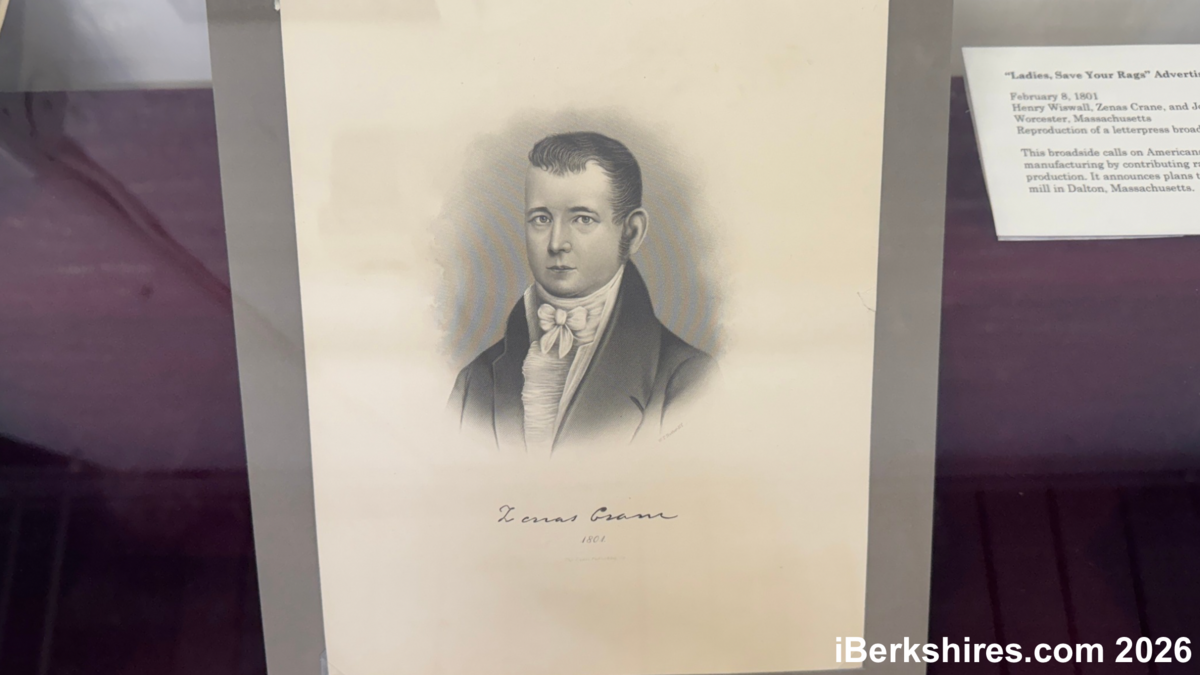
Zenas Crane established his paper mill in Dalton in 1801.
DALTON, Mass. — Crane Currency is celebrating its 225th birthday, from its start as a papermill in the 1800s to becoming a premier printer of high-tech, international banknotes.
Crane NXT CEO Aaron Saak on Tuesday boasted a deep sense of pride in the organization and the more than 6,000 associates that embody the company’s deep sense of purpose.
“But it was from a small papermill here in Western Massachusetts that Crane Currency has survived, grown, and thrived over the past two centuries, with a Civil War, two world wars, recessions, technological advances, and changes,” he said to the gathering in the Crane Museum.
“I think what makes today so meaningful is not just the celebration of a milestone of these 225 years, but the great pride, the great pride everyone in this company takes to the mission that we do for this country and for others, and it’s personally moments like this, standing here in Dalton, surrounded by the people that make this company what it is, that reminds me and humbles me about what makes this organization so special.
“It’s a deep sense of purpose, and you don’t find that everywhere, but you find that here at Crane Currency.”
Stephen Crane’s mill in Boston was used to print money for the colonies; his grandson, Zenas, moved to Dalton to establish Crane & Co., a name that would be linked to fine papermaking and as the lone manufacturer of the nation’s paper currency since the 1870s.
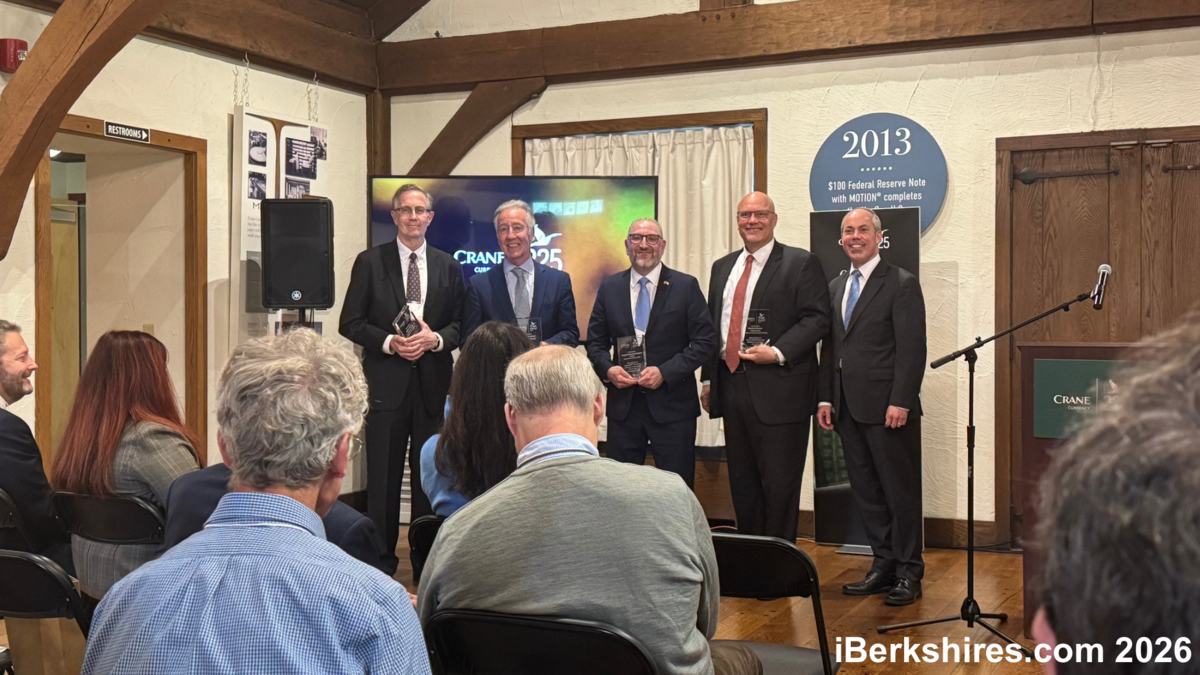
Crane Currency leadership and associates, members of the Crane family, state and government leaders gathered in former rag room of the original Crane mills. The attendees watched a short film with a collection of voices from present and past associates on what it is like to work for the company and the values they possess.
Michael Brown, acting director of the U.S. Bureau of Engraving and Printing, said the bureau’s partnership with Crane is essential to protecting a symbol of stability and trust in the world.
“Together we are not simply producing paper and ink, we are helping safeguard one of the most recognized and trusted symbols of American stability, of America’s strength, and of America’s leadership on earth,” he said.
Brown said the company’s innovation and commitment to excellence is rare, emphasizing the precision and craftsmanship it takes to produce through tiny tolerances, ink shifts, and security features that matter enormously through skills passed down and refined through multigenerational families.
More than 50 countries are using the same micro-optic technology for advanced banknote security, he said, and Crane and the bureau are working on a Catalyst Program to develop the next generation of micro-optic security technologies to stay ahead of counterfeiters.
Brian Lawler, senior associate director of the Federal Reserve Board, said currency still matters to millions of Americans in this digital world.
“The Fed does a lot of research about currency and finds that Americans at every economic level, every cultural background, every age group use currency,” he said. “They often do it for convenience, sometimes they do it to settle the transaction quickly without fees. They do it for privacy, because I don’t want my purchase at the farmers market or the pharmacy to reach this endless trail of email marketing. They do it because it’s part of tradition.”
Lawler added that many economies and industries around the world rely on the dollar and the U.S. holds about 60 percent of global reserve currency share.
The Fed swaps out old tired and torn currency for new but one of the main things it sees are dollars covered through hard work.
“If you go to our largest facilities, you will see crates and crates and crates of currency that is soiled by human sweat,” he said. “People have turned their labor around the world to a living for their family by turning that labor into the U.S. dollar. I have spent currency on almost every continent of the world.”
Failing currency is the difference between prosperity and poverty, war and peace, he said. “So, for all who contribute to the U.S. currency program, you are contributing to prosperity, you are contributing to peace.”
Crane’s also made an impact on passports, with U.S. Government Publishing Office Director Hugh Halpern noting how the history of Crane is in everyone’s lives.
“Crane’s history parallels that of our young nation. Stephen Crane began producing paper for the first effort to finance this infant nation, even before these 13 colonies decided to go their own way,” he said. “And since then the people of Crane Currency have been weaving tiny cotton fibers into a fabric that can buy you breakfast at your local diner or take you to the farthest reaches of the world.”
Halpern said more than 27 million passports were printed this year with Crane paper and that they are working with Crane on a commemorative passport to mark America’s 250th. Other projects with the GPO include a naturalization certificate for new citizens, and a state dinner menu for King Charles’ visit.
“At GPO, Crane has been our trusted partner, producing the US passport for more than 75 years. With each effort to modernize the passport, Crane has been there delivering the secure papers we need to make sure that every American can cross every border without any problems,” he said. “That’s why we recently extended our relationship with Crane for yet another decade.”
U.S. Rep. Richard Neal reflected on the upcoming 250th anniversary of the country and the Declaration of Independence. Neal also spoke about the events at Bretton Woods in 1944, where the allies established an international economic system of which the dollar was pre-eminent.
“It was the acceptance of the American dollar as the currency of the world,” he said. “I have never been anywhere in the world where a 20-year-old kid wouldn’t exchange that currency in their head when they see the dollar put on the table. That’s the reality of an institutional network of what we value on this occasion, beyond this great legacy of the Crane family and their commitment to public service.”
Neal also spoke on the debate of digital currency and its value and said currency is based on confidence.
“The Treasury favors a strong dollar, and that’s what we honor today, a strong dollar, not just in terms of the currency swap that takes place, but what the world thinks of that currency everywhere you go,” he said, but added that the dollar is being challenged by other currency. “There is still a very important consideration what the dollar means in the world, with good reason and good purpose. …
“The rest of the world wants those transactions still to be in dollars, and that’s a testimony to what happened right on this site with the skilled employees and management, and that legacy of the Crane family, and what it meant.”
Saak spoke on the company’s history and its future, including recently completing the new U.S. currency series in Dalton, and expanding its footprint across the states and the world. He emphasized the next generation in security designs to prevent counterfeiting.
“All this utilizing new equipment, new technologies that were really impossible to believe and understand 25 years ago, much less 225 years ago,” he said. “I can tell you I’m personally more excited about the future and what we’re going to create together in this company in the decades ahead …
“I have no doubt Zenas Crane will continue to smile, looking down on us, and perhaps when we celebrate the launch of the new U.S. currency, maybe we’ll get him to dance.”
Guests from Crane facilities around the world were treated to refreshments, got updates security features on roughly 150 denominations, and viewed artifacts from Paul Revere documents and Crane family pictures to contracts and presidential stationary.
Tags: anniversary, Crane, currency, Neal,