
Africa sees world’s fastest growth in ultra-rich as financing costs ease, currencies strengthen
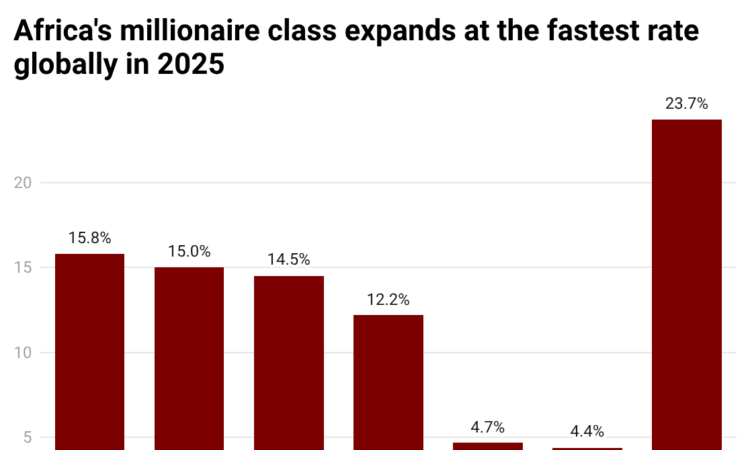
Africa recorded the world’s fastest growth in ultra-high-net-worth individuals (UHNWIs) last year, as lower financing costs, stronger currencies, and rising investment in critical minerals and digital infrastructure boosted wealth creation across the continent.
The number of individuals with a net worth of at least $30 million rose by 23.7 percent to 3,440 in 2025, outpacing every other region globally, according to the World Ultra Wealth Report 2026 by Altrata, a global wealth intelligence and affluent market research firm.
The second most populated continent outperformed Asia, where the ultra-wealthy population grew by 15.8 percent, North America (15 percent), Europe (14.5 percent), Latin America and the Caribbean (12.2 percent), the Pacific (4.7 percent) and the Middle East (4.4 percent).
The strong performance marks a turnaround after two years of relative weakness and signals growing investor confidence in Africa’s long-term economic prospects as global capital increasingly seeks opportunities linked to energy transition, technology and strategic resources.
“After relative underperformance in 2023-24, Africa recorded a 24 percent surge in ultra-wealthy numbers in 2025 to 3,440 individuals,” the report said.
Altrata attributed the increase to more favourable financing conditions, appreciation of several African currencies against the US dollar, accelerating digital transformation and fresh investment tied to growing global demand for the continent’s critical mineral reserves.
Despite recording the strongest growth globally, Africa remains a relatively small player in the global wealth landscape. The continent’s ultra-wealthy population accounts for 0.6 percent of the world’s UHNW individuals, while their combined wealth of about $400 billion represents only 0.7 percent of global ultra-high-net-worth wealth.
By comparison, North America is home to more than 224,000 ultra-wealthy individuals with a combined fortune of $25.7 trillion, while the United States alone accounts for 37 percent of the global UHNW population.
The findings shows that Africa’s wealth boom reflects rapid growth from a relatively low base rather than a shift in the global balance of wealth. Nevertheless, they point to strengthening private capital formation and expanding investment opportunities across the continent.
Africa is home to 23 billionaires with a combined net worth of about $126.7 billion, according to the latest Forbes ranking. The billionaire class remains concentrated in South Africa, Egypt, Nigeria and Morocco, led by Aliko Dangote, Johann Rupert and Abdulsamad Rabiu.
Critical minerals driving wealth creation
One of the biggest drivers of Africa’s wealth creation is the intensifying global race for critical minerals essential for electric vehicles, battery storage, renewable energy systems and artificial intelligence infrastructure.
Countries including the Democratic Republic of Congo, Zambia, Namibia, Zimbabwe and Guinea possess significant reserves of cobalt, copper, lithium, uranium and bauxite, attracting billions of dollars in new investment from multinational mining companies and sovereign investors.
Demand from China, the United States, Europe and Gulf countries for secure mineral supply chains has accelerated investment in mining projects, transport networks, energy infrastructure and processing facilities, creating new business opportunities and wealth across the continent.
Beyond natural resources, Africa’s digital economy is also emerging as a major source of wealth creation.
Rapid growth in fintech, telecommunications, e-commerce and digital infrastructure has supported the rise of technology entrepreneurs and investors, while global technology firms continue to expand investments in African data centres, cloud computing and artificial intelligence infrastructure.
These structural shifts are gradually broadening the sources of wealth creation beyond traditional sectors such as oil, mining and real estate.
Global wealth reaches record high
Globally, 2025 was another exceptional year for the world’s wealthiest individuals.
According to Altrata, the global ultra-wealthy population rose by 14.4 percent to a record 556,850 individuals, marking the second consecutive year of double-digit growth and the strongest expansion since 2017.
Combined wealth climbed 14.3 percent to $63.8 trillion, supported by easing inflation, resilient corporate earnings, recovering financial markets and continued investor enthusiasm for artificial intelligence.
Although geopolitical tensions and shifting US trade policies created periods of market volatility, asset portfolios continued to benefit from improving macroeconomic conditions and sustained investment in technology.
Looking ahead, Altrata expects digital innovation, geopolitical realignment and mobile global capital to reshape wealth creation over the rest of the decade.
The report forecasts that the global ultra-wealthy population will rise to about 746,570 by 2030, with combined wealth expanding to roughly $85 trillion.
Artificial intelligence, private capital, digital infrastructure, energy transition, biotechnology and advanced manufacturing are expected to be among the biggest drivers of wealth creation over the next five years.
For Africa, sustaining the momentum will depend on improving the investment climate, deepening capital markets, expanding digital infrastructure and ensuring that rising investment in critical minerals translates into broader economic development rather than isolated gains for a small group of investors.


