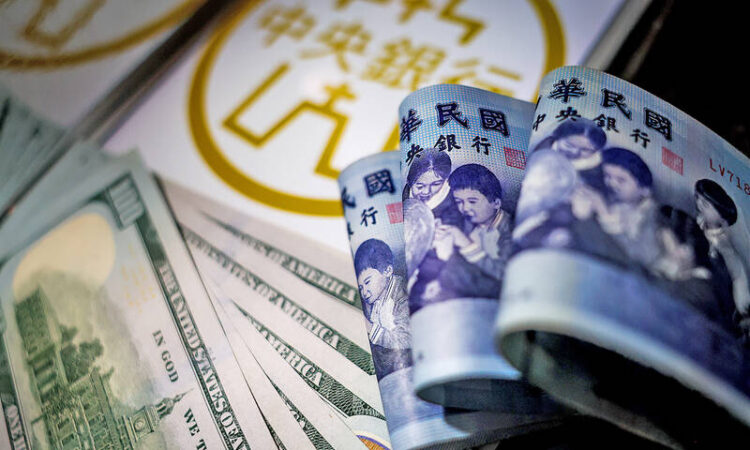
The New Taiwan dollar fell to its weakest level since April last year, erasing gains from last year’s historic rally as US dollar strength and record dividend payouts weighed on sentiment.
The local currency dropped as much as 0.6 percent before paring losses to close at NT$32.178 per US dollar in Taipei yesterday. The move wiped out the sharp gains from May last year, when the currency soared by the most since the 1980s on easing trade tensions and upbeat tech earnings.
The NT dollar now faces a key test as Taiwan enters its peak dividend season this month, with heavy foreign ownership in the semiconductor sector likely amplifying US dollar conversions. Domestic firms are set to pay out more than NT$2.5 trillion (US$77.7 billion) in cash dividends this year, according to data from the Taiwan Stock Exchange, the largest amount in Bloomberg-compiled data going back to 1990.
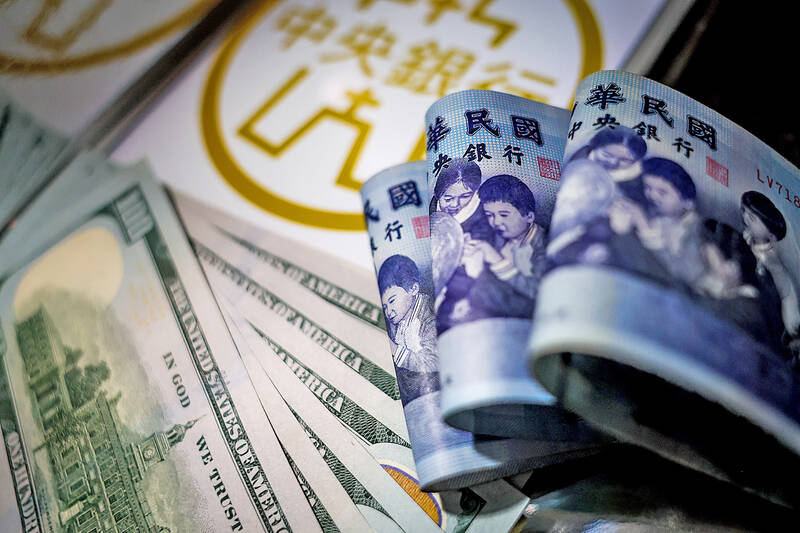
Photo: CNA
The risk of outflows is heightened by a less supportive global environment. The greenback’s strength on expectations that US interest rates will stay elevated for longer, combined with a rebound in oil prices due to renewed Middle East tensions, are adding to headwinds for Taiwan’s currency.
“TWD weakness today is likely due to dividend payment repatriation,” Australia and New Zealand Banking Group Ltd head of Asia research Khoon Goh (吳昆) said. “Taiwan Semiconductor Manufacturing Co (台積電) paid out its quarterly dividend today, and given the large foreign holdings, those flows are weighing on TWD.”
He sees the currency facing near-term pressure and falling to NT$32.5 per US dollar on further dividend payments later this month.
The NT dollar yesterday weakened sharply as foreign investors remitted large sums overseas, according to several traders. While exporter and state-bank greenback sales briefly pared morning currency losses, massive outflow volumes ultimately drove the local currency lower, traders said.
Earlier this week, the central bank was said to have asked local banks to execute some large greenback sell orders on the day they are received instead of delaying or staggering them, people familiar with the matter said.
The intervention came as the NT dollar encountered seasonal weakness. The central bank regularly monitors and guides foreign-exchange transactions including those from exporters and life insurance companies. It permits or encourages them to execute large-scale US dollar sell orders when the NT dollar depreciates while allowing some US dollar buy orders when the local currency strengthens.
For Fiona Lim, senior foreign exchange strategist at Malayan Banking Bhd, developments in the Middle East are likely to steer the currency.
“We should continue to watch the US-Iran headlines and US data for an indication on whether the pressure on the TWD can be sustained. An acceleration in its decline could invite larger interventions,” she said.