
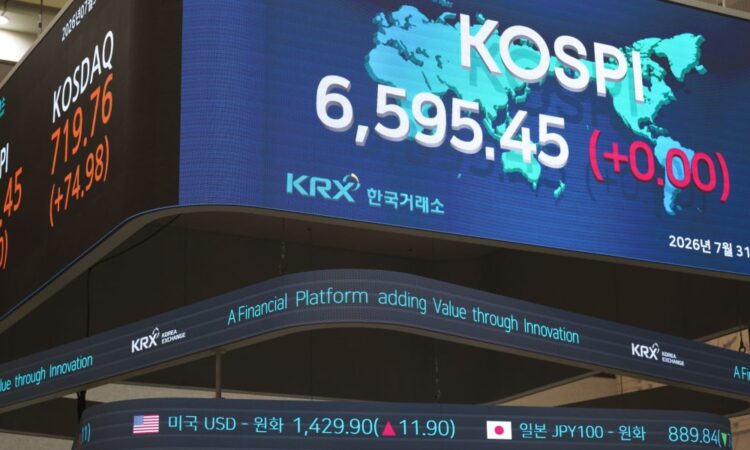
South Korea’s retail traders have long built a reputation for embracing risk. Yet July’s punishing reversal in the Kospi has rattled even this battle-hardened cohort, exposing the limits of their tolerance for volatility.
Some, like Kim Han-kyung, a Seoul resident in her late 30s, have resolved never to invest again, while others are comparing the $3.9 trillion market to a casino. Retail investors sold a record amount of Kospi shares on Friday despite a stunning 18% rebound. The gauge still capped a 22% loss for the month, the steepest since the global financial crisis.
Signs of frustration are everywhere on social media, with much of the blame being directed at the government. Encouraged by President Lee Jae Myung’s stock-market reform drive as well as the debut of single-stock leveraged ETFs offering the prospect of amplified gains, mom-and-pop traders piled about 78 trillion won ($54.2 billion) into Kospi shares over May and June, only to be sucker-punched by the index’s wild swings in July.
“That was the era of the Kospi mania,” said Kim, who started investing in Korean stocks for the first time in early May. “I got completely swept up in the frenzy. Now, I’m honestly scared. I’ve engraved two rules in my mind now. First: don’t invest in the Korean stock market. Second: follow the first rule.”
Trading in Kospi stocks was halted four times during the month, a record run for circuit-breaker suspensions, a tool rarely used before this year.
Ironically, the ETFs, introduced in late May to broaden investment opportunities for retail traders and stem outflows into similar products abroad, have become a lightning rod for criticism and blamed for amplifying volatility.
“The government put fuel into the fire with those leveraged ETFs,” said 40-year-old Lee Jung-min, who took a 50 million won loan with his apartment as a collateral to trade stocks. “I think it’s wrong how they turned the stock market into a casino.”
‘Kospi Mania’
The dramatic unraveling in July followed months of optimism that had built around Korean equities. The market, home to two of the world’s memory chipmakers Samsung Electronics Co. and SK Hynix Inc., remains one of the biggest beneficiaries of the AI frenzy. The two stocks together make up more than 50% of the Kospi.
Samsung’s shares, which slumped 21% in July, are still up more than four times since the start of 2025. SK Hynix’s stock lost 35% but is up nearly 10 times in that period. The Kospi remains among the world’s best performers for 2026 despite the pullback.
“Such volatility level still shows the market is not functioning normally,” said Kim Dong Woo, a 33-year-old who has been trading stocks for more than seven years.
That said, it’s hard to argue that retail investors were unaware of the risks. Surging volatility had been a key feature of the Korean market, but the fear of missing out still drew many of them into concentrated bets on AI-linked heavyweights and margin-financed stock purchases.
“It’s a textbook example of what happens when a crowded trade meets leverage,” said Lale Akoner, global market analyst at eToro Group Ltd. in London. “Deleveraging is unlikely to be resolved in a matter of days, so investors should expect further sharp swings in technology and semiconductor stocks over the coming months,” she said, adding however that “this should not be mistaken for a wholesale collapse in the AI investment case.”
For their part, authorities have sprung into action. They temporarily halted new listings of single-stock leveraged ETFs in mid-July, and last week pledged additional measures to stabilize the stock market and curb retail access to such products.
But many retail investors and market participants say the steps came too late. “The current environment presents a significant challenge” for the government, said Francis Tan, Asia chief strategist at Indosuez Wealth Management in Singapore.
Looking ahead, the AI boom that fueled Korea’s rally remains intact. Yet for many, July served as a lesson that the same forces capable of delivering outsized gains can also unravel swiftly. Rebuilding confidence among them may take longer than it does for the market to recoup losses.
“Retail investors are furious with the government,” said Jung Eui-jung, head of the Korean Stockholders’ Alliance, which has 64,000 members. “The level of anger and criticism is at its peak.”


