
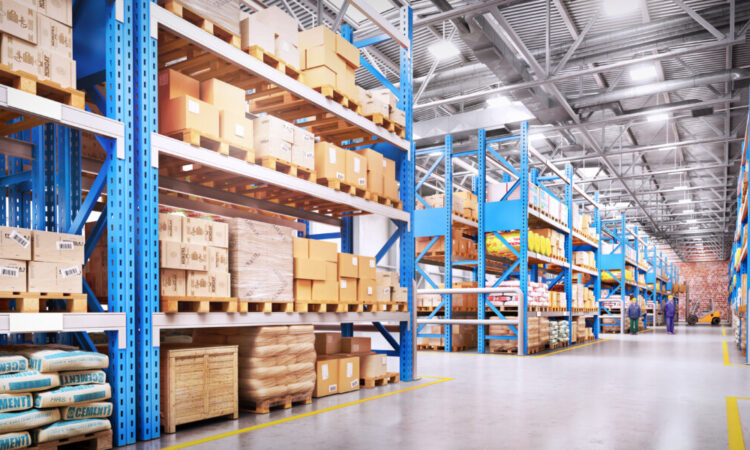
The UK market for large warehouses and logistics facilities recorded take-up of 15.9 million square feet, or approximately 1.48 million square metres, during the first half of 2026. The figures from BNP Paribas Real Estate cover industrial and logistics properties larger than 100,000 square feet, equivalent to around 9,300 square metres.
Activity accelerated in the second quarter, when 8.4 million square feet changed hands. That was 10.7% higher than in the first three months of the year. Take-up was still 2.8% below the first half of 2025, but remained above the 14.8 million square feet recorded for the comparison period excluding the exceptionally strong pandemic years.
The breakdown by occupier is notable. Logistics companies accounted for 45.5% of take-up in the first six months, while retailers represented a further 36.7%. Together, the two groups generated just over 82% of total demand.
UK retailers ramp up logistics investment
Retail’s share has risen sharply. According to BNP Paribas Real Estate, retailers accounted for 22.5% of annual take-up in 2025. By the first half of 2026, that figure had climbed to 36.7%.
Several large requirements from established UK retailers helped drive the increase. Marks & Spencer (M&S) took 437,000 square feet at Fradley 437 in Lichfield. British electronics retailer Currys secured 397,000 square feet in Nottingham, while bookseller Waterstones signed a lease for 295,000 square feet at Indurent Park Burton.
Ben Wiley, head of industrial agency at BNP Paribas Real Estate, said the market so far this year had been shaped by renewed demand from UK retailers and the arrival of new international occupiers.
International e-commerce logistics gains ground
Demand from international e-commerce and fulfilment operators is also becoming more significant. BNP Paribas Real Estate estimates that Chinese e-commerce and fulfilment companies accounted for 12% of total big-box take-up in the second quarter of 2026, compared with 6.2% for the full year 2025.
The classification of these occupiers requires some nuance, however. Recent deals involved Cainiao, J&T Express, TopCloud Logistics and SHEIN. They cannot all be described simply as Chinese companies.
Cainiao developed within the Alibaba ecosystem and remains closely connected to China’s e-commerce logistics sector. J&T Express was founded in Indonesia before expanding its international network, including in China. SHEIN is a global online retailer with Chinese roots, while TopCloud Logistics is registered in the UK.
For the UK logistics market, the more important point is the underlying trend rather than each company’s formal nationality: international e-commerce networks are expanding their operational presence across the UK and increasingly need their own warehousing, sorting and fulfilment capacity.
The Midlands remains the main beneficiary
Much of this demand is concentrated in the Midlands, at the heart of the UK’s logistics ‘Golden Triangle’. Its central location and connections to major transport corridors have made the region a key base for nationwide distribution networks for many years.
Take-up in the Midlands reached 10.4 million square feet, or around 966,000 square metres, in the first half of 2026, according to BNP Paribas Real Estate. That represents a 58.4% increase compared with the same period a year earlier.
More than three million square feet came from particularly large transactions, each involving more than 500,000 square feet.
BNP Paribas Real Estate expects international operators to look beyond the Midlands as they continue expanding their distribution networks. Other UK regions are likely to attract a greater share of attention in the next phase of growth.
New construction slows as modern warehouses become scarce
Rising demand is meeting a gradually narrowing supply base. Available big-box space fell by 2.5% in the second quarter to just over 58 million square feet.
There is not yet an overall shortage of warehouse space: availability remains 63.1% above the ten-year average. The picture is different for high-quality, modern facilities, however. The supply of Grade A space fell by 4.2% in a single quarter.
The development pipeline is also weakening. BNP Paribas Real Estate expects at least 25% fewer completions in 2026 than the long-term average and anticipates limited supply of new projects in 2027 as well.
That shift is already affecting occupier decisions. Space in previously occupied buildings accounted for 33.9% of total take-up in the second quarter, compared with a rolling four-quarter average of 28.4%.
For logistics companies and retailers seeking major distribution hubs, the key question will therefore be less whether warehouse space is available somewhere in the UK than whether sufficiently large, modern facilities suited to their operations can be found in the right location. If construction remains subdued, existing buildings and individually tailored design-and-build projects are likely to become increasingly important in meeting demand for logistics infrastructure.


