
There’s no doubt residential property is not as popular with investors as it was 10 years ago.
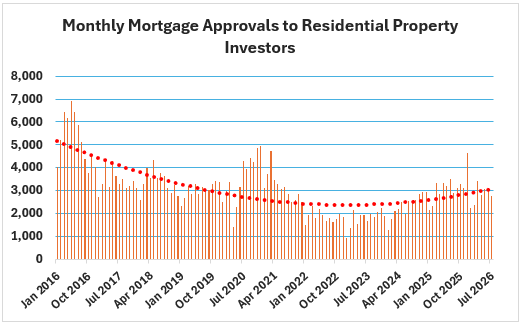
You can clearly see that in the first graph below, which tracks Reserve Bank figures showing the number of mortgages approved to residential property investors each month.
Ten years ago, in July 2016, 5862 new residential mortgages were approved to property investors. In July this year, that number had declined to just 2766.
It is not a perfect measure, but it suggests residential property investor activity could have halved over the last decade.
So far this year there has been plenty to make investors cautious, with prices largely flat or falling slightly, mortgage interest rates slowly rising and uncertainty around the tax situation ahead of November’s election.
However, there has also been a more fundamental long term shift in the market, as house prices have grown much faster than rents, reducing the income returns rental housing can provide to investors.
Interest.co.nz has been tracking residential rents compared to lower quartile house prices since 2012.
At the start of 2012, the Real Estate Institute of New Zealand’s lower quartile selling price was $250,000. By June this year that had increased to $585,000, a 134% increase over that 14 year period.
Over the same period the national median rent, as measured by rental bonds received by Tenancy Services, increased from $325 to $595 a week, up 83%.
So what does that mean for investors?
If you bought a property at the January 2012 lower quartile price of $250,000 and rented it at the median rent of $325 a week, it could generate rental income of $16,900 a year.
That’s a gross return (referred to as the rental yield) of 6.8%.
Jump forward to June 2026 and the lower quartile-priced property would cost $585,000 and the median rent would be $595, generating potential rental income of $30,940 a year, providing a gross rental yield of 5.3%.
A return of 5.3% might seem ok, but there’s a catch.
That figure is gross, and the investor would need to allow for periods of vacancy, which could have a major negative impact on rental income, plus expenses such as rates, insurance, maintenance and the property manager’s fee if there was one.
While those expenses can vary widely between properties, they would likely reduce the rental yield down below the return the investor could get by putting their money on term deposit with a bank.
And of course the above calculations assume the investor paid cash for the property – they make no allowance for mortgage payments.
Let’s say the investor purchased the same lower quartile-priced property with a 40% deposit and a mortgage of $351,000.
In June this year the average two year fixed rate charged by the main banks was 5.26% (compared to 5.91% in January 2012).
Interest.co.nz estimates the payments on a $351,000 mortgage, assuming an interest rate of 5.26% and a 20 year term, would be around $546 a week.
Deducting that from weekly rent of $595 leaves just $49 a week to cover rates, insurance, maintenance, property management and accounting fees and anything else that needs paying.
That makes it very likely the investor would be in a negative cash flow situation, dipping into their pocket to meet the outgoings.
Instead of generating an income, the property would be loss making.
Many investors were prepared to suffer those losses when prices were running hot, generating substantial capital gains, which of course were tax free.
But with prices flat at best, capital gains are drying up, and along with them, investors’ enthusiasm for residential property.
If they can afford to pay cash for a property, they are probably looking at mediocre returns at best, but if they need a mortgage they will probably be in a loss making situation.
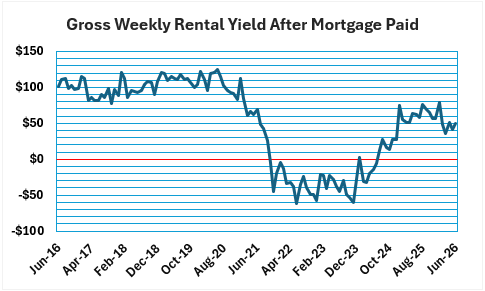
The second graph below shows how much cash would be left each week going back to 2012, if an investor bought a property at the prevailing lower quartile price, rented it at the median rent, and paid for a 60% mortgage at the prevailing rate.
That has declined from $101 a week in June 2016 to $49 a week in June 2026, so it’s more or less halved over the last decade.
So it should be no surprise that investors are increasingly sitting on the sidelines of residential property, because it’s becoming more and more difficult to make the numbers stack up.