

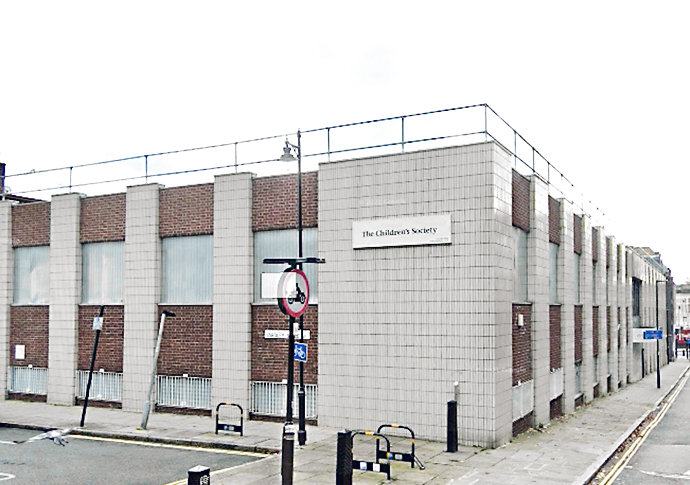
Francois Smit says that neighbours found out the Clerkenwell building has been used as a cannabis farm and was then squatted while sitting empty
A LONG-RUNNING planning dispute over an office development which has seen a former council-owned building sit empty for eight years has ended with councillors approving the scheme.
People living close to Rudolph Edward House in Clerkenwell said they were angry at the verdict and would be stuck with a “great big grey generic” block next to their homes.
The site was purchased by American developers Royal UK Property Holdings UK for £17million in 2018, with plans submitted to demolish the site and construct a four-storey office block.
The company, with headquarters in Delaware, has an extensive portfolio of office space across the city, with records showing they have spent hundreds of millions investing in commercial buildings.
Their proposals were twice rejected by Islington Council on the grounds that it would block light into the Margery Street estate, the housing which sits opposite the site.
But after an appeal to the Planning Inspectorate which promised one floor of affordable workspace, the Town Hall’s decision was overturned and the development was given the green light.
A third planning application was then submitted to the council, that removed this floor of affordable workspace – and this time councillors on the committee voted to give it the green light.
Planning chair Labour councillor Toby North told the committee that it was “disappointing” Royal had gone back on their commitment to affordable workspace, but the council ultimately ruled in favour of the application because its “benefits outweighed the negatives”.
Francois Smit, a representative of Margery Street TRA, has been campaigning against the development since plans were first revealed.
He told the Tribune: “They had their plans rejected by planning twice because they’re not in the keeping of the local environment and would block light into the Margery Street Estate opposite, which is social housing.
“We appealed originally because we just didn’t want another huge office block. To have just a great big grey generic-looking office block plonked in the middle of rows of Georgian housing and 1930s social housing is just not aesthetically acceptable.”
Mr Smit said he felt the land for the site should have been used to build social housing, which Islington was “desperately crying out for”.
He added: “This is not an unusual story for this area. The council sold off the land and so when the building became available the only thing they could have done is buy it back and rebuild social housing. But obviously they have no money to do that, and so private developers get access to the space.”
Mr Smit added that he was disappointed about the ruling, but it felt “inevitable” and that developers had the money to fight rejections.
Royal UK Properties said in a statement to the Tribune: “The scheme originally proposed at pre-application in 2019 included six residential units. The residential element was dropped at the request of Islington’s own officers, because the site is designated a Priority Employment Location in Islington’s Local Plan and sits within the Central Activities Zone, where adopted planning policy gives employment floorspace priority over new residential development. The objection that the area needs housing rather than offices is an objection to Islington’s own planning policy, not to any choice made by the owner.”
It added: “On affordable workspace. The policy requirement under Islington Local Plan Policy B4 applies to the uplift in floorspace, not to the whole building. The first application offered more than double the then policy requirement.
“The second offered a policy-compliant level, and the section 106 agreement concluded with Islington in 2024 expressly provided for a payment in lieu of on-site provision at the council’s option — the Inspector recorded that this largely resolved the debate about the quality of the on-site unit.
“The current application was supported by a viability assessment which Islington referred to BPS, an independent consultant the council itself appointed. BPS reviewed the appraisal, adjusted a number of the inputs, and concluded that the scheme could not viably support affordable workspace either on site or as a payment in lieu.
“The commitment has not been abandoned. A late-stage review mechanism is secured in the section 106 agreement which will capture the maximum viable contribution, up to the full formula value, once the works are complete.”


