
Australia needs property investors, so why is the Budget making rental investment less attractive?


Key takeaways
Australia’s rental crisis is fundamentally a supply problem, with housing construction failing to keep pace with population growth and changing household needs.
Private property investors provide most of Australia’s rental accommodation. Discouraging them could further reduce rental choice.
The 2026 Budget limits negative gearing on established properties and changes capital gains tax concessions. New properties will receive more favourable tax treatment.
Pushing investors towards new property could encourage poor investment decisions. Quality, scarcity, location and long-term growth prospects should remain the priority.
Australia needs policies that encourage more housing supply while keeping private investors engaged. Otherwise, tighter rental markets and stronger rent growth could ultimately hurt tenants.
Australia’s rental crisis is often discussed as though landlords and tenants sit on opposite sides of the table, with any benefit to one automatically coming at the other’s expense.
That may make for a convenient political argument, but it overlooks a basic fact about our housing system: most tenants live in homes supplied by private property investors.
Governments provide social and community housing, and large institutions are now beginning to invest in build-to-rent projects, yet private investors continue to carry most of the load.
So if Australia wants more rental accommodation, it needs more people willing to provide it.
Unfortunately, the federal government’s 2026 Budget changes risk discouraging precisely the investors we need at a time when rental markets remain tight, construction costs are high and the country is already struggling to build enough homes.
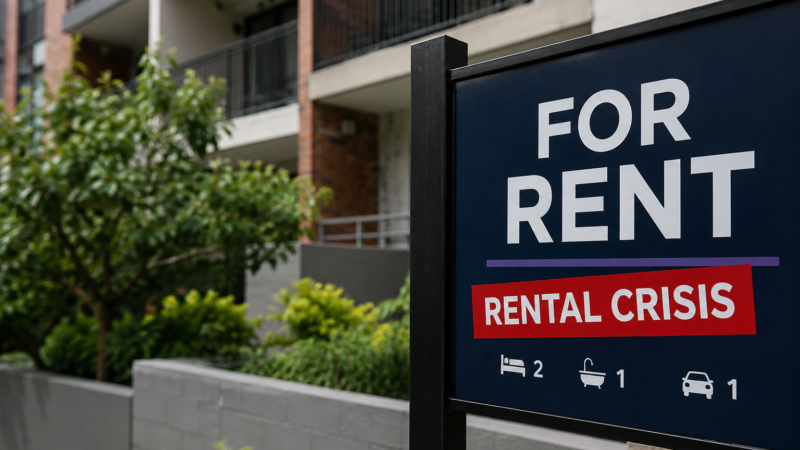
The rental shortage is a supply problem
Rents ultimately rise when the number of people looking for accommodation grows faster than the number of homes available.
Of course, landlords can’t simply charge whatever they like. Tenants have budgets, properties compete with one another, and rents are set by local market conditions.
However, when vacancy rates are unusually low, tenants have fewer alternatives, and landlords have greater pricing power.
SQM Research suggests the national vacancy rate is about 1.3%, while asking rents have risen by more than 7% over the year. In many capital cities and regional markets, conditions are considerably tighter.
Meanwhile, it is estimated that Australia will deliver about 980,000 new dwellings over the five-year Housing Accord period, leaving the nation approximately 220,000 homes short of the government’s 1.2 million target.
However, “net” new supply is expected to be lower than this because some new construction simply replaces homes that have been demolished.
At the same time, demographic demand is continuing to grow as Australia’s population expands, household sizes change and more people live alone.
That means the rental crisis can’t and won’t be solved through slogans, tax changes or shifting ownership between investors and homebuyers. Australia needs more homes and, within that total, it needs more homes available for rent.
Who is going to provide those homes?
Unlike many other countries, Australia doesn’t have a large public housing system that can accommodate everyone who cannot or does not wish to purchase a home.
Nor should we assume every tenant is simply waiting to become a homeowner.
Many Australians rent because of their stage of life, work arrangements, family circumstances, or a preference for flexibility. Others will rent for longer because housing prices have risen faster than incomes, making saving a deposit increasingly difficult.
This growing number of long-term renters makes the need for a stable, well-supplied private rental sector even more important.
Sure, the new build-to-rent developments will contribute to that supply, but they remain a relatively small share of the market and are generally concentrated in selected inner-city locations.
The overwhelming majority of rental accommodation continues to be provided by ordinary Australians who own one or two investment properties.
These investors take on the mortgage, interest-rate risk, maintenance expenses, insurance premiums, council rates, land tax, compliance costs and the possibility of vacancies or damaged property.
In return, they receive rent and hope the property increases in value over the long term.
The arrangement works when the prospective return reasonably compensates them for the associated costs and risks. Once that balance becomes unattractive, investors can redirect their money elsewhere.
What the Budget changes
From 1 July 2027, negative gearing will generally be limited to newly constructed residential properties.
Investors who purchase an established home after the Budget announcement will no longer be able to deduct rental losses from their salary or other non-property income once the new rules take effect. Instead, those losses will be deferred and carried forward and applied to future residential property income or capital gains.
Properties held before the Budget announcement will be grandfathered, allowing their owners to continue using the existing negative gearing rules.
The government will also replace the 50% capital gains tax discount for individuals, trusts and partnerships with cost-base indexation, together with a minimum 30% tax rate on real capital gains.
New residential properties will receive more favourable treatment. Investors who purchase eligible new builds will retain access to negative gearing and can choose between the current CGT discount and the new indexation arrangements.
The government obviously wants to redirect investor demand away from established homes and towards properties that increase supply.
However, housing markets are more complicated than the policy assumes.
Established properties still provide rental accommodation
An investor who purchases an established property doesn’t construct another dwelling, but they add that home to the rental pool.
If an investor sells to another investor, rental supply remains unchanged. If the purchaser is an owner-occupier, one rental property leaves the market. In some cases, the buyer may previously have been a tenant, which can release another rental property.
But the transition is rarely perfectly balanced.
The home being purchased may accommodate one former renter while displacing a family of four. It may be located in a different suburb, fall into a different price bracket or be unsuitable for the tenants searching in that area.
Clearly, housing is not a uniform commodity. A vacant apartment in an inner-city tower does little to help a family looking for a three-bedroom home near schools in an established middle-ring suburb.
This is why changes in ownership can still create rental shortages in particular locations and segments, even when the total number of dwellings remains unchanged.
New property is not automatically a better investment
Some policymakers seem to believe investors can simply switch from established homes to new properties without changing their risk or return.
Experienced investors understand why that assumption is questionable.
New properties frequently carry a developer’s margin and marketing premium. Some are built in areas with large amounts of similar stock, limited land value and weak owner-occupier demand.
Investors may also face construction delays, builder insolvency, settlement valuation shortfalls and quality concerns.
And under the Budget rules, the next investor who buys that property may not receive the same tax treatment because the dwelling is no longer new. That could reduce the depth of the resale market and affect the price future buyers are willing to pay.
Of course, some new developments will make excellent investments. But tax policy should not push people into buying a poorer-quality asset simply because it comes with a concession.
In my mind, investment decisions should be based on the property’s location, scarcity, owner-occupier appeal and long-term prospects, rather than a temporary tax advantage.
The pressure is coming from more than Canberra
The federal changes have arrived after years of rising costs and tighter state-level regulations.
Property investors have faced higher land taxes, increased compliance obligations, limits on rent reviews, minimum property standards and restrictions on how tenancies can be managed.
Insurance, repairs, strata levies and property management costs have also increased substantially.
Many of these measures may have reasonable objectives when considered separately. The problem is their cumulative effect.
Governments can’t continue increasing the cost, complexity and risk of providing rental accommodation while expecting private investors to supply more of it.
Some investors will absorb the higher costs. Others will purchase fewer properties, sell existing holdings or invest in shares, commercial property or other assets instead.
When fewer investors compete to provide rental homes, tenants eventually carry part of the cost through tighter choice, lower mobility and upward pressure on rents.
Will the Budget cause rents to surge?
It would be simplistic to claim that the tax changes alone will cause rents to rise by a particular percentage.
Rents are determined by tenants’ capacity to pay, local vacancy rates, household formation, population growth and the amount of available accommodation.
The government estimates its reforms will add less than $2 per week to the median rent and argues that its wider housing policies will place downward pressure on rents over time. Models can estimate the immediate effect of a tax change, but they cannot perfectly capture how thousands of individual investors will respond over many years.
Most credible analysts expect rents to rise by 15% to 30% over the next two years.
The larger risk is gradual. If investors buy fewer properties, developers find it harder to secure presales, and more existing rentals are sold to owner-occupiers, vacancy rates could remain lower than they otherwise would.
The impact may emerge through fewer rental choices and stronger rent growth over several years rather than one dramatic jump.
There is a better way forward
Australia needs a more balanced housing policy that recognises the legitimate interests of first-home buyers, tenants and investors.
We need faster planning approvals, more serviced land, better infrastructure coordination and a construction industry capable of delivering homes at prices households and investors can afford.
Governments should also encourage investors to fund genuine additional supply, including townhouses, duplexes, smaller apartment projects and the conversion of underused buildings, rather than favouring only large new estates and apartment towers.
A better policy could provide incentives based on outcomes, such as retaining a property in the rental pool for a minimum period, offering longer leases or supplying accommodation in areas with critically low vacancy rates.
Most importantly, policymakers should stop treating property investors as an obstacle to housing affordability.
A healthy housing market needs homeowners, social housing providers, developers, institutional capital and private investors. Each serves a different group and each contributes to the system.
The bottom line
Australia’s rental crisis developed because housing supply failed to keep pace with population growth and changing household needs.
The country now needs substantially more rental accommodation, yet the Budget reduces the attractiveness of providing it, particularly in the established-property market where most tenants currently live.
Directing investors towards new construction sounds sensible, but the policy may produce unintended consequences if those properties do not offer acceptable risks and returns.
Property investors will respond to incentives, costs and opportunities. If residential property becomes less attractive, their capital will move elsewhere.
Unfortunately, tenants can’t move so easily.


