

It is a challenging time for the global economy. Not only are there serious disruptions to trade, but there are also growing concerns about the high levels of indebtedness in some of the largest economies. But despite this difficult backdrop, Asia remains an economic bright spot, accounting for around 60 per cent of global growth,¹ while at the same time presenting relatively benign levels of inflation compared to many Western economies.
Asia is not homogeneous. Each market presents its own growth story, monetary policy trajectory and credit profile, creating a diverse set of opportunities for strategic and tactical allocations that can potentially result in a more resilient portfolio.
Hong Kong dollar (HKD) bonds can complement a broader Asia allocation. For investors with HK dollar liabilities, the market provides high-quality assets in the currency of the obligation. For US dollar-based investors, Hong Kong’s link to the currency can also help limit risk.
Issuers in the Hong Kong dollar market typically have good credit quality, including the Hong Kong government, as well as other well-rated quasi-sovereign, supranational and corporate issuers. Yields in Hong Kong are relatively modest, but the market’s robust credit fundamentals and relatively contained local inflation have supported its defensive characteristics. This can make HKD bonds a comparatively stable source of defensive exposure.
For some investors, accessing the market through individual securities can be challenging. Institutional minimum sizes can put many issues out of reach, liquidity can be thin in some parts of the market, and most HKD non-government bonds are issued through private placements rather than via public offerings. For that reason, many investors find a fund or exchange-traded fund the more practical route into the asset class.
Asia US dollar credit: resilience amid volatility
Beyond local currency markets, the Asia US dollar bond market can provide diversification benefits for global investors, underpinned by robust investment-grade fundamentals and improving high-yield conditions.
Asia dollar investment-grade credit has historically held up well in periods when external events have widened spreads – such as the Covid-19 pandemic, the start of the conflict in Ukraine in 2022, the implementation of new tariffs by the US in 2025 and the energy price shock that followed the blocking of the Strait of Hormuz off Iran.
Resilience, in part, reflects the quality and composition of the Asia credit universe. About 87 per cent of the constituents in the J.P. Morgan Asia Credit Index are classified as investment grade.² Furthermore, the index’s composition has become less concentrated over time, with greater diversification across geographies and sectors.
Within Asia credit, two investment themes stand out.
The first is supply chain realignment. Many international companies are implementing so-called “China plus one” strategies, which extend supply chains to other Asian economies. At the same time, more mainland Chinese companies are expanding manufacturing operations across the region, especially in Southeast Asia. All this drives capex and local infrastructure financing, which may support a broader regional corporate bond universe – potentially giving investors greater diversification and more opportunities to identify relative value across markets and sectors.
The second theme is artificial intelligence (AI). Select Asian technology companies are likely to see demand lift as AI adoption widens. Momentum remains strong in Asian hardware tech, including leading regional foundry and memory chip companies, which stand to benefit from data centre demand and a memory super-upcycle. Fundamentals in these segments remain stable, with manageable capex well within financial limits.
Often thought of as an equity story, AI is increasingly relevant to Asian fixed income as well, broadening the investable universe. Technology now accounts for about 10 per cent of the Asia US dollar investment-grade universe, underscoring the rapid growth of tech- and AI-linked exposure.3
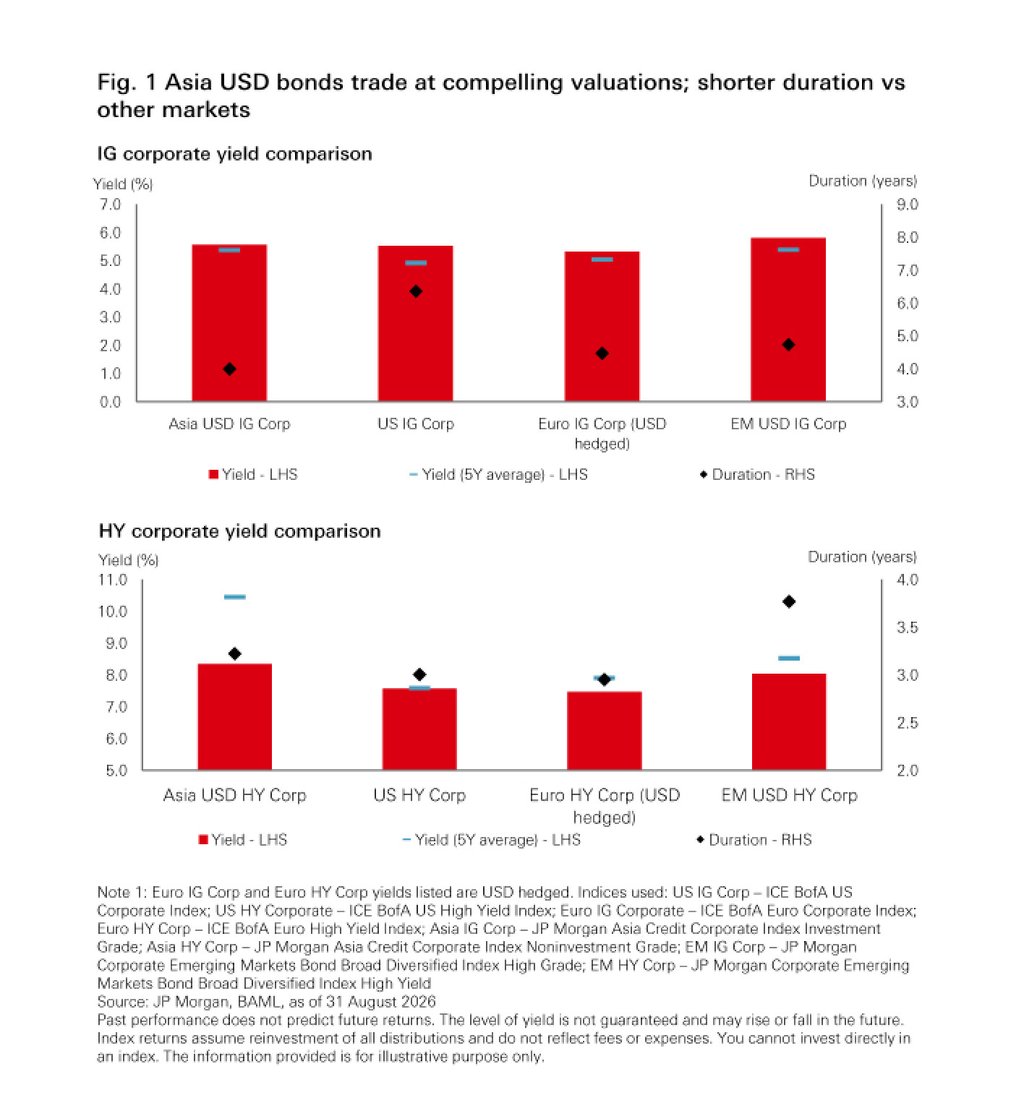
Spreads in both investment-grade and high-yield markets have narrowed in recent years, with high yield making a recovery after China’s property market downturn.
Although spreads are relatively tight, Asia credit continues to be supported by shorter duration, robust local funding markets and sound corporate fundamentals. Potential alpha can be found in relative value opportunities and careful security selection.
Building a strategic allocation
In short, all these factors mean Asian fixed income can be treated as a strategic allocation rather than a tactical one. The region’s growth profile, subdued inflation and a diverse mix of markets gives investors more ways to build resilience into a global portfolio, while supply chain realignment and AI adoption are opening up parts of the corporate universe that were previously the reserve of equity investors.
Within that allocation, HKD bonds serve a more specific purpose, acting as a defensive, high-rated local-currency holding for investors with HK dollar liabilities, and a way for US dollar-based investors to add regional exposure without taking in significant currency risk.
Find out more about Hong Kong dollar bonds here.
For professional investors only.
1. IMF, October 2025
2. JP Morgan Asia Credit Index as of July 31, 2026
3. HSBC Asset Management, April 2026
Diversification does not ensure a profit or protect against loss. The views expressed above were held at the time of preparation and are subject to change without notice. Any forecast, projection or target where provided is indicative only and is not guaranteed in any way. HSBC Asset Management accepts no liability for any failure to meet such forecast, projection or target. This information should not be construed as a recommendation to invest in the specific country, product, strategy or sector.
Important information
For professional investors and intermediaries only. This document should not be distributed to or relied upon by retail clients/investors.
This document provides a high level overview of the recent economic environment. It is for marketing purposes and does not constitute investment research, investment advice nor a recommendation to any reader of this content to buy or sell investments. It has not been prepared in accordance with legal requirements designed to promote the independence of investment research and is not subject to any prohibition on dealing ahead of its dissemination.
This document is prepared for general information purposes only and does not have any regard to the specific investment objectives, financial situation and the particular needs of any specific person who may receive it. Any views and opinions expressed are subject to change without notice. This document does not constitute an offering document and should not be construed as a recommendation, an offer to sell or the solicitation of an offer to purchase or subscribe to any investment. Any forecast, projection or target where provided is indicative only and is not guaranteed in any way. HSBC Global Asset Management (Hong Kong) Limited (“AMHK”) accepts no liability for any failure to meet such forecast, projection or target. AMHK has based this document on information obtained from sources it reasonably believes to be reliable. However, AMHK does not warrant, guarantee or represent, expressly or by implication, the accuracy, validity or completeness of such information. Investment involves risk. Past performance is not indicative of future performance. Please refer to the offering document for further details including the risk factors. This document has not been reviewed by the Securities and Futures Commission. Copyright © HSBC Global Asset Management (Hong Kong) Limited 2026. All rights reserved. This document is issued by HSBC Global Asset Management (Hong Kong) Limited.


