

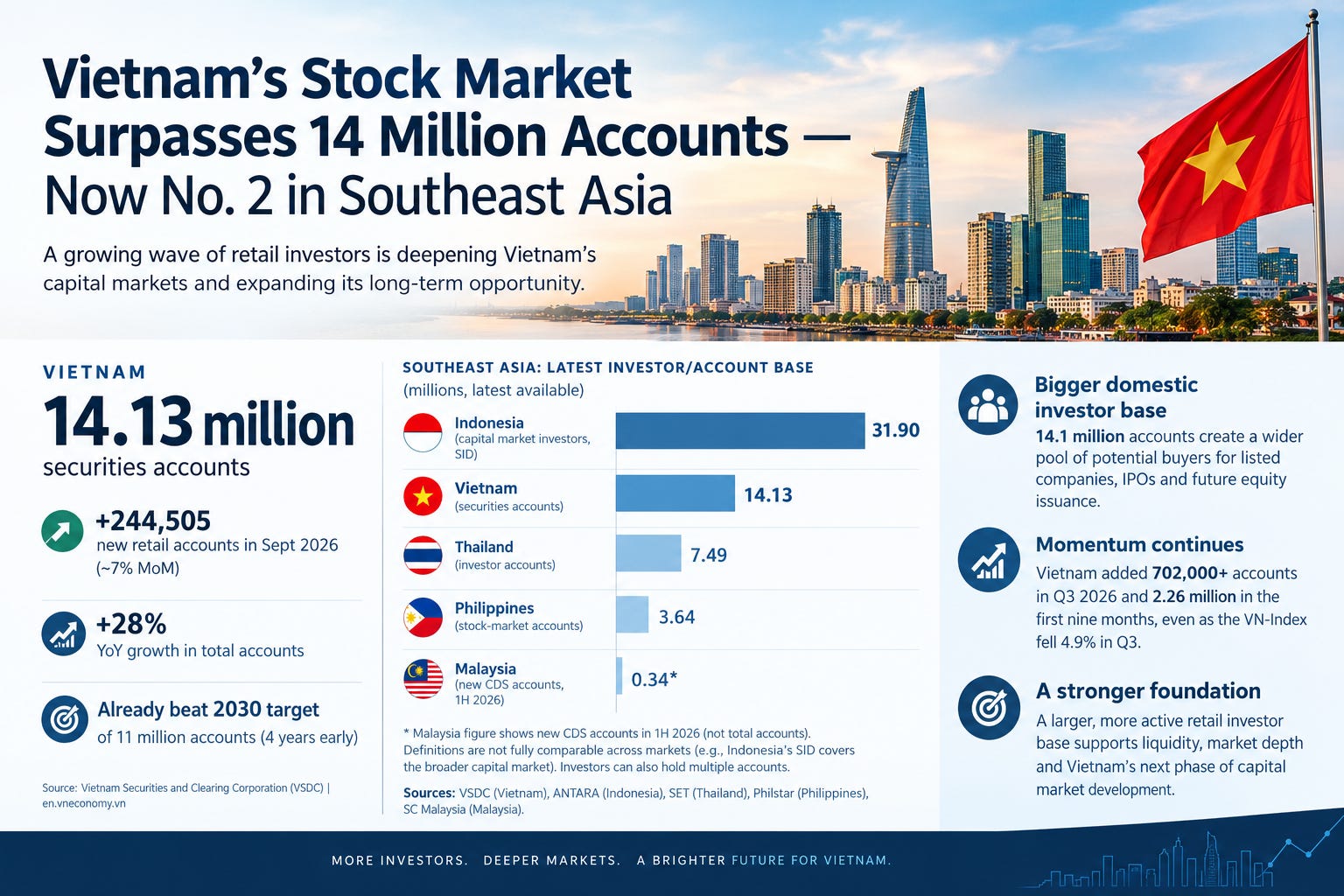
Vietnam’s stock market added nearly 245,000 domestic retail accounts in September, pushing its total above 14.1 million and making it one of Southeast Asia’s largest retail-investor markets.
According to the Vietnam Securities and Clearing Corporation (VSDC), 244,505 domestic individual accounts were added in September, up about 7% from August, taking total securities accounts to 14.13 million as of September 30. The overall account base increased 1.76% month-on-month and about 28% year-on-year.
Domestic individuals now account for more than 14.05 million accounts, or over 99% of Vietnam’s domestic investor accounts.
Even more striking: Vietnam has already surpassed its government target of 11 million securities accounts by 2030 — four years ahead of schedule.
On reported investor/account numbers, Vietnam now ranks No. 2 among major Southeast Asian markets for which comparable recent data are available:
-
Indonesia: 31.90 million
-
Vietnam: 14.13 million
-
Thailand: 7.49 million
-
Philippines: 3.64 million
Indonesia reported 31.90 million Single Investor Identifications (SID) at the end of September 2026, up from 31.14 million a month earlier.
Thailand reported 7.49 million investor accounts in August 2026, while the Philippines had 3.64 million stock-market accounts at the end of 2025, of which 3.61 million were retail accounts.
Malaysia is also experiencing strong retail participation: more than 342,000 new CDS accounts were opened during the first six months of 2026, up approximately 24% year-on-year, according to Malaysia’s Securities Commission and Bursa Malaysia.
The definitions are not perfectly comparable — Indonesia’s SID covers the broader capital market, while Vietnam, Thailand, and the Philippines figures are securities/stock-market accounts. Investors can also hold multiple accounts. The ranking should therefore be viewed as a measure of market scale rather than a precise count of unique people.
The momentum is notable because Vietnam added more than 702,000 accounts during the third quarter alone and more than 2.26 million during the first nine months of 2026.
The growth is occurring despite a softer third quarter for Vietnamese equities: the VN-Index fell about 4.9% during the quarter and 3.47% in September.
That makes the trend particularly noteworthy.
Vietnam is not merely experiencing a stock-market rally-driven surge in participation. Its domestic investor base is continuing to expand even when market conditions are less favorable.
For Vietnam’s capital markets, the significance is straightforward: 14.1 million accounts creates a much broader domestic pool of potential buyers for listed companies, IPOs, and future equity offerings — an important foundation as the country develops into a larger regional capital market.


