
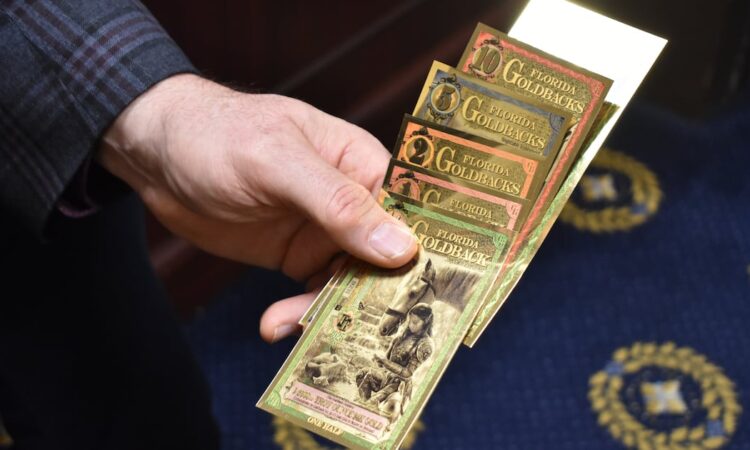

JUNEAU — The Alaska Legislature passed a bill Tuesday to establish gold and silver currencies as legal tender and exempt them from sales taxes.
The bill passed the House unanimously last week, and passed the Senate 19-1 on Tuesday.
The legislation applies specifically to specie — gold-backed currencies, gold and silver coins and bullion stamped with their metal content. It would not apply to metal bars or nuggets, which aren’t considered currency.
The bill’s sponsor, Big Lake Republican Rep. Kevin McCabe, says the bill is intended to solidify “financial freedom of choice,” as it allows stores and other entities to accept specie as tender but does not require that they must.
McCabe said he sees the bill as a way to incentivize saving, where savers “store the value in their safe” as precious metal instead of cash, a strategy viewed as a hedge against inflation.
“The tax exemption has real teeth for anyone actually using it.” McCabe said in a speech on the House floor last week.
Sen. Mike Cronk, a Tok Republican and sponsor of the Senate companion bill, said the bill brings Alaska into alignment with the U.S. Constitution, which permits states to recognize gold and silver as legal tender. Cronk said passing the bill would mean Alaska would join the more than 40 states that have eliminated sales tax on gold and silver.
The bill would prohibit municipalities from levying a sales tax on the purchase of gold and silver specie, as well as from taxing the specie itself when used as currency. A person would still have to pay any applicable sales tax on the item being purchased using specie as currency.
As McCabe explained, a customer wouldn’t be taxed for purchasing a $100 bill in exchange for two $50 bills — and the bill would apply in the same way to purchasing specie. Under the bill, if the specie were used to buy a car, that car would still be subject to sales tax, but the specie itself would not.
Since Alaska does not have a statewide sales tax, taxes levied on specie come only from municipalities.
Under the bill, when selling or buying a gold coin as a collectible with a value above the intrinsic cost of the gold, for example, that additional “collectible” value would be subject to taxation.
Sen. Jesse Kiehl, a Juneau Democrat, cast the lone no vote in the Legislature. He said he was concerned about implementation, including how municipal sales tax offices would distinguish the value of the precious metal versus the collector value.
“Ultimately, what we also have here really is special tax treatment for certain collectibles. We don’t do this for Pokemon cards — they’ve gained value,” Kiehl said.
“And finally, what does it mean to call something legal tender if no one has to take it in payment to the debt, that’s literally the definition of legal tender,” he said.
The Alaska Municipal League has softened its previous opposition to the bill, submitting a stance of non-endorsement in February. Nils Andreassen, the organization’s executive director, wrote that it appreciates changes to the bill that would allow local governments, in particular, to opt out from accepting specie as tender to avoid legal and operational concerns. But the group argues that the loss of local tax still raises concerns about municipalities’ “fiscal authority and local revenue policy.”
McCabe’s office said their analysis of the bill estimates that tax revenue loss would be between $80,000 and $95,000 per year across Alaska’s 152 sales tax divisions.
The bill now goes to Gov. Mike Dunleavy’s desk, where it will await his decision to sign, veto or let it pass into law without his signature. Jeff Turner, spokesperson for Dunleavy, declined to comment on the governor’s intentions for the bill.


